POETS Day! Talkin’ Chaucer at the Godsibbing Fense

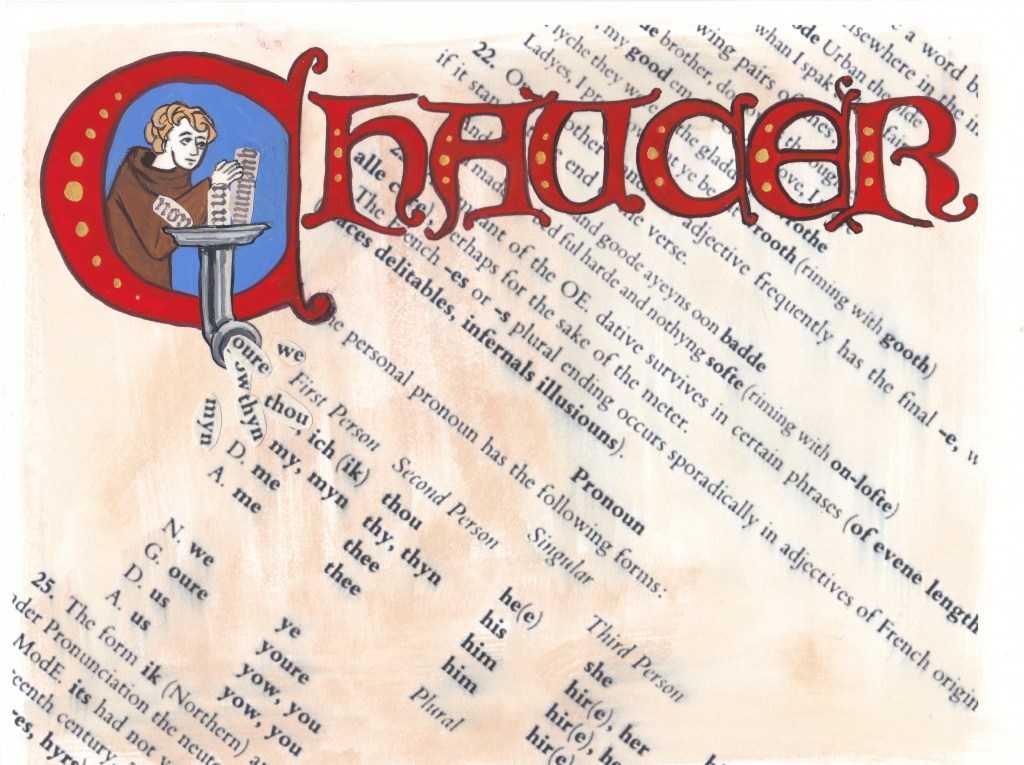
Illustration by Rene Sears

[This entry is cross posted at ordinary-times.com]

I’m listening to a book about free speech and the necessity of, and the author went on for a few minutes about punishments meted out for violations of English law in Colonial America. It was amazing stuff. They’d cut off your ears for offending the Crown’s reputation, even for questioning it. Lucky loudmouths might get off with a cropping where they’d just trim off the ear tops. Tongues were bored, ears were nailed to pillories, many whippings of designated number and severity were prescribed.

One sorry SOB had his tongue bored, his arms broken, and then with his arms “dangling,” according to the author Jonathan Turley, was forced to run a gauntlet as men beat him with rifle butts.

What the hell did he say?

I hope he said it loudly. Clearly and from a high place on a stark, windy day. I hope his wind aided preferably bass voice carried across the land and turned the head of every man, woman, and child. I don’t know the content, but I hope he got the most from it.

This isn’t a segue to slippery slopes and non-crime hate incidents. It’s POETS Day. Piss Off Early, Tomorrow’s Saturday. Get out of work and read a book. There are a lot of them out there. I’m enjoying Against the Country, by Ben Metcalf. Listening to a book, as I’m doing in the car with Jonathan Turley’s The Indispensable Right: Free Speech in an Age of Rage, doesn’t count. That’s not really reading, even if it is fun. Maybe read the Turley book, though. I’ve heard good things.

In any case, take time for a little verse first.

***

ITEM:

On May 4, 1380, Cecelia Chaumpaigne signed a quitclaim releasing Geoffrey Chaucer from “all manner of actions related to my raptus.” That’s a translation. The entire statement was recorded in Latin, as was customary. The word “raptus” is left untranslated and italicized as no one was quite sure exactly which of its uses common as legal terms at the time was intended in this case.

Continue reading
POETS Day! Vita Sackville-West

[This entry is cross posted at ordinary-times.com]

Veda Sealbinder Bonds and Vita Sackville-West were not alike. One was an award-winning poet who had lady sex with Virginia Woolf and the other was a put-upon innocent who made do speaking with only her tongue and lips as her jaw was clenched rictus fast when she said things like “Yew liddle brayats!”

They inhabit the same rhythmic space despite Veda bringing an extra syllable along for the ride. The -er in Sealbinder is nearly dropped and the -ville in Sackville is drawn out so they’re exchangeable timing wise. I wish I could say that Sealbinder is a dactyl substitution but I always over think feet. Veda Sealbinder Bonds could be trochees followed by an iamb? It’s enough to say that if you were writing a song about Vita and suddenly roved an eye toward Veda, an eraser’s all you’d need. Three stresses and the song remains the same. I think of one and the other comes along mnemonically.

Two friends in seventh grade scoured the phone book for strange names, and poor Veda’s made them laugh. For a decent chunk of 1984 or 85 she was subject to increasingly elaborate though decreasingly coherent prank calls with a giggling chorus of their fellows listening in on other phones throughout the house. Her name was so funny to us.

Continue reading

How To Deal with That Family Member at Thanksgiving Dinner

Thanksgiving dinner

[This entry is cross posted at ordinary-times.com]

Thanksgiving dinner is intended to be a convivial affair. Much is made of the idea that we should stop and consider our blessings, note the good that others have done for us, count the times that we have feared but not lost, and the recognize than when we have lost the sadness felt was in proportion to the joy we were lucky enough to share in. I’ll not object to such exercizes. We should enumerate and recognize the things that make our lives better and give thanks for them each and separately. I don’t think I’ve ever done that, but we should. To me, and I assume many others, the wonder of Thanksgiving comes from less the mental tabulations – again, worthy activities – than time set aside to spend in communion with those we love; the feelings of thanks flowing effortlessly from and through the fellowship and unbidden forming yet another entry on the grand ledger for which we give even further thanks. Properly set, the Thanksgiving dinner table is a familial perpetual emotion machine. At least, it should be. We do our best. That’s why I’m so loathe to bring this up.

We all have that relative who is going to disrupt the Thanksgiving dinner harmony this year. It’ll likely be a man. I don’t want to be sexist, but it will. Your brother, uncle, brother in-law, father, grandfather, or cousin is going to say something controversial. Ideally, I’d sit on my hands and hope his inane thoughts get ignored and he moves on to other subjects, but these days there are devoted cable stations, web sites, and all manner of social media clamour feeding the bubble he lives in and god knows how many circular bias reinforcing bar conversations he’s a veteran of. He’s been marinating in this fantasy and has enough ammunition to blather on from soup to nuts. In addition to annoyed eye rolling adults, there’s the matter of any children present at the table. Should you sit by while a supposed authority figure fills their minds with this? You have to weigh his intrusion on their formative mind against the risk of upsetting your host and having it out with the offending presence right then and there (in which case I believe your host and probably all of the other guests will be secretly relieved and thank you later.) I say have it out. If you are cutting and decisive you may have him vanquished and silent before anyone sits at the table because when he sees Detroit playing Buffalo on TV he won’t be able to help but smugly inject some variation on “Flip channels so we can watch some real football. Brazil and Serbia, man! World Cup!” Properly armed you can end this now.

Continue reading