POETS Day! The Scoundrel, Sir John Suckling

Illustration by Rene Sears

You’re still at work? What do you think you’re getting done between now and quitting time? Cut out and stop pretending. Take a POETS Day. Piss Off Early, Tomorrow’s Saturday.

First, a little verse.

***

This week I turned cartwheels in the surf. I exuberated. One passer-by was heard to exclaim, “By Goodness! He’s filled with beans.” Another called upon me to have decency and quiet the ruckus.

What catalyst, you ask, set off such an uncharacteristic reaction? I found John Aubrey’s Brief Lives, Vol I. I can’t share on these pages, intended, for the most part, for public readings and sharing with our less deviant peers, the extomysis I experienced when recalling the wise admonishments of Frank Thomas, my ninth grade English teacher in explaining how to properly structure arguments: “You cannot have an ‘A)’ without following it later with a ‘B)’ or you look like an idiot [In the 80s you could call students idiots.] Write ‘First’ to open a paragraph and one of the next better damn [You could also say “damn” at them] well begin with ‘Second.’”

To whit: If there is a Brief Lives, Vol. I, there must follow a Brief Lives, Vol II. And there does.

Continue reading


POETS Day! Leonora Speyer

Illustration by Rene Sears

[This entry is cross posted at ordinary-times.com]

You still at work? What do you think you’re getting done between now and quitting time? Cut out and stop pretending. Piss Off Early, Tomorrow’s Saturday.

First, a little verse.

***

There’s a photograph of Leonora Speyer where she looks to be in her early twenties. She was born to some wealth. I can’t tell if her her family was idly comfortable or extravagantly rich. Her father, who died six months before her birth, was Count Ferdinand von Stosch originally of Monze, later of Washington, DC. There’s not much on her in the typical poet biography places and scant to zip on her father. He fought for the Union side in the Civil War, settled in Washington, and died at around forty years old; no information about rank or deeds or cause of death. He immigrated in the 1840s or 50s, so he was a kid when he came. That’s about it. Otherwise he’s an addendum to the bio of the daughter he never met.

An AI search–so take it or leave it–reports the photo is from some time in the 1890s, which I’d already assumed. Leonora showed an early proclivity for music and led a public life. She gave her first public performance in Washington at age ten: Beethoven’s Moonlight Sonata. One source tells me she and her mother sailed for the continent in 1899, when Leonora was sixteen, to continue her musical studies in Brussels. Another tells me she debuted with the Boston Symphony Orchestra at age seventeen. It’s possible they went back for a visit, but I can’t find record of it. As best I can tell, she and her mother stayed abroad, first in Brussels and then in Paris with another violin teacher, until 1891 or 92.

Maybe they went back and forth, maybe she was seventeen when they left, maybe she was sixteen in Boston. No matter the details of her precociousness, Leonora was talented. She was a force on the piano as well as the violin, but there came a time to specialize. Whether she had a preference or felt she had a greater talent for violin is unclear to me, but she chose pure string violin over string/percussion piano in the end. Encyclopedia.com tells me she’d played the violin since her “chin was firm enough to hold it.” Having seen the photograph of her in her early twenties, my first though: “That must have been very, very, very, very early.” It’s not a flattering picture.

Continue reading

POETS Day! Dorothy Wellesley

Illustration by Rene Sears

[This entry is cross posted at ordinary-times.com]

The work week’s nearly finito; barely a few hours left. What are you doing? You’re not getting anything done between now and quitting time. Cut out and stop pretending. Piss Off Early, Tomorrow’s Saturday.

First, a little verse.

***

from Fire
Dorothy Wellesley (1889-1956)

(‘Does not our life consist of the four elements?’
—Shakespeare)

The great stone hearth has gone.
An oblong electric tube is set in the wall
Like a cheap jewel.
Men converge no more to fire,
Men are on with the isolation:
The pride of science stands, and the final desolation.

No smoke, no danger, you tell me with veneration:
Much dies with the fire, young man,
More than one generation:
Man has known fire more than one generation.

That’s a tremendous opening. Yeats came across Dorothy Wellesley’s poetry in 1935 while putting together The Oxford Book of Modern Verse: 1892-1935 and had to meet her. According to Kieth Alldritt in his W.B. Yeats: The Man and the Milieu, the great poet was overcome: “My eyes filled with tears. I read in excitement that was more delightful because it showed that I had not lost my understanding of poetry.” Yeats further honored her with commentary in the Oxford Modern Verse introduction, writing “I knew nothing of her until a few months ago I read the opening passage in Horses, delighted by its changes in pace, abrupt assertion then a long sweeping line, by its vocabulary modern and precise.”

Continue reading

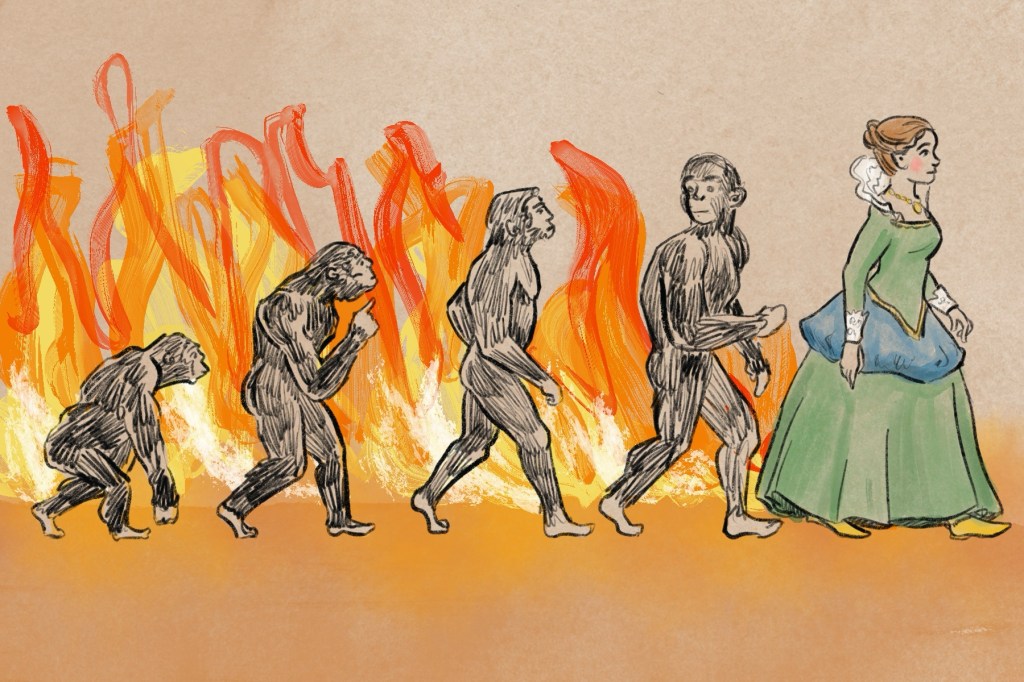
POETS Day! Apes in Hell

Illustrated by Rene Sears

[This entry is cross posted at ordinary-times.com]

The work week’s nearly done and you’re spending these last few hours doing what exactly? Trying to look busy? Surreptitiously scanning restaurant reviews? Checking game times? Texting your friends about restaurants and game times? Cut it out and cut out. Piss Off Early, Tomorrow’s Saturday.

First, a little verse.

***

I’ve mentioned before that I’m an introduction reader if the introduction is relatively short or obscenely long. My theory is that I might as well read a short one and that a long one indicates something in the book requiring the long introduction; something I might otherwise miss. My experience shows mid-length ones to be fumbling, fawning, and filled with ten dollar praise of the sort grad students fuss out over beloved former teachers. If I like the book, I’ll read those after. It’s a slapdash theory, but it’s served me and I’m fixed in my habits.

Christian Lorentzen wrote the Introduction to the NYRB Classic edition of Take a Girl Like You by Kingsley Amis, and I’m a little ticked off at him. He’s funny and drops some whispered-about biographical info, though he’s writing about Amis and the info is about infidelity so it was loud whispering to begin with, but entertaining. I’m not going to work out the chronology, but Harper’s claims Lorentzen as a contributor, as do the London Review of Books and others. This intro is a small sample size, but I’m content to dub him one of the good guys and read what I come upon in the future. Still, he ticked me off. I’m pretty sure he gave away the ending of the book.

Not so terribly that I won’t read. I’m pretty, not totally, sure he spoiled it. Lorentzen gives a who’s who of the characters, outlines the conflict central to the plot, and then tells us the ending is “genuinely shocking.” But given the build up as explained there’s only one genuinely shocking ending. If he’s pulled a feint and one of the mains out of nowhere joins the priesthood, reveals himself as the Lindbergh baby, grows a trunk: fine. The ending isn’t spoiled. But given where the story, by his touching on it tells, is going… Dammit.

Continue reading

POETS Day! Ford Madox Ford’s “In the Little Old Market-Place”

Rene is out of town so there’s no illustration from her this week. The above is what happens when I’m left to my own devices.

[This entry is cross posted at ordinary-times.com]

In the Little Old Market-Place
Ford Madox Ford (1873-1939)

(To the Memory of A. V.)

It rains, it rains,
From gutters and drains
And gargoyles and gables:
It drips from the tables
That tell us the tolls upon grains,
Oxen, asses, sheep, turkeys and fowls
Set into the rain-soaked wall
Of the old Town Hall.

This is a longer poem, ninety-two lines, than I usually feature here, so I’m breaking it up with commentary as I see fit. I hope you’ll excuse my not prefacing each excerpt with “from In the Little…” An added apology: I have no idea who A.V. was. I did look around.

This work first appeared in his collection High Germany, dated 1911 but apparently not published until 1912, and reappeared in the debut anthology of Imagiste poets, back when the movement was helmed by Ezra PoundDes Imagistes. Pound was awed by Ford and eager to get the established critic, novelist, editor, and poet on board. In part, Pound was thankful. Ford gave several notable poets a beginning in England, among them Pound, DH Lawrence, and Wyndham Lewis. When put on the pages of Ford’s English Review, they were elevated, sharing space with Yeats and Ford’s dear friend Conrad. It’s said here and about that he “discovered” these new voices, but that’s a messy term. I’m sure what it means in the pertinent sense, as all had published but not to scale, is that Ford lifted them up and made them salon worthy subjects.

Continue reading

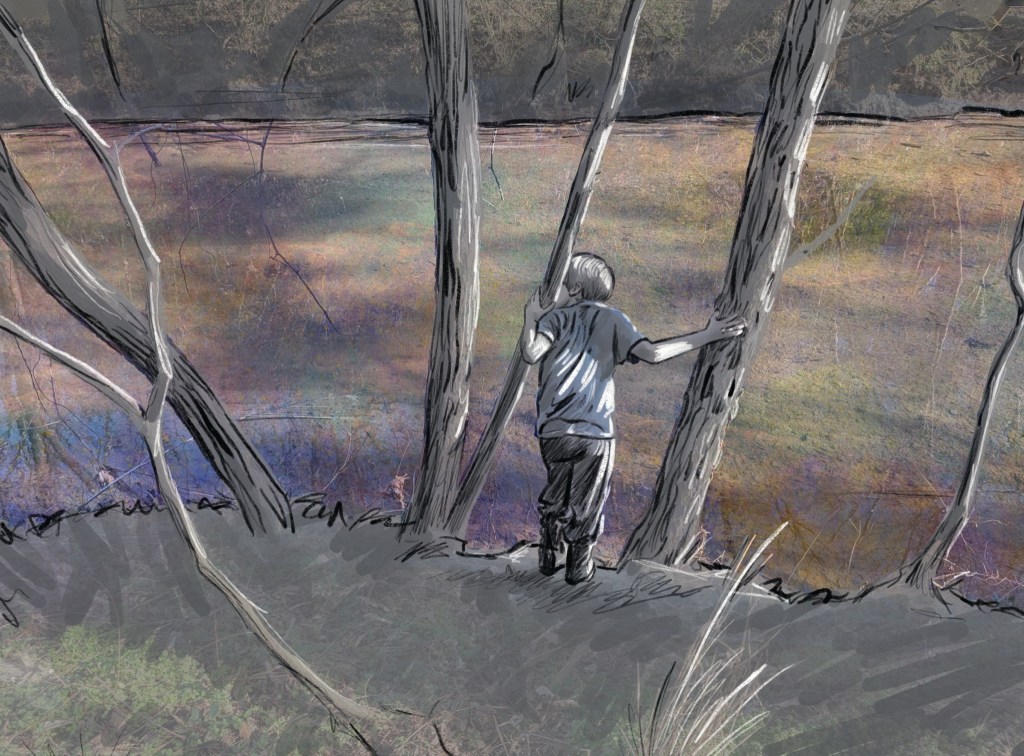
POETS Day: A Boy’s Life

Illustration by Rene Sears

[This entry is cross posted at ordinary-times.com]

Officially, the work week’s gonna be over in a few hours. What are you doing? You’re not getting anything done between now and then. Cut it out and stop pretending. Piss Off Early, Tomorrow’s Saturday.

First, a little verse.

***

Boys play seriously. Words used metaphorically by noncommisioned adults, words like “scout” and “reconnoiter,” carry a punch in their youthful declarations implying duty or professionalism.

For a brief stretch of years, they patrol the neighborhood with pant legs tucked in galoshes on the lookout for good sticks, skipable rocks, animal tracks, and fossils. If they’re lucky enough to live near slate deposits or any shale that cleaves, “arrow heads” abound.

My wife and I walk roughly the same path everyday, weather permitting, along our creek. The city is making improvements no one wants. They cut ten foot paths through grass and laid asphalt pathways intermittently. Then they stopped. Debris containing construction fences have been in place for ten months now. The wiffle golf players don’t come out any more, nor do the Russian card players, though one of their chairs litters a fenced off section near the put in. The old foot worn paths remain. Neighbors ignore the city’s trails and keep on as habit and sense dictates, but the city paths wind. They snake in such a way that all the clearings that hosted croquet and touch football are intruded upon.

Continue reading

POETS Day! Eliot’s 1st Part of the 2nd of Four Quartets

Illustration by Rene Sears

[This entry is cross posted at ordinary-times.com]

There’s a BarBQ place a mile and a half from our house that my children like to ride their bikes to, get an order of fries, and spend an afternoon downing soda and reading books. Monday, I hopped in the car for a quick trip to the store and came up on my youngest cycling, about halfway to the restaurant, and pulled over to ask if he wanted me to pick up anything while I was out. He told me I wasn’t the first person to pull over and talk to him that afternoon. Some persnickety woman rolled down her window a block or so from our house to “Make sure everything was all right.” She told him it wasn’t safe to be out biking.

The kid is thirteen. When did it become an oddity that one of his tribe might be outside by themselves? We hope she does it again. Next time my kid is going to point at her and start screaming “Stranger Danger!” at the top of his lungs.

Piss Off Early, Tomorrow’s Saturday. Go outside and have some fun. Make it an honest to God POETS Day. Skip out of work and be as free and independent as a kid on a bike.

***

East Coker is a real place. Barely. It’s a tiny village in Summerset set as inland as can be, sandwiched between the Bristol and English Channels, on the north and south respectively; somewhere between Southampton and Plymouth on that southernmost extension of Great Britain the Pilgrims watched sink below the horizon. Wikipedia counts the population as 1667 souls as of the last edit and pictures tell me it’s the kind of quaint English village ripe for a festival-related trio of murders only a clergyman or spinster can solve, to the embarrassment of the local constabulary.

Continue reading

POETS Day! Charles Mackay of Extraordinary Popular Delusions Fame

Illustration by Rene Sears

[This entry is cross posted at ordinary-times.com]

My kid can type. I don’t mean he just knows how. He dropped into a conversation about something else that he started fiddling with a typing tutor website and “plays” the exercises between games or watching videos when he’s messing around on the computer. He’s been at it for three years. We think we keep an eye on what he does online but this was the first my wife or I heard about it, so we tested him on a random type training site, one he wasn’t familiar with.

He’s over one hundred words a minute at 99% accuracy. He’s thirteen. We’re a little terrified that he was able to spend as much time as he obviously has online without our knowing what he was up to, but damn. He won’t need a POETS Day plan. If he sticks to white collar employment, he’ll blaze throught as much by noon as his co-workers manage all day.

As for the rest of you, come up with something. Pretend a cough, remember a religious observance, whatever you have to do to get out of work and live it up on a Friday afternoon. Piss Off Early, Tomorrow’s Saturday.

First, here’s a bit of verse.

***

One of the reasons I subscribe to The Free Press is for access to dueling articles on a subject. Here’s a guy who thinks war is bad. Here’s a guy who thinks war is good. And they’ll cross link if the two come out a few days apart.

I read the comments on both. Their paired articles seem less plagued by comment section trolls than the standard stuff, not that those are particularly afflicted when compared to the internet as a whole. I don’t think think I’ve ever been radically swayed by one of the exchanges—article or comment—but I get a few questions answered and pick up a few new questions in the process and emerge just as annoyingly opinionated but with a new array of plugged-in patina building bits of info to pester friends and family with. More than worth the $10 a month subscription price.

Continue reading

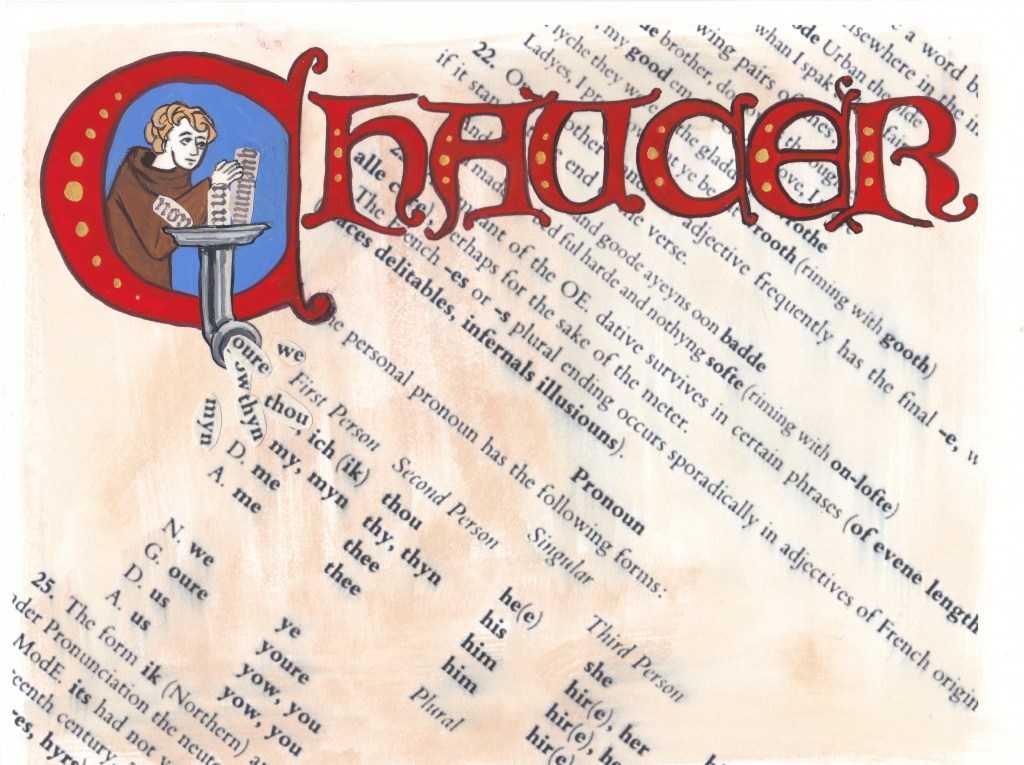
POETS Day! Talkin’ Chaucer at the Godsibbing Fense

Illustration by Rene Sears

[This entry is cross posted at ordinary-times.com]

I’m listening to a book about free speech and the necessity of, and the author went on for a few minutes about punishments meted out for violations of English law in Colonial America. It was amazing stuff. They’d cut off your ears for offending the Crown’s reputation, even for questioning it. Lucky loudmouths might get off with a cropping where they’d just trim off the ear tops. Tongues were bored, ears were nailed to pillories, many whippings of designated number and severity were prescribed.

One sorry SOB had his tongue bored, his arms broken, and then with his arms “dangling,” according to the author Jonathan Turley, was forced to run a gauntlet as men beat him with rifle butts.

What the hell did he say?

I hope he said it loudly. Clearly and from a high place on a stark, windy day. I hope his wind aided preferably bass voice carried across the land and turned the head of every man, woman, and child. I don’t know the content, but I hope he got the most from it.

This isn’t a segue to slippery slopes and non-crime hate incidents. It’s POETS Day. Piss Off Early, Tomorrow’s Saturday. Get out of work and read a book. There are a lot of them out there. I’m enjoying Against the Country, by Ben Metcalf. Listening to a book, as I’m doing in the car with Jonathan Turley’s The Indispensable Right: Free Speech in an Age of Rage, doesn’t count. That’s not really reading, even if it is fun. Maybe read the Turley book, though. I’ve heard good things.

In any case, take time for a little verse first.

***

ITEM:

On May 4, 1380, Cecelia Chaumpaigne signed a quitclaim releasing Geoffrey Chaucer from “all manner of actions related to my raptus.” That’s a translation. The entire statement was recorded in Latin, as was customary. The word “raptus” is left untranslated and italicized as no one was quite sure exactly which of its uses common as legal terms at the time was intended in this case.

Continue reading

POETS Day! William Makepeace Thackeray

Illustration by Rene Sears

[This entry is cross posted at ordinary-times.com]

I was chatting with a guy from New Jersey yesterday. It was cold and glum in Alabama. He was making fun of me for acting as if temperatures in the thirties were Armageddon-ish and I shook my head and mumbled something like “…wouldn’t last a second around here in August… humidity.”

He showed me an amazing foul weather trick so epoch shaking I might deign to call it a life-hack. “If you are ever bothered by the weather,” he said, “take out your phone, pull up your weather app, and bring up Iowa City, Iowa.” He demonstrated. It was 9° with a blue subscript that read “feels like 7°.”

According to Wikipedia, there are 171,000 people living in the greater Iowa City Metropolitan Area. I don’t know how that’s possible. It’s POETS Day. Look outside. Now look at your phone weather app, type in Iowa City, Iowa, and look outside again. There are 341,000,000 people in this country, and in comparison, no matter what it looked like out that window, 340,829,000 of you just realized what a beautiful day you’ve been blessed with.

It’s Friday afternoon. Piss Off Early, Tomorrow’s Saturday. Have at it.

First, a little verse.

***

I usually come across one or two odd and interesting facts when looking into the lives of poets for these posts, and want as I might, I can’t shoehorn or wrestle them into sense with even the loosest narrative, and I can get pretty loose. I found two this week while reading up on the life of William Makepeace Thackeray and I like them too much to discard. I don’t know if it’s still an aside when you haven’t begun anything to momentarily distract from, but a couple of quick asides if you… whether you mind or not, I guess.

Continue reading