POETS Day! William Morris

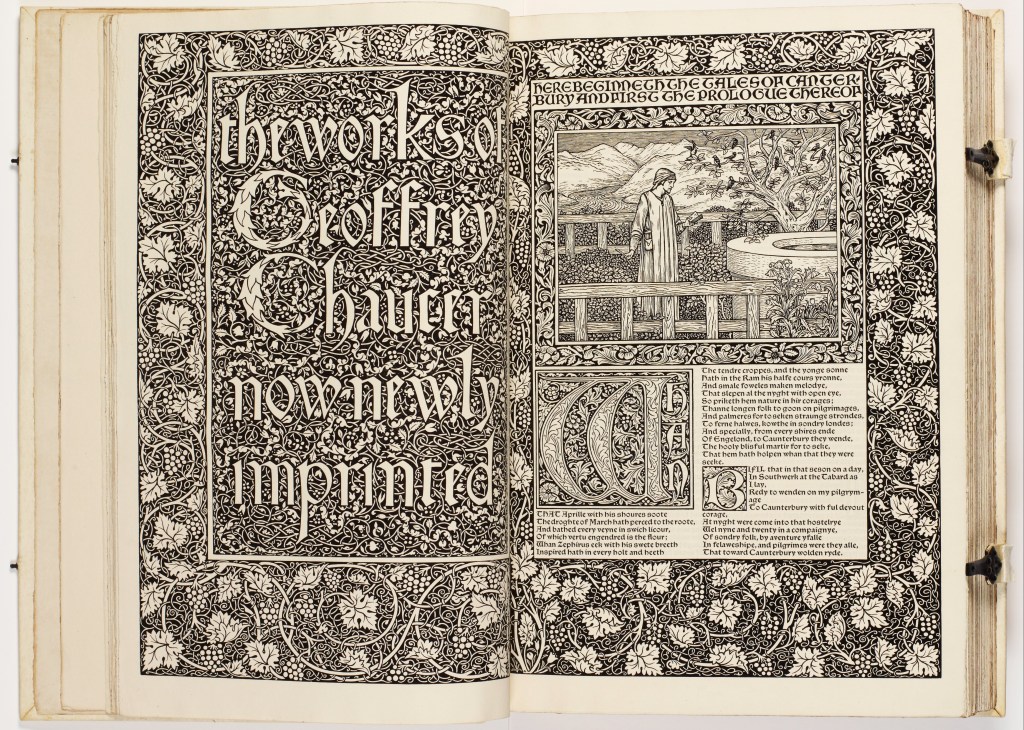
From the Kelmscott Chaucer, designed by William Morris and Illustrated by Edward Burne-Jones

[This entry is cross posted at ordinary-times.com]

You still at work? What do you think you’re getting done between now and quitting time? Cut out and stop pretending. Piss Off Early, Tomorrow’s Saturday.

First, a little verse.

***

Before JRR Tolkien’s Gandalf, there was William Morris’s King Gandolf. Before Tolkien wrote about the horse Shadowfax, Morris wrote about the horse Silverfax. Morris introduced both of the latters in his just-under-the-wire-not-posthumous 1896 novel, The Well at the World’s End. Tolkien didn’t steal. Theft in literature is generally more interesting than something that direct, but neither Gand-whatever nor whatever-fax were properly owned to begin with. Tolkien was doubtlessly inspired by Morris’s popular book, but both authors took names from Norse and Icelandic myth. They heard the same stories.

Plugged in fans and obsessives—I say that lovingly—of the genre credit Morris as one of the fathers of modern High Fantasy. Tolkien takes all the laurels, and deservedly so, for standing on earlier shoulders and leaping as high into the air as possible. Two of those shoulders were Morris’s; David Byrne shoulders.

These days, Morris is best known for textiles and design. He was an vocal socialist; important enough that those who take interest in the development of socialism, at least in England, have been at work on his Wikipedia page. Among the signs of ardents tinkering: his mother is described as “descended from a wealthy bourgeois family.” As an artist and artisan, he catered to what most outside of the struggle session green room call the middle and upper classes. His furniture was, and maybe still is, in St. James Palace and the Duke of Westminster’s Eaton Hall. Per the biographer Fiona MacCarthy, he decried such work as “ministering to the swinish luxury of the rich.” But minister on he did, soldiering his way to increasing an already solid inherited fortune.

Continue reading

POETS Day! Edwin Arlington Robinson

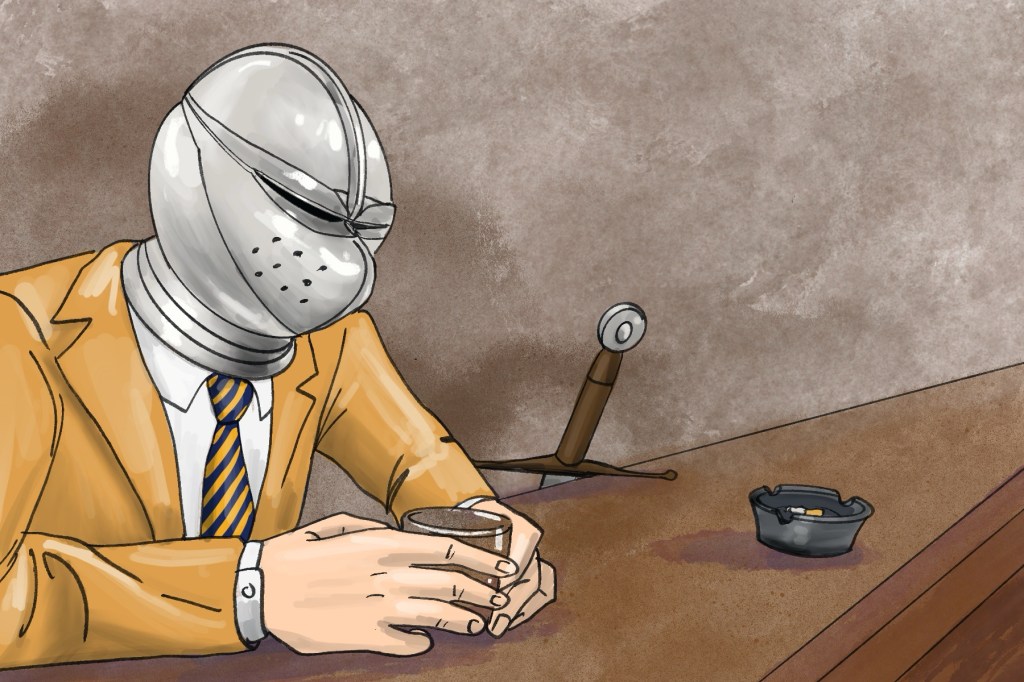
Illustration by Rene Sears

[This entry is cross posted at ordinary-times.com]

Why are you still at work? You’re not getting anything done between now and quitting time. Cut out and stop pretending. Piss Off Early, Tomorrow’s Saturday.

First, a little verse.

***

We mourn, but with the qualification that, after all, his life was a revel in the felicities of language.”
– 
Robert Frost from his introduction to King Jasper by Edwin Arlington Robinson

When Edwin Arlington Robinson won the inaugural Pulitzer Prize for Poetry in 1922, I imagine it was a fine day of congratulations and warm feelings from all the other poets. For three years prior, there had been what we now call the Special Pulitzer Prize for Poetry, but that’s retconning. That was then known as the Columbia Prize, and stood apart. Harriet Monroe, writing in celebration of Robinson’s laurels threw in, “Four years ago, when the Poetry Society of America gave its first annual five hundred dollars to Sara Teasdale’s Love Songs, the award, being made in conjunction with the Pulitzer prizes, was falsely attributed to the same origin.” The Columbia put five hundred dollars in the winner’s pocket. The Pulitzer was worth one thousand. Neither was chump change in 1922, but double is considered by most who make their living in verse to be better.

Not that a true poet would ever consider something so crass as money, but on those odd occasions when the subject came up in conversation, it must have been nice knowing, for those of a zero-sum view, that there was more to be contested than had been before. When the second Pulitzer was awarded to Edna St Vincent Millay in 1923 and the third to Robert Frost, I assume along with standard jealousies the warm feelings continued.

In 1925, Robinson won his second Pulitzer. In the audience of the poetry place where all the poets hang out, I imagine heartfelt applause on hearing, because EA, as he didn’t like the name Edwin, was a kinda dour guy but he wasn’t offensive. Maybe he was a little dark, but he was witty dark, not depressing dark. Still, as the crowd dispersed to cocktails and cliques coalesced, jocular between swigs, “You know, there are other poets out there.”

Continue reading

POETS Day! Sir Philip Sidney Didn’t Get the Girl

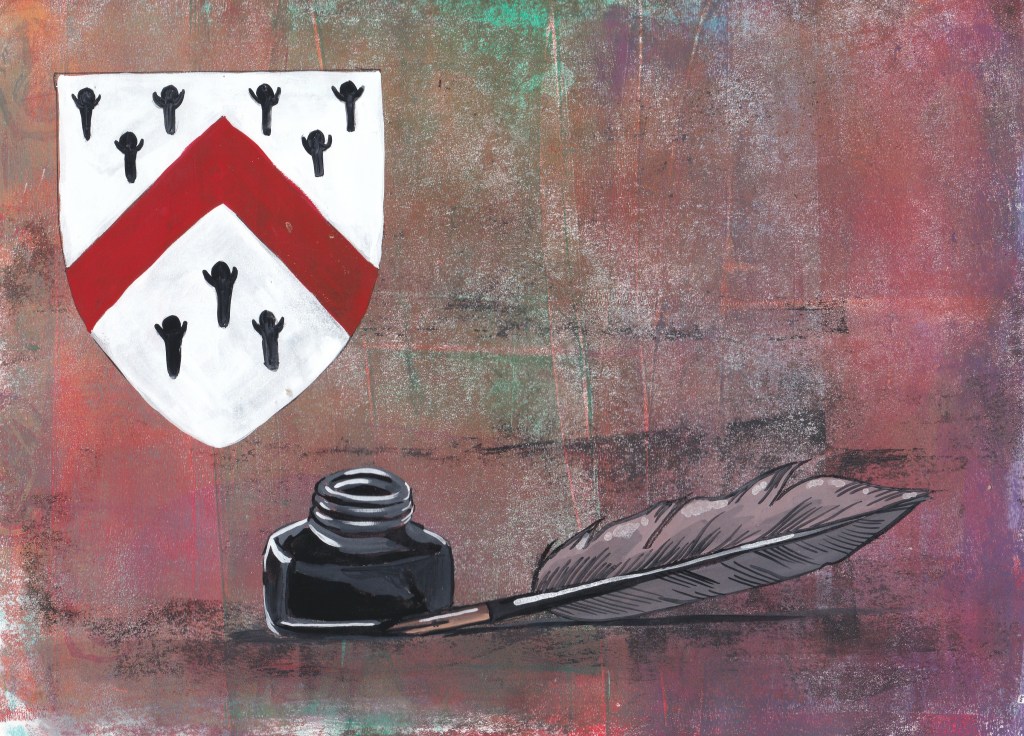
Illustration by Rene Sears

[This entry is cross posted at ordinary-times.com]

Welcome once again to POETS Day, where we usher in Henry Ford’s greatest creation – the weekend – a few hours ahead of schedule by embracing the ethos of the day: Piss Off Early, Tomorrow’s Saturday.

Life’s too short for work, and nobody’s gonna notice if you hoof it mid-afternoon.

***

In a 1579 letter from Edmund Spenser to Gabriel Harvey, Spenser brings up an organization he’d been invited to join by “Master Sidney and Master Dyer.” The Masters were Sir Philip Sidney and Edward Dyer, a pair of Elizabethan courtiers who acted as agents and soldiers abroad for Her Majesty. Sidney, at least, would be shocked that he’s remembered as a poet rather than envoy or governor. The organization was called The Areopagus, and it’s fairer to call it the proposed organization as it’s not known whether it ever made it past planning. No meetings are recorded.

Sydney may have been inspired in conceiving his literary club by the Wilton Circle, a literary circle of which Spenser is confirmed to have been a member, founded and led by Philip’s sister Mary Sydney and run by Sir Walter Ralegh’s half brother (possibly Humphrey Gilbert, though I haven’t found a site willing to lift whomever out of Ralegh’s shadow with more than “half-brother.”) The Wilton Circle is described by the Shakespearean Authorship Trust as “the most important and influential literary circle in English history.” The Authorship Trust’s mission, depending on your disposition, is “just asking questions” regarding the authorship of plays ascribed to William Shakespeare, or they’re a bunch of conspiracy nuts on a snipe hunt. It’s also possible that Mary’s Wilton Circle postdated Sydney’s idea for the Areopagus. I can’t find minutes.

Continue reading

POETS Day! Poems from Wallace Stevens’s Harmonium

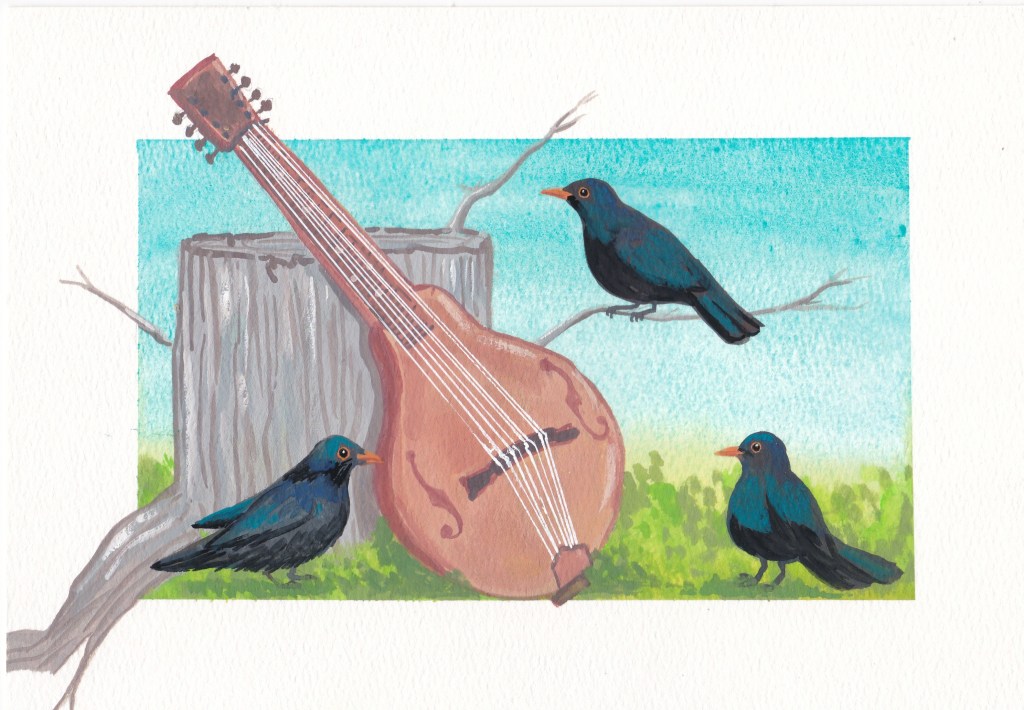
Illustration by Rene Sears

[This entry is cross posted at ordinary-times.com]

TGIF is POETS for those without initiative. Make it happen. Piss Off Early, Tomorrow’s Saturday.

First, a little verse.

***

Wallace Stevens started late. His first poetry collection held an impressive, by debut poetry collection standards, eighty five titles, but when the book, Harmonium, was published in 1923, its author was in his early forties. He’d had time to backlog.

I covered Stevens’s morning routine—composing in his head as he walked to his office at Hartford Accident and Indemnity Company—in this space three years ago. In Harmonium, he wrestles with how he should see the world. Should he be grounded in the rational or loose in the imagination? The question is posed piecemeal and never resolved.

I remember when Donna Tartt’s A Secret History came out. My mother’s kitchen table review was that it’s a great book, but she put all she’s ever learned and considered into it and she won’t have anything else to say for five to ten years. That was in 1992. Tartt’s second book came out in 2002. Stevens spends a great deal of energy trying to sort himself. He wrote sparingly through the 20s, not writing regularly again until 1933 and not publishing another bound volume until Ideas of Order in 1936. Harmonium received harsh reviews. Mark Van Doren dismissed him from the genre by writing in The Nation, per Wikipedia, that Stevens’ wit “is tentative, perverse, and superfine; and it will never be popular.” There were nice things written too, but the negatives weighed on him. Maybe he, like Tartt in Mom’s pinning, spent his store. Maybe the critics brushed him back. Maybe he had to reconcile vers libre with actuary tables.

Continue reading

POETS Day! The Present in TS Eliot’s “The Dry Salvages”

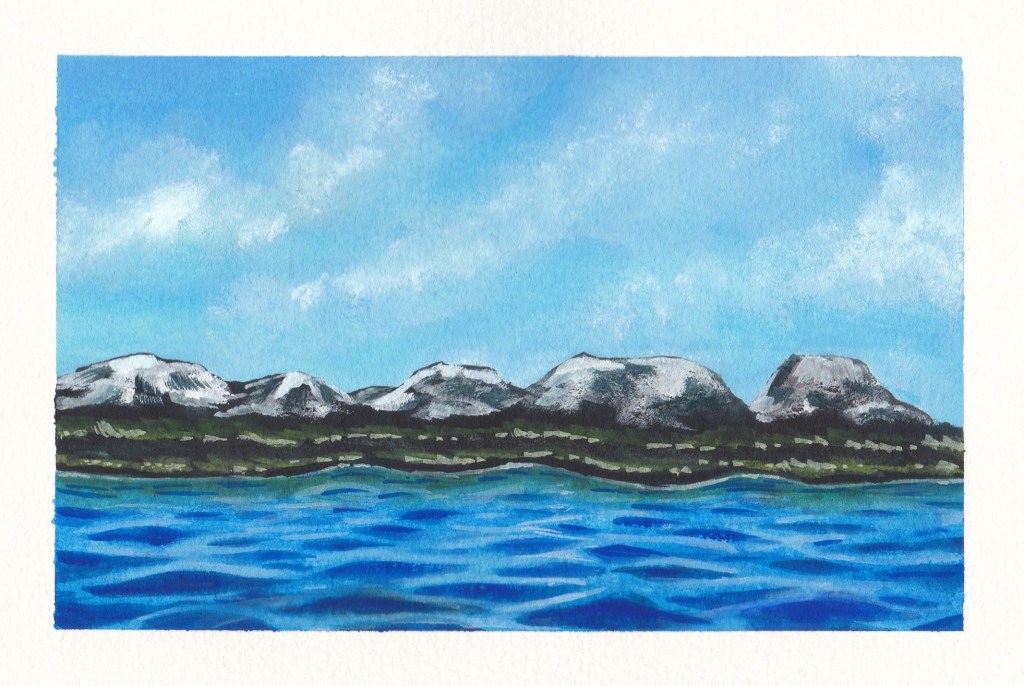
Illustration by Rene Sears of The Dry Salvages rock formation off the coast of Gloucester, Massachusetts where TS Eliot spent his boyhood summers.

[This entry is cross posted at ordinary-times.com]

Welcome once again to POETS Day, where we usher in Henry Ford’s greatest creation – the weekend – a few hours ahead of schedule by embracing the ethos of the day: Piss Off Early, Tomorrow’s Saturday.

Life’s too short for work, and nobody’s gonna notice if you hoof it mid-afternoon.

***

TS Eliot titled the third of his Four Quartets “The Dry Salvages” after a rock formation off the coast of Gloucester, Massachusetts, a fishing village and seaside retreat where the St. Louis based Eliot family spent their summers when the poet was a boy. Dry Salvages derives from an original French name for the formation transformed by time, mishearings, and local accent. Eliot tells us in a parenthetical preceding the poem, “presumably les trois sauvages,” Anglicized over time but, he instructs, “pronounced to rhyme with assuages,” so not as yet a fully English subject.

As with all of the Four Quartets, “The Dry Salvages” manages competing images presenting a theme. There’s a great deal going on and a great many ways to spend a thousand words on an aspect without touching on any number of other aspects. In this poem, the opening and recurrent image is that of water. The river is present, flowing, perceptible action. The sea is unknowable depths. Water rises from the sea, rains and forms oceans and back to the sea. The sea is the past and the future. We cannot know which or guess at more than the surface. The river is with us, changing in the moment. It is present. The idea permeates.

Continue reading

POETS Day! Dorothy Wellesley

Illustration by Rene Sears

[This entry is cross posted at ordinary-times.com]

The work week’s nearly finito; barely a few hours left. What are you doing? You’re not getting anything done between now and quitting time. Cut out and stop pretending. Piss Off Early, Tomorrow’s Saturday.

First, a little verse.

***

from Fire
Dorothy Wellesley (1889-1956)

(‘Does not our life consist of the four elements?’
—Shakespeare)

The great stone hearth has gone.
An oblong electric tube is set in the wall
Like a cheap jewel.
Men converge no more to fire,
Men are on with the isolation:
The pride of science stands, and the final desolation.

No smoke, no danger, you tell me with veneration:
Much dies with the fire, young man,
More than one generation:
Man has known fire more than one generation.

That’s a tremendous opening. Yeats came across Dorothy Wellesley’s poetry in 1935 while putting together The Oxford Book of Modern Verse: 1892-1935 and had to meet her. According to Kieth Alldritt in his W.B. Yeats: The Man and the Milieu, the great poet was overcome: “My eyes filled with tears. I read in excitement that was more delightful because it showed that I had not lost my understanding of poetry.” Yeats further honored her with commentary in the Oxford Modern Verse introduction, writing “I knew nothing of her until a few months ago I read the opening passage in Horses, delighted by its changes in pace, abrupt assertion then a long sweeping line, by its vocabulary modern and precise.”

Continue reading

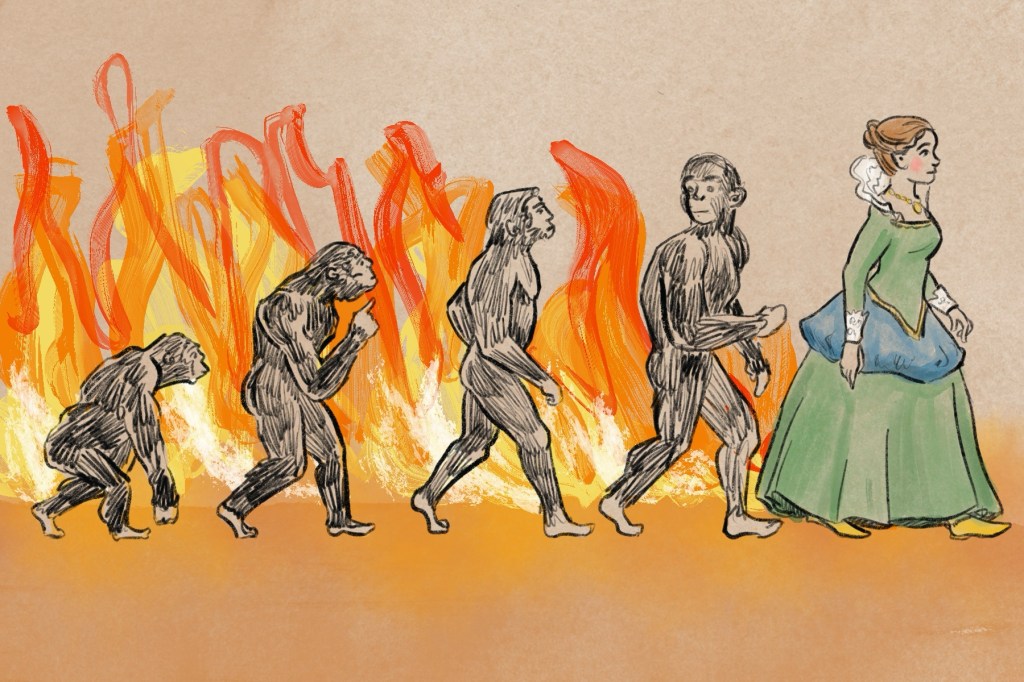
POETS Day! Apes in Hell

Illustrated by Rene Sears

[This entry is cross posted at ordinary-times.com]

The work week’s nearly done and you’re spending these last few hours doing what exactly? Trying to look busy? Surreptitiously scanning restaurant reviews? Checking game times? Texting your friends about restaurants and game times? Cut it out and cut out. Piss Off Early, Tomorrow’s Saturday.

First, a little verse.

***

I’ve mentioned before that I’m an introduction reader if the introduction is relatively short or obscenely long. My theory is that I might as well read a short one and that a long one indicates something in the book requiring the long introduction; something I might otherwise miss. My experience shows mid-length ones to be fumbling, fawning, and filled with ten dollar praise of the sort grad students fuss out over beloved former teachers. If I like the book, I’ll read those after. It’s a slapdash theory, but it’s served me and I’m fixed in my habits.

Christian Lorentzen wrote the Introduction to the NYRB Classic edition of Take a Girl Like You by Kingsley Amis, and I’m a little ticked off at him. He’s funny and drops some whispered-about biographical info, though he’s writing about Amis and the info is about infidelity so it was loud whispering to begin with, but entertaining. I’m not going to work out the chronology, but Harper’s claims Lorentzen as a contributor, as do the London Review of Books and others. This intro is a small sample size, but I’m content to dub him one of the good guys and read what I come upon in the future. Still, he ticked me off. I’m pretty sure he gave away the ending of the book.

Not so terribly that I won’t read. I’m pretty, not totally, sure he spoiled it. Lorentzen gives a who’s who of the characters, outlines the conflict central to the plot, and then tells us the ending is “genuinely shocking.” But given the build up as explained there’s only one genuinely shocking ending. If he’s pulled a feint and one of the mains out of nowhere joins the priesthood, reveals himself as the Lindbergh baby, grows a trunk: fine. The ending isn’t spoiled. But given where the story, by his touching on it tells, is going… Dammit.

Continue reading

POETS DAY! Keats Gets Snippy About Wordsworth

Illustration by Rene Sears

[This entry is cross posted at ordinary-times.com]

In the summer of 1818, John Keats and his friend Charles Armitage Brown went on a walking tour of Scotland. It looks like the pair covered somewhere between six hundred to six hundred and fifty miles over forty-four days, so about fifteen miles a day, give or take and accounting for weather.

Keats wrote a series of letters about the journey to his consumptive brother Thomas, unable to travel with what they didn’t know at the time was his last bout with tuberculosis. He brings his brother along in these letters. It’s endearing. He’s colloquial and considerate. Reading, you get the sense he really did “Wish you were here.” You also get the sense that he was entertaining a bedridden friend, and further, the sense that his audience enjoyed laughing at small frustrations.

There’s a great deal about lovely views, divine salt water baths, and all the joys that make for good travel brouchuring, but Keats peppers it with amusing observations; little asides he would give were Thomas along.

Continue reading

POETS Day! George William Russell, Co-Host of the Irish Literary Revival

Illustration by Rene Sears inspired by the Paintings of AE

[This entry is cross posted at ordinary-times.com]

For those who care about golf, this is your time. The Masters and its NPR whisper-excitement for four televised days is a duck out of work away. For those who don’t care about golf, it’s going to be a pain in the ass getting a table at the neighborhood joint. My local sods the dining room and patio, props azaleas in all the corners, pulls in an under-armor collared shirt Hootie type band for post-round, and makes it damn near impossible for a regular to eat a club sandwich in peace. People in green and white holding red solo cups spill out into the parking lot. They pack the place and good for them, I guess.

Piss Off Early, Tomorrow’s Saturday. I hope your golf team wins.

First: verse.

***

In his younger years, George William Russell had a vision. Details of the vision are unclear to me, but “Aeon”, a Gnostic word meaning early being or ancient cosmic intelligence, popped from the fringe of understanding and held court, nipping at his synapses. He claims to have never heard the word before and to have been ignorant of its meaning until revelation fixed it front and conscious center. Obviously, he looked it up. Obviously it had meaning and implications. He decided Aeon would be his non de plume.

Something got confused. A printer was buffaloed by Russell’s use of the ash, or “Æ” character, to spell Æon. There doesn’t appear to be an academic reason for the ash. I can’t find support for using the symbol in aeon though there was a fashion for dressing up Latin and Greek terms with it as flourish in the late 19th and early 20th centuries whether called for or not. There were heavy metal album cover designers before there were heavy metal albums, so it’s possible Russell spelled for an esoteric aesthetic.

For whatever reason, he used it and the printer didn’t pick up on what he laid down. To the printer’s defense, Russell’s handwriting was notably atrocious. He’s lucky to have deciphered the hieroglyph as resembling A and E at all. The result was a work credited to an author named AE. Russell liked AE and kept it.

Continue reading

POETS Day! Ford Madox Ford’s “In the Little Old Market-Place”

Rene is out of town so there’s no illustration from her this week. The above is what happens when I’m left to my own devices.

[This entry is cross posted at ordinary-times.com]

In the Little Old Market-Place
Ford Madox Ford (1873-1939)

(To the Memory of A. V.)

It rains, it rains,
From gutters and drains
And gargoyles and gables:
It drips from the tables
That tell us the tolls upon grains,
Oxen, asses, sheep, turkeys and fowls
Set into the rain-soaked wall
Of the old Town Hall.

This is a longer poem, ninety-two lines, than I usually feature here, so I’m breaking it up with commentary as I see fit. I hope you’ll excuse my not prefacing each excerpt with “from In the Little…” An added apology: I have no idea who A.V. was. I did look around.

This work first appeared in his collection High Germany, dated 1911 but apparently not published until 1912, and reappeared in the debut anthology of Imagiste poets, back when the movement was helmed by Ezra PoundDes Imagistes. Pound was awed by Ford and eager to get the established critic, novelist, editor, and poet on board. In part, Pound was thankful. Ford gave several notable poets a beginning in England, among them Pound, DH Lawrence, and Wyndham Lewis. When put on the pages of Ford’s English Review, they were elevated, sharing space with Yeats and Ford’s dear friend Conrad. It’s said here and about that he “discovered” these new voices, but that’s a messy term. I’m sure what it means in the pertinent sense, as all had published but not to scale, is that Ford lifted them up and made them salon worthy subjects.

Continue reading