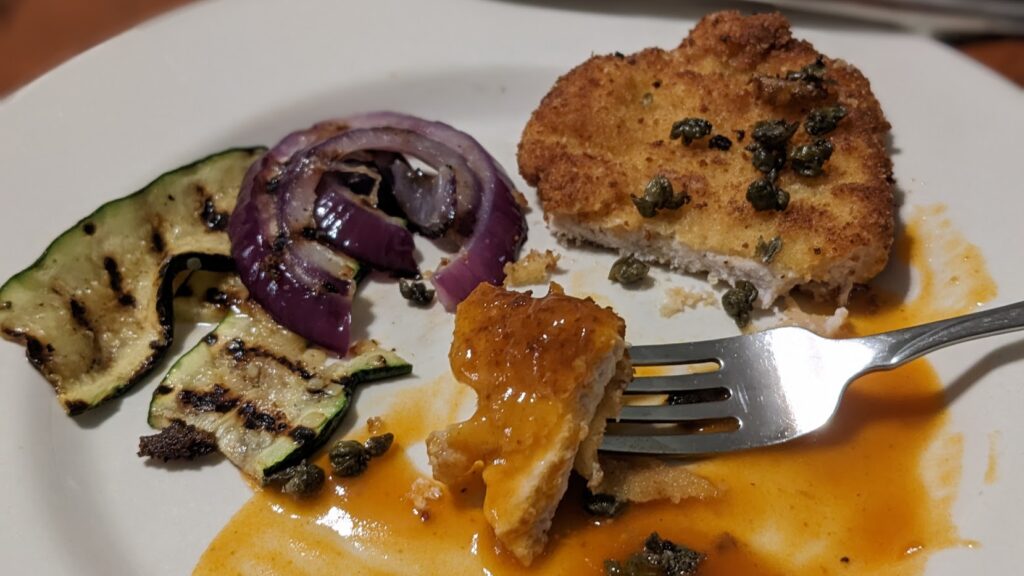
Chicken Spiedini with Amogio Sauce

[This entry is cross posted at ordinary-times.com]

“Spiedini” is an Italian word, but it means “skewer.” There’s nothing innately Italian about that part. People have been cooking things on sticks the world over since the first guy burnt his hand. “Amogio” is innately Italian, specifically Sicilian; old as the hills but with no good story trailing behind. It’s citrus and herbs with olive oil and a touch of spice. It’s a simple recipe that takes advantage of the island’s selective bounty.

I’ve read that when the Greeks arrived, Sicily was inhabited by the Elymi to the west, the Sicuni in the central region, and the Siculi along the east. Each had a style of cooking that, other than that they all used roughly the same ingredients – citrus, herbs, olives, nuts, seafood, and the occasional meat, I’ve read was distinct. I can’t find any commentary to enlighten me as to how they were distinct, just that they were. The Greeks didn’t change much to the cuisine other than introduce fish stew, which seems improbable. Anybody that lives by the sea and has a pot will get that notion on their own.

The Greeks had staying power. Syracuse was a force as early as the fifth century B.C. and Hellenic dialects were still dominant under Augustus when Rome was dependent on the island for wheat. In 831, under Saracen rule, the capital moved from Syracuse to Palermo and Greek influence faded. According to Waverley Root in his book The Food of Italy, the Saracens never left, “They are at any rate still with us in the kitchen. Almost everything which strikes us today as typically Sicilian is typically Saracen.”

Continue reading

Nero Wolfe’s 45 Minute Scrambled Eggs

[This entry is cross posted at ordinary-times.com]

If you haven’t read any of the Nero Wolfe mysteries by Rex Stout, you’ve deprived yourself of endless well spent afternoons. That’s why the books exist. They’re lunch to dinner length and engaging so you don’t nap away a day off.

My dad claims to have read them all though I don’t see how he knows. I’ve read ten or twelve, I think. Maybe I’ve read six of them twice or four of them three times. They’re not meant to be life changingly memorable. The plots are intricate enough to keep you guessing but evenly so throughout the series. They’re tuxedos; none of them impolitely stands out, interchangeable like a Bertie and Jeeves story, but with crimes more serious than pilfering cow creamers.

Murder’s not the thing anyway, at least for me. It’s the joy of spending time in the agoraphobic Wolfe’s brownstone with the orchids or in the study where every seat has an attending table to sit a beer on, stopping for a ham sandwich and a glass of milk with Archie Goodwin the narrator, or imagining the menu put out by Fritz Brenner, Wolfe’s live-in chef.

Continue reading

The Chic-faux-Lay Sandwich

[This entry is cross posted at ordinary-times.com]

Can you plagiarize yourself? This is the third time I’ve written down the recipe and step by step for this sandwich. The first time I called it an “ersatz Chic-fil-A” because in ninth grade I read Tom Robbins’s Still Life with Woodpecker and his main character used a baptismal candle as an “ersatz” sexual aid. Robbins was transgressive in way that didn’t hit you over the head with a sledgehammer. He drove the phonies nuts.

I tried to re-read one of his novels a few years ago and confirmed only good books grow up with you. Still, the word “ersatz” stuck in my head and I use it more often than I should. I like the sound and the memory of stopping to go to the dictionary. The word seemed arcane to me. Now I have problems with Robbin’s usage. He’s saying the candle was an ersatz ersatz?

I used “Chic-fil-esque” in that article, which was an unwitting segue into my second go at this sandwich, the second go being my first possible plagiarism. In that one I called it a Chic-faux-a, visually mimicking the emphatic syllable divisions in “Chic-fil-A”, but without the “L” sound the satirical similarity is reliant on a slanted assonant rhyme like this is some kind of folk or contemporary pop song and readers deserve better.

Continue reading

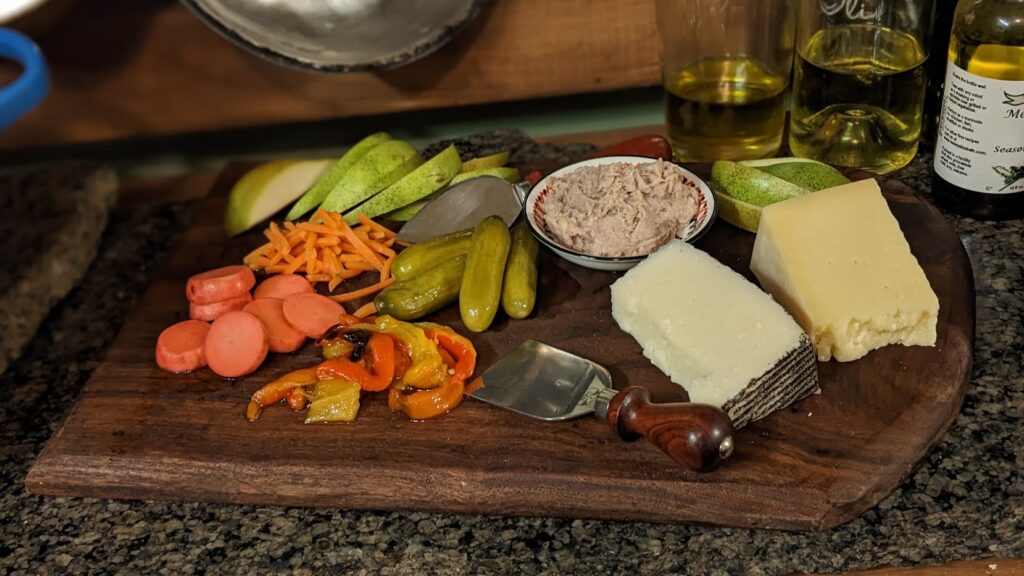
Rillette and Other Things That Start with “P”

[This entry is cross posted at ordinary-times.com]

I can’t be alone in occasionally wishing to forget all my troubles and become a wizened old half of a Boston marriage with leathery skin and piercing blue eyes. How comforting would it be to know the names of all the birds you hear singing while you press bits of colored glass into fresh concrete steppingstones in the side garden. Oh, the scarves I would own. When I told people it’s a waste to flush when they just “make water” I wouldn’t even blush. My home would be a shrine to rugged DIY projects and stuff with beads. People would look to each other and say of all manner of things, “I don’t know how to do that, but I bet that composting lady can show you.”

Of course, there’s no wand or Subaru dealership that magically conveys the air of brisk assurance I’m seeking, but if you want to feel as one with “all the violet tiaras, braided rosebuds, dill and crocus” there’s always putting food in decorative yet practical jars. I can do that.

I want to be clear that when I put food in practical jars I’m not doing so for practical ends. That involves precision. I’m doing it for a psychosomatic taste enhancing aesthetic that serves no other purpose using Tupperware could not achieve.

Continue reading

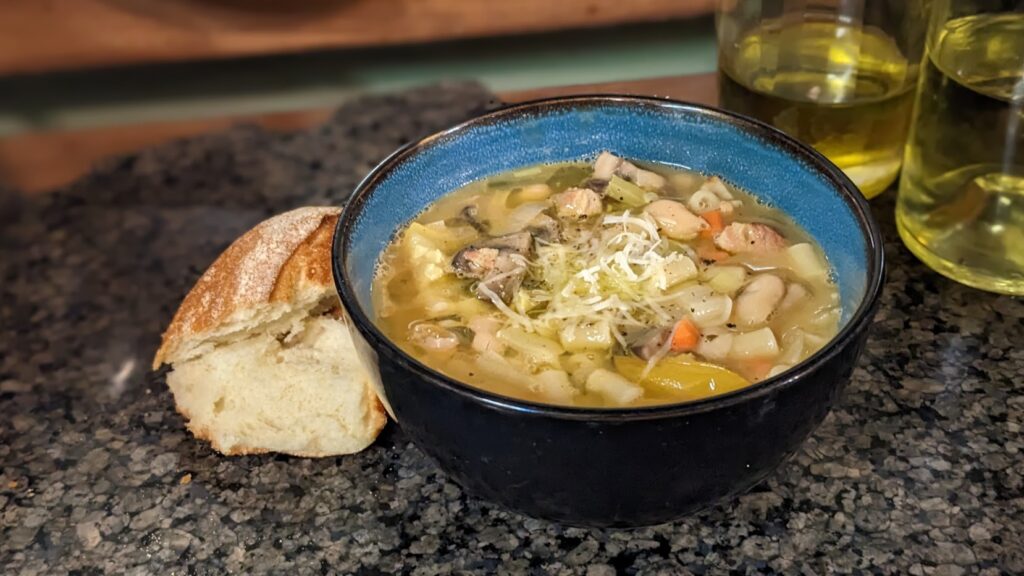
Spring Minestrone

[This entry is cross posted at ordinary-times.com]

“The natural progression from boiling water to boiling water with something in it can hardly be avoided, and in most cases is heartily to be wished for.”
– M.F.K. Fisher

The Ligurians invented ravioli, kinda. They claim cooks on ships out of Genoa collected leftovers to pack in little pasta pouches for the next day’s meals. The culinary world seems content to go along with the Genoese and pretend that their 14th century concoction is somehow different from the stuffed pasta envelopes mentioned in a French document dated 1228 or the raviolis mentioned in Venice and England around the same time as the Ligurians were supposedly revolutionizing the putting stuff inside of other stuff industry. Malta’s had a version going back farther still, but the Maltese don’t get conquered as much when people forget their island exists so they won’t be voicing any challenges.

The truth is that we let Ligurians get away with big talk about “their” pasta because we feel sorry for them and nobody really cares anyway. The Basque fishermen kept their favored sites off the coast of ur-Canada a secret and Leif Erickson had shitty PR so the Genoese defaulted their way into discovering America even though people named it after that buttinski Florentine. Eventually, though, it was decided that you can’t discover something that you didn’t know existed so newer text books took away their claim to fame. As a palliative, people figured “Sure. You can have ravioli.”

Continue reading

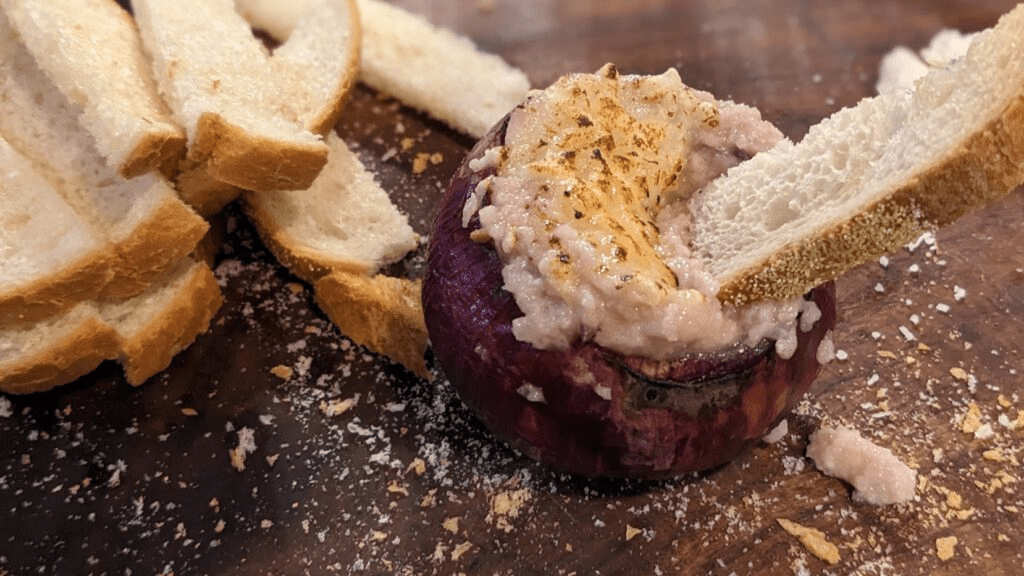
Not French Onion Dip

[This entry is cross posted at ordinary-times.com]

This week’s recipe is an adaptation of an apparent Tuscan comfort food as recorded by a Tuscan-raised food writer who rediscovered the dish in a chic Roman restaurant just as chic restaurants Eternal City wide were bandwagoning as only really innovative and vibrant hot spots can.

The food writer is Giancarlo Caldesi and the cookbook this recipe is taken from is Rome: Centuries in and Italian Kitchen, co-written with his wife, Katie. My copy lists the publishing date as 2015 so given time for writing, editing, art direction, printing, and distribution, I’m guessing the Caldesis ate at Roscioli, the chic Roman restaurant where Giancarlo reacquainted himself with cipolle sotto sale or salt baked onions, in 2012 or 2013.

Brian McCannachie performed a bit on National Lampoon’s Radio Hour back in the early 70s called “Quick Canada Quiz.” He would pop in and ask a, as the name of the skit implies, quick question about Canada and then later in the show ask the question again and give the answer. I had to look up who voiced it. Until today I thought it was Chevy Chase. What I couldn’t find was a direct transcript of one of my favorite suddenly-not-Chevy Chase lines from the quiz, but it was something like “What song was number one on the Canadian pop charts for August of 1971?”

I’m sure I got the year wrong, but anyway, he came back later in the show and asked again. “What song was number one on the Canadian pop charts for August 1971?” Then a beat pause. “I don’t know, but I’m willing to bet that whatever it was, it was number one on the U.S. charts six months earlier.” Rim shot.

Continue reading

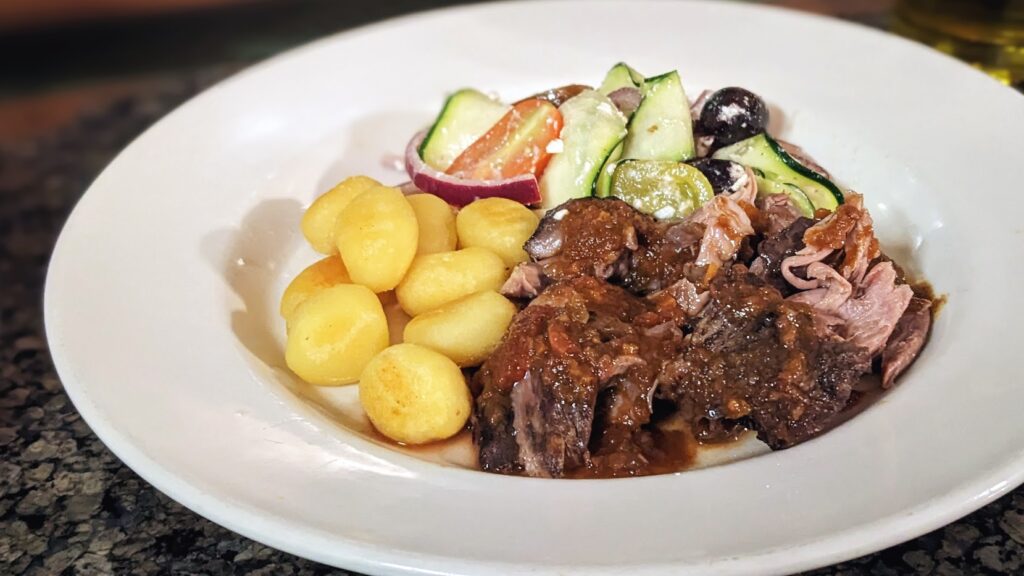
Braised Lamb Shanks with Tarragon

[This entry is cross posted at ordinary-times.com]

“Agnus Day with gnocchi and some zucchini. Easter is this Sunday.”
– Gregorian Chant (alternate)

I don’t use direct salt when I cook stir fries because I let soy sauce lull me into complacent bliss by hiding its sodium content in that little white square on the back of the bottle, filled with numbers and uninteresting acronyms, that nobody ever reads. According to Waverley Root, tarragon does the same thing but with no scolding square to ignore. He goes further. From his book, Food: An Authoritative, Visual History and Dictionary of the Foods of the World:

“In the less than a thousand years that it has been known to Westerners, food writers have extolled [tarragon] for its ability to replace salt, pepper, and vinegar. (It can also replace garlic for those for those allergic to this food.)”

This was news to me, although since reading I’ve found numerous dietary web sites that make the same claim. I can see the peppery and maybe some of the brightening of flavor you get from vinegar or other acids. That brightening may be what he means when he says tarragon replaces salt, but I have to concentrate to find it. It is there on the tongue, but as a shadow.

Continue reading

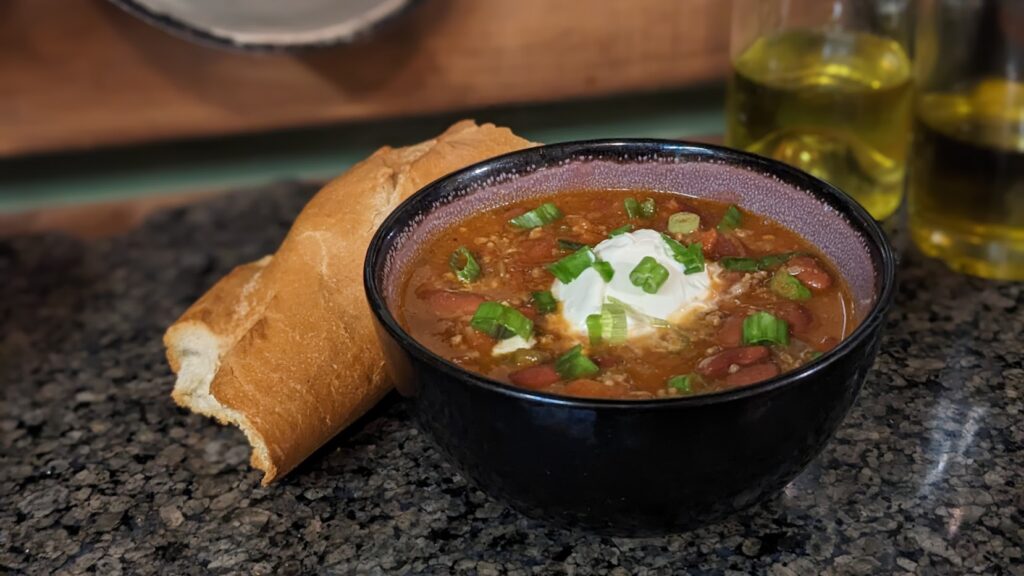
Chili with Szechuan Pepper

[This entry is cross posted at ordinary-times.com]

All of this is true.

I don’t live in Austin. I don’t live in San Antonio, Houston, El Paso, or Amarillo. I don’t even live in Texas. In fact, I hate the Dallas Cowboys in that sports sense of hate where I’m sure they’re a bunch of good guys but want them to fail miserably at their job and still snicker over their veteran heavy team getting beaten by a bunch of Redskin scabs back in ’87. Otherwise, I love the place. I’ve been to the Lone Star State three times so far and have yet to meet a Texan I didn’t like.

I had chili in Austin, sort of. There was a fenced-in area with food trucks and a sultry twenty-something woman who was barely wearing any clothes. My then eight-year-old asked her if he could pet her dog several times. I was there for chili because that is, to an outsider, the mythopoetic foodstuff of the town. I’m still not sure if Austin chili is all they say because I was told I had to have it the local way, which I’m pretty sure meant the hipster way. I had Frito Pie, which means I had a bag of Fritos with some chili poured in and shredded cheddar sprinkled on top. It was great, but between the chips and cheese I couldn’t tell you what was distinctive about the chili. I’d rather have had it unadulterated.

If my travels and Guy Fieri have taught me anything it’s that Texans think they know chili, but really the state is populated by ribbon whores. Everyplace with a health department score and a chalk board is home to award winning best in the state county fair champion three years running five alarm homemade as seen on tv (television) genuine original Texas chili. Everybody gets a trophy in this culinary little league.

Continue reading

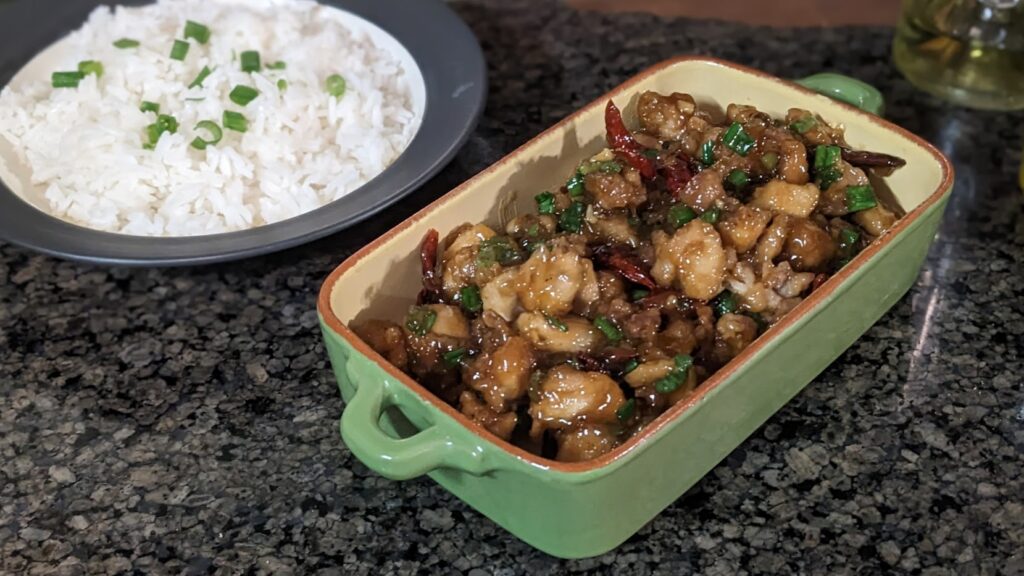
Mongolian Chicken: The Koumintang Consolation Prize

[This entry is cross posted at ordinary-times.com]

A: On the wall of the shop was a piece of paper, and at the top it said “NOTICE TO ALL CUSTOMERS.”
B: What did it say?
A: It said: “All revolutionary comrades who come in the revolutionary door of this revolutionary photography shop, before asking any revolutionary question, must first call out a revolutionary slogan. If any of the revolutionary masses do not call out a revolutionary slogan, then the revolutionary shopkeeper will take a revolutionary attitude and refuse to give a revolutionary response. Revolutionarily yours, the revolutionary management.”
B: Really “revolutionary”, all right. It was like that in those days. As soon as you went into the shop it went like this: “Serve the People!” Comrade, I’d like to ask a question.
A: “Struggle Against Selfishness and Criticize Revisionism!” Go ahead.
B: [to the audience] Well, at least he didn’t ignore me. [Back in character] “Destroy Capitalism and Elevate the Proletariat!” I’d like to have my picture taken.
A: “Do Away with the Private and Establish the Public!” What size?
B: “The Revolution is Without Fault!” A three-inch photo.
A: “Rebellion is Justified!” Okay, please give me the money.
B: “Politics First and Foremost!” How much?
A: “Strive for Immediate Results!” One yuan three mao.
B: “Criticize Reactionary Authorities!” Here’s the money.
A: “Oppose Rule by Money!” Here’s your receipt.
B: “Sweep Away Class Enemies of All Kinds!” Thank you
.

That’s a from a bit of xiangsheng written by Jiang Kun called “How to Take a Photograph.” Xiangsheng is a form of Chinese comedy theater that, as far as I can tell, is an Eastern cousin of the straight man/comic skits of the Abbott and Costello style vaudeville acts. I was looking for a sketch by Wu Zhaonan but couldn’t find a transcript or video of his act anywhere. His DVDs are for sale and pretty easy to find, but if you just wanted to see a clip to get an idea of what he did, you’re out of luck. Where’s all that Chinese entertainment piracy floated all about the black market when you need it?

Continue reading

Pork Chops alla Milanese

[This entry is cross posted at ordinary-times.com]

“Outside Italy, these are known as ‘Viennese chops’ (Wiener schnitzel). It is difficult to know who gave the recipe to whom; Lombardy was in fact under Austrian domination for a long period.”
– The Complete Italy: The Beautiful Cookbook, Patrizia Passigli, Fred Plotkin – Harper Collins

The Italians have cotoletta alla Milanese and the Austrians have Wiener schnitzel. Both are simple dishes of pounded veal, breaded and lightly fried. Both claim that their dish came first and was borrowed by the other.

As evidence of Lombardi origin, the Italians cite a letter written to Emperor Franz Joseph by his aide-de-camp Count Attems extolling a Milanese veal preparation and suggesting the Emperor introduce the recipe at court. The Austrians rightly counter that the letter in which Count Attems mentions the Italian version doesn’t exist and that there was never an aide-de-camp from the Attems family attendant to Franz Joseph. They show that the dish existed in Austria as early as the publication of a popular German language cookbook in 1831. Point: Austria.

I get the feeling that the Count Attems letter was a feint by the Italians to force a misstep by the German speakers because once they fixed 1831 as a near enough date of the Austrian version’s first appearance, the giggling Italians slapped down a copy of Pietro Verri’s History of Milan, published in 1783, which recounts from available records a menu from a feast given at the Basilica Sant’Ambrogio in 1134 featuring lombolos cum panitio which is an obvious ancestor of cotoletta alla Milanese. Point: Italy.

They should probably get a bonus point for going medieval.

Continue reading