[This entry is cross posted at ordinary-times.com]
The work week’s nearly finito; barely a few hours left. What are you doing? You’re not getting anything done between now and quitting time. Cut out and stop pretending. Piss Off Early, Tomorrow’s Saturday.
First, a little verse.
***
from Fire
Dorothy Wellesley (1889-1956)(‘Does not our life consist of the four elements?’
—Shakespeare)The great stone hearth has gone.
An oblong electric tube is set in the wall
Like a cheap jewel.
Men converge no more to fire,
Men are on with the isolation:
The pride of science stands, and the final desolation.No smoke, no danger, you tell me with veneration:
Much dies with the fire, young man,
More than one generation:
Man has known fire more than one generation.
That’s a tremendous opening. Yeats came across Dorothy Wellesley’s poetry in 1935 while putting together The Oxford Book of Modern Verse: 1892-1935 and had to meet her. According to Kieth Alldritt in his W.B. Yeats: The Man and the Milieu, the great poet was overcome: “My eyes filled with tears. I read in excitement that was more delightful because it showed that I had not lost my understanding of poetry.” Yeats further honored her with commentary in the Oxford Modern Verse introduction, writing “I knew nothing of her until a few months ago I read the opening passage in Horses, delighted by its changes in pace, abrupt assertion then a long sweeping line, by its vocabulary modern and precise.”
It wasn’t to be a long friendship. Yeats died in 1939, but in the short four intervening years, the two became friends and poetic sounding boards. Maybe more. I have no evidence of an affair, but you pick things up. They were “very” close. He made several trips to Wellesley’s Sussex home, Penns in the Rocks. Pointing towards one conclusion: Yeats’s wife Georgie remained at their Dublin Home, Riversdale. She was well aware of what he’d gotten up to on others of his unaccompanied trips, writing to him in a letter, “When you are dead, people will talk about your love affairs, but I shall say nothing, for I will remember how proud you were.” Towards the other: Wellesley, or “Dottie” to the close, shared Penns in the Rocks with her lover Hilda Matheson. I have no idea how modern these Moderns were but when he died in the Hôtel Idéal Séjour in Roquebrune-Cap-Martin on the French Riviera, Georgie and Yeats’s final mistress, Edith Shackleton Heald, were bedside, holding his hands. That night, wife and lover took turns holding vigil with Dottie and Matheson.
Before Yeats and Matheson, Wellesley was one of Vita Sackville-West’s flings, which is a far too flippant way of describing a relationship I know only the bare details of, but Sackville-West keeps turning up. As a kid I was told by a friend’s grandmother that her own Bohemian mother, so my friend’s great, once shared an apartment with Amelia Earhart. “Once shared an apartment with Amelia Earhart” is one of those phrases that you don’t notice you’ve heard three or four times until you’ve heard it six or seven times and by then it’s too late to accurately judge ubiquity. I heard it enough times to first think it was a jazz-age version of “my uncle was at Woodstock” before deciding it was a euphemism for lesbianism; not to be taken seriously. It turns out, per Bhamwiki, my friend’s great-grandmother shared an apartment with Amelia Earhart in Abington, Pennsylvania. Now I have no idea what to think.
I’d like to float as a competing euphemism “Gardened with Vita-Sackville West.” From the anonymous biographer at Poetry Foundation:
“A founding member of the National Trust’s garden committee, Sackville-West wrote a weekly gardening column for The Observer and was awarded a Veitch Memorial Medal from the Royal Horticultural Society. She died of cancer at Sissinghurst Castle in Kent, where the gardens she created with her husband, writer and diplomat Harold Nicolson, remain open to the public, preserved by the National Trust.”
The Sackville-West affair I know most about was with Mary Campbell, Roy Campbell’s wife. It seems that Mary felt rapturous while Vita saw it more as a dalliance. Wellesley, a passionate gardener herself according to the biography written by her granddaughter, Jane Wellesley, seemed to have held expectations more in concert. Their relationship was consequent enough that Wellesley left her husband and children to carry on.
The two women remained involved from roughly 1922 through 1932. There’s guesswork in those dates, but Wellesley was separated in 1922, Sackville-West dedicated her epic, The Land, to Wellesley in 1926, and it appears there was only a short spell between breaking up (though they remained friends) with Sackville-West and taking up with Matheson. That pair I’m told were together for the last eight years of Matheson’s life which ended in 1940. They were on again-off-again or had an understanding as Sackville-West was gardening with Virginia Woolf around that time as well. Very modern.
“Fire” is the first of her poems as arranged by Yeats in Oxford Modern. He gave her a surprising fifteen pages in the original format. For comparison, TS Eliot got twelve. Pound got six. He only gave himself nine. I’m not implying favoritism. It was the poetry that drew him to her. This wasn’t a case of him being smitten and that coloring his professional judgment.
The opening, as I mentioned, is tremendous. It’s a long poem; six of her fifteen pages. As Yeats wrote, she changes pace. I’ll defer to Yeats, but not all the pace changes are welcome. The following I like alone:
Butcher, baker, candlestick-maker,
Blood, and bread, and taper,
Meat, and wheat, and light,
Along with Jones the draper
The wife finds these in little shops
On the right of the undertaker.
Not as an aside or break in the outset’s tone. And then she nails what should have been the ending:
Send him with torches, blaze the pyre,
Far from town and street:
Burn his body on the shore
Where Earth, Air, and Water meet,
As all poets know,
As all dead men know.
But continues with a non-aphorism in aphorism’s clothes.
Death’s the first and everlasting,
Life the lean time and the fasting,
Birth the end and everlasting,
Whether we will or no.
I’m forced to pause and adopt a more sonorous voice. I didn’t want to do that.
I think Aspects of History has an excerpt from Blue Eyes and a Wild Spirit, that biography written by the granddaughter. If it isn’t an excerpt, then they have an entertaining teaser for the book written by the author. Jane Wellseley shares a note and tales from her grandmother’s drop of-a-hat trip to Persia. It’s a charming history. With a few companions the ladies saw sites, braved bandit lands, always on the lookout for desert flowers.
Dottie left the group before the last leg and flew out on her own. Virginia Woolf, who never flew herself, asked her to write about the experience. Jane—which sounds overly familiar but the page is awash in “Wellesley” so forgive the intimacy—shares from Dottie’s response.
“Then came the Caspian. I looked slap down into those green depths & into all that caviar. I got hungry. I thought: this has been for years the place of my dreams, the land between the old caravan routes, & the empire of Trebizond, & here on the map you’ve put your finger & said: ‘I wish I were there.’”
Like Yeats before with her poetry, I’m delighted by her prose.
Again, this next is taken from a longer poem. I don’t have a date on this, but I don’t think I’m taking much risk in saying she wrote it after her Persian trip.
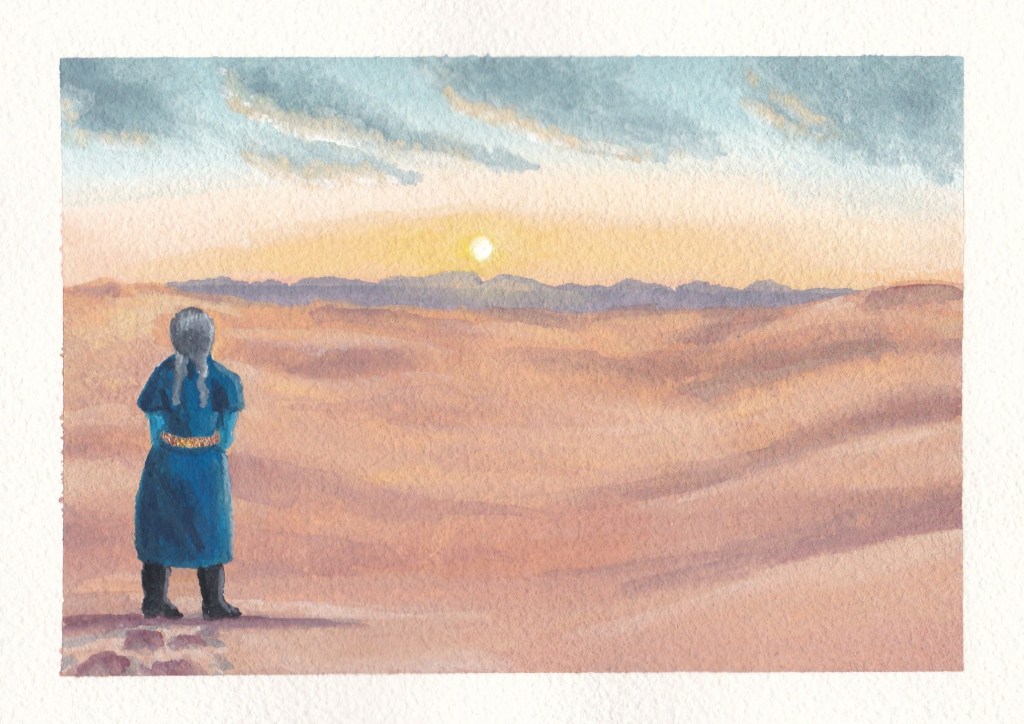
from Asian Desert
Here she has no heart,
Lies not as the earth in other lands
With her limbs apart.Here strongly the sap is outwrung,
Here the memory divine
Of an old woman is mine
So old she was never young.Ah, but see, is she not beautiful?
Hank of stone, wrinkle of rock,
Pared, seared, stark with age?
Is she not tenderer far than what she allures
Man on his pilgrimage?
Such were rail routes that the journey to Tehran took Wellesley and Sackville-West through Moscow, where they visited Lenin’s tomb.
from Lenin
Greedy of detail I saw,
In those two minutes allowed,
The man was not wax, as they said,
But a corpse, for a thumb nail was black,
The thing was Lenin.Then a woman beside me cried
With a strange voice, foreign, loud.
And I, who fear not life nor death, and those who have died
Only a little, was inwardly shaken with fear,
For I stood in the presence of God;
The voice I heard was the voice of all generations
Acclaiming new faiths, horrible, beautiful faiths;
I knew that the woman wailed as women wailed long ago
For Christ was a wax man too,
When they carried him down to the grave.
Jane tells us they stayed at the British Mission in Moscow, and right after that writes, “‘Look here,’ she said to Vita, ‘I believe people are watching us and listening to what we say. I don’t think we ought to talk.’”
Was Wellesley worried that Soviets were listening, or that in the British Mission, artists were watched—Bloomsbury affiliation bestowing protection and drawing suspicion—for communist sympathies? I don’t know. They were very modern.
 The Columbo Game