POETS Day! “The Waste Land” Lees

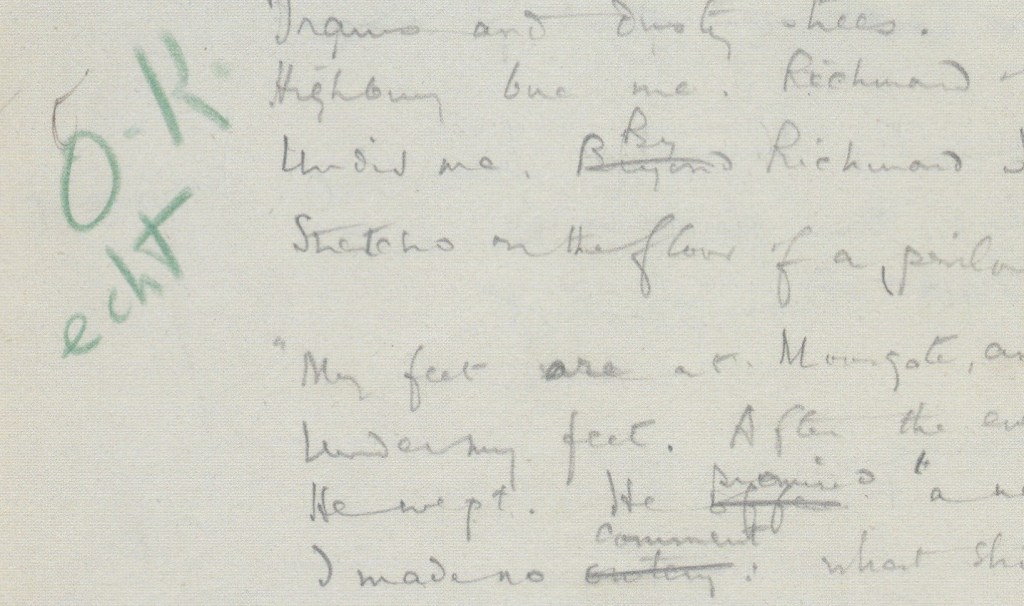
Close up of the original draft of T.S. Eliot’s “The Waste Land” with annotations by Ezra Pound.

[This entry is cross posted at ordinary-times.com]

I went on longer than I’d planned this week, so to the point without preamble: Piss Off Early, Tomorrow’s Saturday. Get out of work. Run and be free. You’ve done your part, slaved the workweek throroughly enough. Escape the office and hit a happy hour, still sunlit park, catch a ball game, or ring up that attractive someone you’ve had a mind towards.

It’s POETS Day. Make the most of it.

But first, a little verse.

***

“I had thought of the Lycidas as a full-grown beauty—as springing up with all its parts absolute—till, in an evil hour, I was shown the original copy of it, together with the other minor poems of the author, in the library of Trinity, kept like some treasure to be proud of. I wish they had thrown them in the Cam, or sent them after the latter Cantos of Spenser, into the Irish Channel. How it staggered me to see the fine things in their ore! interlined corrected! as if their words were mortal, alterable, displaceable at pleasure! as if they might have been otherwise, and just as good! as if inspiration were made up of parts, and these fluctuating, successive, indifferent! I will never go into the workshop of any great artist again.”
– Charles Lamb, “Oxford in the Vacation”, kinda

I say “Kinda” because I’ve got lying eyes. I trust Cleanthe Brooks and Robert Penn Warren more than most. One of them wrote, in their coauthored classic Understanding Poetry, that Lamb wrote the above “in his essay ‘Oxford in the Vacation.’” The other one, no doubt, went over the final copy and approved. I read “Oxford in the Vacation,” and the quote was nowhere to be found. I ctrl F-ed it and tried to find “Lycides” on the page in case somehow a paragraph length distraction caused me to miss it. It wasn’t there.

Brooks or Warren was right, though, with the other also right but in an editorial capacity. I found an Atlantic article by Edmund Gosse in the May, 1900 issue, which the internet happened to have laying about. Gosse writes, “When Lamb came to read over these sentences, he was perhaps struck with their petulance, for they were omitted from the completed Essays of Elia [Lamb’s pen name] in 1823.” The original appeared in The London Magazine October 1820. It’s funny to me that a quotable quote about the mess of editing and rewriting was itself cut on consideration.

Were Lamb born a couple of centuries scant later, he’d wrestle with T.S. Eliot’s The Waste Land. I can’t say what opinion he’d have of the poem, only that he’d have one. The poem has been inescapable for those with poetic interests since its 1922 publication. What would he have made of The Waste Land, Centenary Edition in Full Color: A Facsimile & Transcript of the Original Drafts Including the Annotations of Ezra Pound from Liverwright, the original publisher of the poem in book form?

It’s one thing to read that Ezra Pound excised almost two thirds of Eliot’s manuscript, quite another to see reproductions of beige typewritten pages with pencil notes, slashes, suggestions sometimes themselves slashed and rewritten, and Pound’s querysome marginalia: “Vocative?” and “Vocative??”

Continue reading

POETS Day! Things from William Carlos Williams

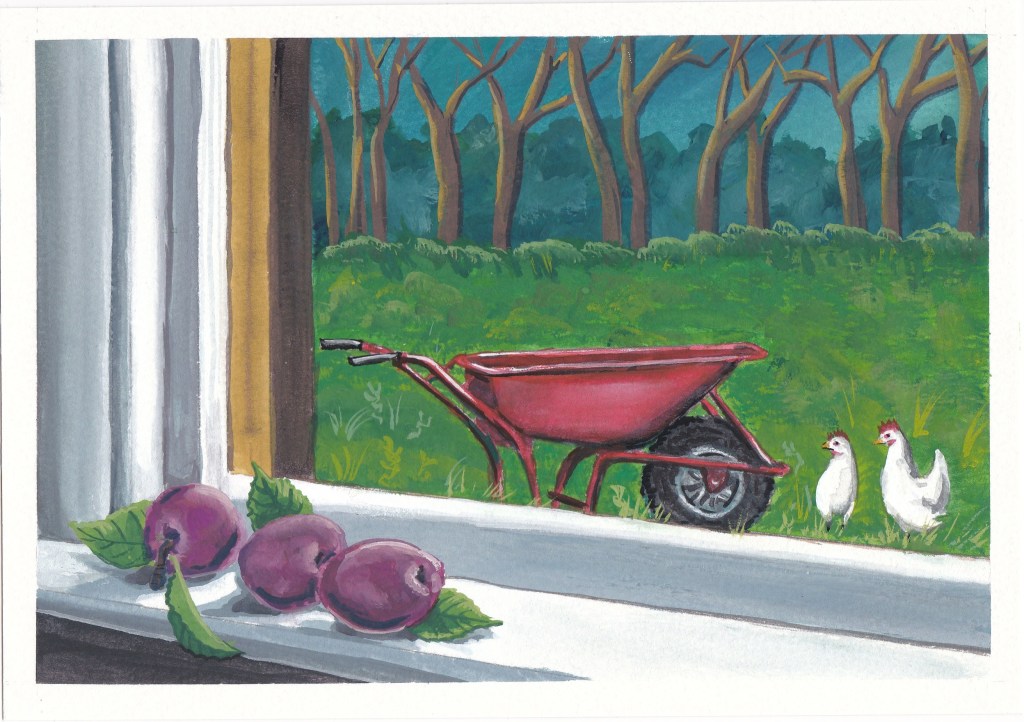
Illustration by Rene Sears

[This entry is cross posted at ordinary-times.com]

People who read a lot mispronounce words. There are a lot more opportunities to read obscurities than to hear them said. Rather than be embarrassed at the mangling, they should be proud at knowing how to use a word they’ve never heard. They’ve expanded beyond the town square. That’s good. But people still get embarrassed.

To help, there are thousands of ten- to fifteen-second YouTube videos titled something along the lines of “How to Say Qatar” or “How to Pronounce Siobhan.” Handy stuff.

The other day I was reading and came across synecdoche, which isn’t tossed around at the lunch counter all that often. I’ve been all over that word for years, throwing stress forward and backward. I finally went to YouTube’s “How to Pronounce Synecdoche” and it made me so happy. You have to go listen.

Piss Off Early, Tomorrow’s Saturday. Don’t waste a Friday afternoon working. Go do that. Put something funny somewhere to catch people unaware. Be an acid free merry prankster. Synecdoche.

First, some verse.

***

Paterson is William Carlos Williams’s great work. He initially planned four books, added a fifth, and died with a sixth in the works. The poem is set in Paterson, New Jersey, with a one-third-dropped Nicene conception of Paterson as man and city, separate and inseparable depending on book or stanza, as the protagonist.

Most towns were not founded by Alexander Hamilton. Paterson comports with the majority, but Hamilton envisioned the city as an industrial center with the falls as its early engine and encouraged its growth into such. Hamilton got D.C. designer Peter L’Enfant involved and though there was some disagreement causing L’Enfant’s departure, his plan to harness the river’s power was implemented. Immigrants followed, more so than to most of the rest of the country: Germans, a bunch of English, Scots, and many, many Irish.

The Passaic River flows through the town, in whose midst lies Paterson Great Falls State Park, green for a block or so spreading from each bank. The Passaic Falls strikes just east of where Wayne Avenue and Maple Street intersect, if Google Maps is true. Assuming I’ve read properly, the settlement began below the falls and spread south, east, and west before eventually engulfing the wilderness to the north. Williams presents a beautiful image of water drawn from disparate sources in that wilderness, mixing violently, but running towards something common. Past eddies, shore lapping, with impediment rocks washed away long ago, right before the falls every drop is of a singular energy.

Continue reading

POETS Day! Richard Aldington

Illustration by Rene Sears

[This entry is cross posted at ordinary-times.com]

It’s POETS Day.

Do what you must. Lie to your boss. Fake a cough at school. Invite Jamaal Bowman to do his thing. Nothing productive gets done on a Friday after lunch anyway.

Piss Off Early, Tomorrow’s Saturday.

But first, take time for a little verse.

***

“As for ‘free verse’, I expressed my view twenty-five years ago by saying that no verse is free for the man who wants to do a good job. No one has better cause to know than I, that a great deal of bad prose has been written under the name of free verse; though whether its authors wrote bad prose or bad verse, or bad verse in one style or in another, seems to me a matter of indifference. But only a bad poet could welcome free verse as a liberation from form. It was a revolt against dead form, and a preparation for new form or for the renewal of the old; it was an insistence upon the inner unity which is unique to every poem, against the outer unity which is typical. The poem comes before form, in the sense that a form grows out of the attempt of somebody to say something; just as a system of prosody is only a formulation of the identities in the rhythms of a succession of poets influenced by each other.”
                             – T.S. Eliot “The Music of Poetry”

I very much enjoyed Paul Johnson’s book, The Quest for God: A Personal Pilgrimage. I took a great deal from it but one of the things I most remember coming away with was an admiration for his practical appreciation of Catholicism.

He was very fond of the age and history of the Church, the scholarship and arguments – even those about angels and pin heads, which is a punch line though it shouldn’t be – of two thousand years. He felt a weight lifted. There may be facets and tenets that made no sense or seemed at odds to him, but he could put doubts aside and rest easy, secure in the knowledge that wiser and more learned heads than his had considered, deliberated, and concluded. He found faith.

Continue reading

POETS Day! Thoughts on Part IV of TS Eliot’s “Burnt Norton”

Sunflower in Bavaria, November 2020 – Kritzolina

[This entry is cross posted at ordinary-times.com]

Welcome once again to POETS Day, that wonderous day where we do our best to usher in Henry Ford’s greatest creation – the weekend – a few hours ahead of schedule by embracing the ethos of the day: Piss Off Early, Tomorrow’s Saturday.

Life’s too short for work, and nobody’s gonna notice if you hoof it mid-afternoon.

***

T.S. Eliot will with good reason be best known for The Waste Land, but it’s not uncommon to come across writings that hold up Four Quartets, considered as a whole, as the better work. The former was epochal. There is poetry before The Waste Land and poetry after, the full scope and impact being the subject of numerous heavy books. The Waste Land had the advantage of making a larger splash, not having been presaged by The Waste Land as Four Quartets was. I gladly claim agnosticism; “They can both be great,” and such. Being above the fray hides all manner of deficiencies in judgement.

“Burnt Norton” was the first of the Four Quartets, published in 1936 as part of Eliot’s Collected Poems 1909–1935. In the course of production or during the run up to his play, Murder In the Cathedral, a number of lines were discarded on advice of his director, E. Martin Browne. Eliot held Browne in some esteem – the two would continue to collaborate over the following two decades – and so deferred as to what was appropriate for the stage but he held on to the lines. He hated waste. James Matthew Wilson tells us in an informative video about “Burnt Norton” (one of four in a series on Four Quartets to which I’ll be referring to in this post – well worth your viewing time) that he was slow to write, or if not slow, frustratingly contemplative. “Constipated,” Eliot would say. It wasn’t his desire to waste what was painstakingly crafted, so a priest’s struck dialogue from Murder in the Cathedral begins his poem. In the gardens of Burnt Norton, a manor house Eliot once visited with Emily Hale, he says to her,

Time present and time past
Are both perhaps present in time future,
And time future contained in time past.

“Burnt Norton” is in five parts, as was The Waste Land and later the remaining of the Four Quartets. Eliot wrote extensively on Elizabethan drama and its five act structure is certainly being mirrored, but Wilson points out that Eliot was a devout man and this is a religious work so we see in the five parts the structure of mystical prayer. Here I’m paraphrasing, but first setting, then discovery or imagination of setting followed by a contemplation or inward turn. Fourth is a purgation, some sort of repentance or prayer of hope. Finally, we have a reconciliation.

Continue reading

POETS Day! Andrew Marvell

Spudgun67, CC BY-SA 4.0 , via Wikimedia Commons

[This entry is cross posted at ordinary-times.com]

Remember when you were a kid and every other kid in the neighborhood got a pony and you didn’t even know you wanted a pony but suddenly you had to have one? Everybody’s playing with ChatGPT. How did I make it all these years without a clockwork house elf serving uncanny valley made-to-order imitations of Metallica songs for my amusement? I asked it to do the Piss Off Early, Tomorrow’s Saturday introductory paragraph for me this week. Courtesy of our soon to be overlord:

Write an intro paragraph like ordinary-times POETS Day.

Ah, finally it’s that time of the week again! It’s POETS Day, my friends! For those of you who may not know, POETS stands for “Push Off Early, Tomorrow’s Saturday.” It’s the day when the office clock seems to slow down to a crawl and everyone is counting down the minutes until they can head out and enjoy the weekend. Whether you’re planning on hitting the town or just relaxing at home, there’s no denying the excitement that comes with the start of the weekend. So, let’s wrap up those last few tasks and get ready to let our hair down – after all, it’s POETS Day!

Write an intro haiku like ordinary-times.com POETS Day.

POETS Day arrives,
A break from the daily grind,
Weekend, unbound joy.

Continue reading