

POETS Day! Sir Philip Sidney Didn’t Get the Girl

Illustration by Rene Sears

[This entry is cross posted at ordinary-times.com]

Welcome once again to POETS Day, where we usher in Henry Ford’s greatest creation – the weekend – a few hours ahead of schedule by embracing the ethos of the day: Piss Off Early, Tomorrow’s Saturday.

Life’s too short for work, and nobody’s gonna notice if you hoof it mid-afternoon.

***

In a 1579 letter from Edmund Spenser to Gabriel Harvey, Spenser brings up an organization he’d been invited to join by “Master Sidney and Master Dyer.” The Masters were Sir Philip Sidney and Edward Dyer, a pair of Elizabethan courtiers who acted as agents and soldiers abroad for Her Majesty. Sidney, at least, would be shocked that he’s remembered as a poet rather than envoy or governor. The organization was called The Areopagus, and it’s fairer to call it the proposed organization as it’s not known whether it ever made it past planning. No meetings are recorded.

Sydney may have been inspired in conceiving his literary club by the Wilton Circle, a literary circle of which Spenser is confirmed to have been a member, founded and led by Philip’s sister Mary Sydney and run by Sir Walter Ralegh’s half brother (possibly Humphrey Gilbert, though I haven’t found a site willing to lift whomever out of Ralegh’s shadow with more than “half-brother.”) The Wilton Circle is described by the Shakespearean Authorship Trust as “the most important and influential literary circle in English history.” The Authorship Trust’s mission, depending on your disposition, is “just asking questions” regarding the authorship of plays ascribed to William Shakespeare, or they’re a bunch of conspiracy nuts on a snipe hunt. It’s also possible that Mary’s Wilton Circle postdated Sydney’s idea for the Areopagus. I can’t find minutes.

Continue reading
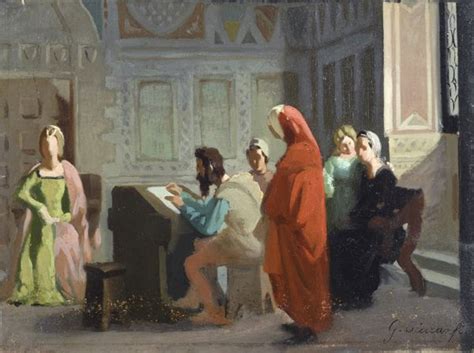

POETS Day! Some Sonnets with 14 Lines

Petrarch observing Simone Martini while painting a portrait of Laura – Giuseppe Ciaranfi (1818-1902)

[This entry is cross posted at ordinary-times.com]

“Piss Off Early, Tomorrow’s Saturday” as usual and enjoy the weekend, but I got caught this week and ran short of time. This week’s is gonna be a quick one.

I was looking to do something on George Meredith’s sonnet series called Modern Love. He’s known for his novels. At least he was. I think The Egoist is the only one many would recognize these days, and I’ll wager few have read it. Modern Love is the story of a marriage as it falls apart told over the course of fifty sixteen-line sonnets. The story is engrossing as only the best soap opera like guilty pleasures no one admits to can be. I very much want to do a post on it in the future, but I got caught up by the idea of a sixteen-line sonnet. Can you do that?

I was of the impression that the sonnet was a set form. It’s usually a thought posited in an octave with a volta, or turn, taken in a sestet that may or may not resolve the thought. It doesn’t have to be laid out with a break that way. You can set stanzas in various ways or leave it all as one beautiful verse lump. There are plenty of rhyme schemes to choose from. The one thing I’d never seen as anything but a constant is that a sonnet has fourteen lines. When defining the form, length is the characteristic that first pops to mind. I’d be surprised if I’m alone in that.

Continue reading

Unprovoked Rant

I’m reading A Survey of Modernist Poetry by Laura Riding and Robert Graves. This struck me:

“Yet the sonnet theory can be provoked in Shakespeare’s sonnets as all pre-Shakespearian dramatic theories can be provoked in his plays.”

The sentence is in service of the authors view that it’s not enough to present as evidence of experimentation an excellent poem as excellent poems may have in them borrowings as well as innovations. I very much liked the use of “provoked.”

Continue reading