Officially, the work week’s nearly done; barely a few hours. What are you doing? You’re not getting anything done between now and then. Cut it out and stop pretending. Piss Off Early, Tomorrow’s Saturday.
First, a little verse.
***
My favorite librarian passed away. I didn’t seen him the last few times I was in, but I never divined his comings and goings well enough to know his days off. Poor health caught up to him. I don’t know what to say other than I’ll miss chatting with him. A few falls ago, I mentioned a Muriel Spark book I picked up. He recommended a few of hers he liked. They were the odd ones people didn’t talk about that often. His co-workers put up a memorial photo of him over a shelf filled with his recommendations. There’s a stack of printed sheets listing his “LOST Classics of the 20th Century,” for the interested, in the spirit of his Sparks recommendations: lesser-known books picked from respected but not bankable authors, for the most part. It’s an idiosyncratic list. That fits. Godspeed.
Last September, he and I were talking about the poets to come out of Vanderbilt University in the years surrounding World War II. He mentioned James Dickey. I knew Dickey was Poet Laureate back when they still called the office holder Consultant in Poetry to the Library of Congress, but I didn’t know much more beyond. We had to read Deliverance in 9th grade and as 9th graders, we watched the movie in addition and made 9th grade “Squeeeel like a pig!” jokes, but ignorance beyond that.
Officially, the work week’s gonna be over in a few hours. What are you doing? You’re not getting anything done between now and then. Cut it out and stop pretending. Piss Off Early, Tomorrow’s Saturday.
First, a little verse.
***
John Millington Synge is gross. Not really. At least not as far as I know. I was reading The Oxford Book of Modern Verse and got caught without a bookmark. J.M. Synge starts on page 144, so that was my little mnemonic: “John Millington Synge is gross.”
Synge was a great Irish playwright who wrote poetry, but very little of it. At least, he published very little of it. As best I can tell his sole collection is Poems and Translations. It contains twenty-two original poems, all short and mostly light and amusing. In addition are translations of poems by Petrarch and Villon, but they’re prose translations of the original author’s verse. I don’t find those terribly interesting.
The twenty-two seem more from a man who wanted to play with an amusing thought that channel a muse. Yeats was fastidious after perfection. Heaney feared frogs. Gogarty swashbuckled. Irish poets have great origin stories. Synge was wickedly clever and insightful, but I don’t get the sense he envisioned himself as a poetic force. That’s not to say he didn’t think big thoughts on the subject. There was a conservator about him.
The work week is gonna be over now, or it’s gonna be over in a few hours. What are you doing? You’re not getting anything done. Cut it out and stop pretending. Piss Off Early, Tomorrow’s Saturday.
First, a little verse.
***
I’m re-reading David Foster Wallace’s essay, “E Unibus Pluram.” If you aren’t familiar, he discusses the impact of television on his generation of fiction writers, as well as those subsequent. He makes the case that we’ve been roped into an irony trap – too post-modern for our own good – and served a side of warped empathy to boot.
The idea that we’re shaped by consumed drama has nagged at me. Frankly, I feel bludgeoned by it. The saddest scene I’ve seen on video is one lost to channel surfing. It was one of those true crime investigative documentary series. I can’t find or recall the name of the show where I saw the original, but plenty of similar scenes exist. A young woman’s mother was murdered. She’s giving her victim’s impact statement before a judge as part of the pre-sentencing procedure. This should be unprecedented in someone’s life. There should be no proper way of doing things. There should be no blueprint. But she has one.
The work week is gonna be over now, or it’s gonna be over in a few hours. What are you doing? You’re not getting anything done. Cut it out and stop pretending. Piss Off Early, Tomorrow’s Saturday.
First, a little verse.
***
Carl Sandburg was posthumously honored with a postage stamp bearing a sketch of the poet done by his friend William A. Smith and the poet’s “distinctive autograph.” The “distinctive autograph” language comes from Wikipedia which appears to have gotten it from the world stamp authority, Scott Catalogue. Who doesn’t have a distinctive autograph? Signatures are supposed to be distinctive.
Before this week, I didn’t know much about Sandburg beyond a handful of poems I really liked and a handful I really didn’t. I knew he was a major figure in American letters, but didn’t realize the scope. In short, I was aware of his poetry and impact on that discipline, vaguely aware that he’d written Lincoln biographies, and think I’d heard somewhere that he helped preserve and widen the audience for American folk music. I didn’t realize how beloved he was in his time. Rather, I didn’t realize how large a figure he was in his time, because for all that he was beloved, he was scorned too.
I hope you get a gift so awesome it makes you feel like that time when you were a kid and Santa brought the big red shiny bike/doll house/basball mitt you always wanted. And I hope you have such a good time with friends and family that you forget all about whatever gift made you feel like that time you got the big red shiny bike/doll house/baseball mitt. And then the next day you get lost in a Christmas book and eat leftovers before a football nap.
It’s the best time of year. Cheers, and God bless.
***
I am the oldest of twenty-one cousins just on my mother’s side, so I get my fair share of Christmas cards. Shutterfly, Zazzle, and Adobe, to pull a few from a very long list, make it extraordinarily easy to send family portraits, family travelogue pictorial collages, and a funny one with room for the pets on the back of a decently weighted card stock. My grandfather was a dentist, and there’s something of his preventative ethic still in his great-grandchildren, aligned by height or posed in a teardrop around my cousins and their spouses, pearly whites beaming. We’re old enough that some of the great-grand-level kids tower over cousins I still consider babies. Add the same from my wife’s side, and there are enough wide-shouldered teen giants in the mix to put together a formidable 3-4 defense.
It is rainy and depressing and awful here for those who like to go outside or look out windows. Has been for a week. It’s cold, too. I’m frustrated with my senses. I don’t know how cold. If I practice, say listening to music in a formal teaching setting, I suspect I’d know a C from an A from a C flat soon enough. I’ve been on this Earth for decades and still have to check a thermostat to see how cold it is. I know it’s cold, but if I say it’s in the forties it may well be in the fifties. What a weak and imprecise sensory apparatus we wear. Defective.
I don’t know what the weather is like where you are, either. But if it’s nice out, go enjoy it. Piss Off Early, Tomorrow’s Saturday. Friday afternoons are fun if you’re free.
First. A little verse.
***
“But first, a historical fragment, a digression: early in the century, Pound, poet of unsurpassable ear, declared war on the iamb. What followed, and indeed surrounded this act, was a period of enormous and profound linguistic discovery, not all of it directly related to Pound’s imperative, but all of it in some manner a shucking of constraints, all confident authority and easy bravura, as though the past were being dared to stop this inspired future. And certain of the tastes of the present moment can be traced to what we now call the Moderns, with that ominous upper case, principally our bias toward the incomplete, a taste that seems to treat the grammatical sentence as Pound treated the iamb: a soporific, a constriction, dangerously automatic and therefore unexamined.”
– Louise Glück, “Ersatz Thought,” American Originality: Essays on Poetry
I’m not a huge fan of Louise Glück’s poetry. If she were alive, I doubt she’d care one whit. People who give out the Pulitzer, the Bollinger, the Nobel, and name US Poet Laureates have already come down on her side of the taste equation. I should add that on this site I’ve held her up as a prominent practitioner of dreaded poets voice and managed not to detail any dreams resulting from Glück reading-induced narcolepsy.
That aside, I genuinely respect the woman as a poet and theorist. Her essays are brilliant, ranging things. She treats bits of process laity realizes as essential when brought up, hovered on the edge of should-have-know before. I went to the library wanting theories on American poetry: what defines it, what the rebels and revolutionaries like Whitman, Dickinson, Pound, Eliot, and Stevens were rebelling against. I have my own thoughts, but I wanted confirmations and challenges. My favorite librarian was off, but a new and yet unranked librarian suggested the above American Originality, by Glück. Strong debut for the new librarian.
I went on longer than I’d planned this week, so to the point without preamble: Piss Off Early, Tomorrow’s Saturday. Get out of work. Run and be free. You’ve done your part, slaved the workweek throroughly enough. Escape the office and hit a happy hour, still sunlit park, catch a ball game, or ring up that attractive someone you’ve had a mind towards.
It’s POETS Day. Make the most of it.
But first, a little verse.
***
“I had thought of the Lycidas as a full-grown beauty—as springing up with all its parts absolute—till, in an evil hour, I was shown the original copy of it, together with the other minor poems of the author, in the library of Trinity, kept like some treasure to be proud of. I wish they had thrown them in the Cam, or sent them after the latter Cantos of Spenser, into the Irish Channel. How it staggered me to see the fine things in their ore! interlined corrected! as if their words were mortal, alterable, displaceable at pleasure! as if they might have been otherwise, and just as good! as if inspiration were made up of parts, and these fluctuating, successive, indifferent! I will never go into the workshop of any great artist again.” – Charles Lamb, “Oxford in the Vacation”, kinda
I say “Kinda” because I’ve got lying eyes. I trust Cleanthe Brooks and Robert Penn Warren more than most. One of them wrote, in their coauthored classic Understanding Poetry, that Lamb wrote the above “in his essay ‘Oxford in the Vacation.’” The other one, no doubt, went over the final copy and approved. I read “Oxford in the Vacation,” and the quote was nowhere to be found. I ctrl F-ed it and tried to find “Lycides” on the page in case somehow a paragraph length distraction caused me to miss it. It wasn’t there.
Brooks or Warren was right, though, with the other also right but in an editorial capacity. I found an Atlantic article by Edmund Gosse in the May, 1900 issue, which the internet happened to have laying about. Gosse writes, “When Lamb came to read over these sentences, he was perhaps struck with their petulance, for they were omitted from the completed Essays of Elia [Lamb’s pen name] in 1823.” The original appeared in The London Magazine October 1820. It’s funny to me that a quotable quote about the mess of editing and rewriting was itself cut on consideration.
Were Lamb born a couple of centuries scant later, he’d wrestle with T.S. Eliot’s The Waste Land. I can’t say what opinion he’d have of the poem, only that he’d have one. The poem has been inescapable for those with poetic interests since its 1922 publication. What would he have made of The Waste Land, Centenary Edition in Full Color: A Facsimile & Transcript of the Original Drafts Including the Annotations of Ezra Pound from Liverwright, the original publisher of the poem in book form?
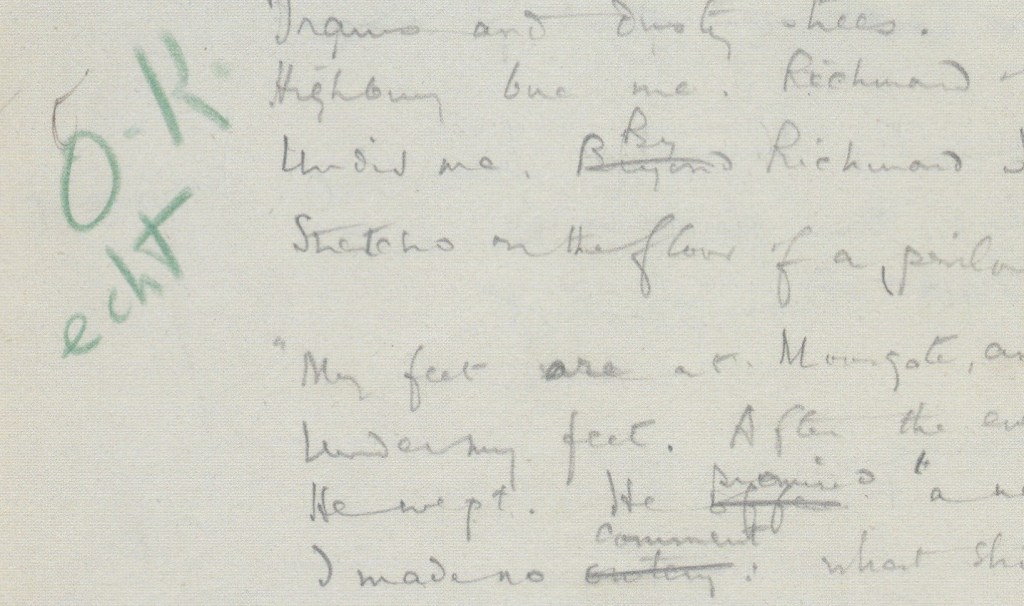
It’s one thing to read that Ezra Pound excised almost two thirds of Eliot’s manuscript, quite another to see reproductions of beige typewritten pages with pencil notes, slashes, suggestions sometimes themselves slashed and rewritten, and Pound’s querysome marginalia: “Vocative?” and “Vocative??”
My favorite librarian is missing. He’s been gone ever since I asked about a collection of James Dickey poetry. We couldn’t find it in the Jefferson County system or through inter-library loan systems with universities and other institutions (I have no idea what other institutions participate in library loan systems, but I’m told there are others). He said he owned a copy of the book personally and would let me borrow his copy. I haven’t seen him since.
Did he violate a librarian code? Do they have non-competes? Did they take him away for re-education? Are there really investigators like Mr. Bookman from that Seinfeld episode? It’s like he’s been shushed out of existence.
It’s POETS Day, so Piss Off Early, Tomorrow’s Saturday. Ditch work. There’s an afternoon of fun to be had, but first take a look and make sure any library books you’ve checked out aren’t late. Be safe.
***
There’s a very good article called “Ovid in exile” in last month’s New Criterion. Ovid’s out at Columbia University. I had a stumble when I came across the embedded quote by Lisa Libes, described as a “veteran of Literature Humanities” by article author David Lehman: “Ovid was sent on a three-year furlough, returning to the syllabus briefly in 2018 before being nixed entirely.” I stumbled wondering why a 2018 controversy, settled with seeming finality in 2021, showed up as consideration meat in the October 2025 issue, but the editors published it under the “Reflections” heading and Lehman, aside from being a poet and critic is the founder and series editor of The Best American Poetry anthologies, so he can bring up what he wants when he wants and we’re all the better for it.
Per Lehman, “In plain English, the students singled out the Metamorphoses because of the Greek and Roman god’s habit of coming to earth, pursuing mortal nymphs, and raping them.” He then lists the rapes of Perserpine by Pluto, Europa by Jupiter, Philomena by Terseus, and Apollo’s attempt at Daphne.
Mississippi is where I pass on the right. Folks come from all round to make me pass them on the right in Mississippi. I saw tags from New York, and I passed them on the right in Mississippi. I saw tags from North Carolina driving 70 mph, and I passed them on the right in Mississippi. Someone driving in car with tags from neighboring Arkansas, seeing me pass him on the right in Mississippi, so loved being passed on the right in Mississippi that he let a whole train of fellow travelers dart past a slow truck in the right lane and pull up behind him before changing lanes to pass him on the right in Mississippi and then change lanes back again to pass a pick-up towing an empty trailer in the right lane some medium distance ahead. We all snaked.
I will never understand Mississippi. I read a Joan Didion novel in Louisiana. It was very good.
It’s POETS Day so Piss Off Early, Tomorrow’s Saturday. Get out of work mid afternoon. Live life in the fast lane (but actually drive fast.)
First, a little verse.
***
Edwin Muir published the piece of literary criticism, Scott and Scotland, in 1938. In it he argues if Scotland is to have a national literature, they must do away with far and wide dialects and decide on a common language.
“If Shakespeare had written in the dialect of Warwickshire, Spenser in Cockney, Ralegh in the broad Western English speech which he used, the future of English literature must have been very different, for it would have lacked a common language where all the thoughts and feelings of the English people could come together, add lustre to one another, and serve as a standard for one another.”
Glasgow sneered incomprehensibly, Edinburgh twanged nasally, and Aberdeen wore fuzzy boots.* The one language common to them all through radio, newspaper, and all the missives of empire, was English. He put it that Scots survived in nursery rhymes and “anonymous folk-song.” The old language as men lived in his time “expresses therefore only a fragment of the Scottish mind.” He made the case that the Scots, who already spoke English, needed to proceed in English in their literature. This made him very unpopular with Hugh MacDiarmid (M’Diarmid), whose “Lallan” movement, “Lallan” being a Scots pronunciation of “Lowlands,” was beating the curtains for kilts and cursing. Muir had no patience for nationalism.
In the Victorian Era, the Brits were very competent. They had dispatches and requisitioning to attend along with all the other mechanism of empire, but suddenly they had real mechanisms in unseen number as the Industrial Revolution gained… sorry… steam. To maintain competence, a person of import suddenly had to be conversant on things that in simpler recent times were shut up in clocks or behind organ cabinetry. Now they were bigger and populating sooty factories. Sprockets and springs, cogs and belts. A piston required precision casting in a way a pitchfork didn’t. Everything had to be just so.
The age was infected through and through with exactitude so it should be no surprise that women who, pace the Queen, were left out of warring, administrating, and engineering picked up the persnickety habits of their eminently measured husbands/brothers/fathers/Darcys/Wickhams. The societal mood infected society ladies. As a result, the laying of a 5.08 x 8.89 cm calling card, a Regency convenience supercharged and transformed by the fast paced 1800s, conveyed affronts, condolences, respect, disdain, attraction, or congratulations depending on how, when, and by whom it is delivered. The result was a great deal of foot traffic, gossip, and stationer’s children attending better schools than they once had.
Initially the secret Atreides battle language of an elite few, the coded missives transmitted by font, weight, and fold were revealed to a status hungry public by newspaper articles and pamphlets funded by Big Stationery. It’s antiquated nonsense now, but arcana makes for fun cocktail party chat. If deployed at the right moment to the right audience, demonstration of obscure knowledge can be devastatingly effective.
Take your business card and bend the bottom right corner inward and leave it on your boss’s desk. This signals that you, named on the card, are leaving for a trip and so the recipient, your boss, is relieved from the duty of a reciprocal call. And then leave.
You might get fired. Not everyone is up on Victorian etiquette or thinks such things cutesy, but that’s not what’s important. It’s Friday afternoon. Piss Off Early, Tomorrow’s Saturday. Enjoy the weekend.
First, a little verse.
***
I found E.B. White on the poetry shelves at my local library.* That he wrote poetry was something I didn’t know that I didn’t know, to borrow a phrase from Robert Gates. It surprised me.
Like I assume is the case with most, I know White primarily as an author of ubiquitous children’s books and have repeatedly said “Oh. I forgot that was the same guy,” when reminded that he was also the White of “Strunk & White,” the two last names a handy eponym for the famous guide written by William Strunk and later revised and expanded by White, The Elements of Style.






 The Columbo Game