POETS Day! A Few Poems by Kingsley Amis as Pretense to Discuss One of His Novels

Illustration by Rene Sears

[This entry is cross posted at ordinary-times.com]

I don’t like poinsettias and take comfort in the fact that they usually do the honorable thing and die shortly after Christmas time. They’re fine in season I suppose, but so are ugly sweaters and bells on adult shoes.

They’re poisonous flowers, I think. I read that people who don’t like cats but somehow ended up with one buy poinsettias intending to plead ignorance later and get on with their lives. Ours is still in the kitchen thriving in its pot so I daydream about adopting some sort of reverse cat that’s poisonous to poinsettias.

I’m supposed to be encouraging you to take a POETS Day, but I’m distracted by this velveteen-flop looking plant with one petal beginning to wilt and a couple of dozen more that won’t follow its example. I’m distracted like you might be on a Friday afternoon, so preoccupied with weekend thoughts that you can’t get any poinsettia work done, sitting performatively, wasting your time. You should Piss Off Early, Tomorrow’s Saturday.

Read a poem first.

***

I’ve written about Kingsley Amis in this space numerous times (see here, here, here, and here). I’m an unabashed fan so an unapologetic writer though I don’t claim any “Best” titles for him. There are better novelists, better poets, better editors, and your average park bench made for a better husband. He simply seems to be the writer I like most most of the time.

Continue reading →

POETS Day! Poems Found While Reading an Essay by Anthony Hecht

Illustrated by Rene Sears

[This entry is cross posted at ordinary-times.com]

There’s a constant drip to my life now. A background sound would imply direction. This isn’t that. This ubiquitous drip, this relentless hydro-metronome, reverberates from the porcelain of the bathroom behind me, the steel of the kitchen I’m in, and somehow through two bedroom doors from the other bathroom. It is of the house.

In 2010, a cold snap came. We were newly minted homeowners, landed for only a week at the time. The inspection report showed an open heating duct in the crawlspace so I donned my fiscal responsibility hat and had the duct capped immediately on moving in. The pipes froze a few days later and one burst a day or two after that. Chesterton’s fence was under my house.

In Wisconsin and other Big10 locales, pipes are insulated or designed to expand somehow. I’ve read about systems where conductive wires are wrapped around water pipes to provide warmth when switched on. This is all Star Trek stuff to Alabamians. Nobody has that here so we drip our faucets.

It hasn’t been above freezing for three days now. The drip haunts me. Mocks me. Its maddening report more assault than assurance. But what if it stops?

Take a POETS Day. Piss Off Early, Tomorrow’s Saturday. Nothing gets done at work on a Friday afternoon anyway, so go do fun stuff. Or if you live in Alabama, go home and listen. Listen and fear.

Drip. Drip. Dri…

***

I have a copy of Anthony Hecht’s Melodies Unheard: Essays on the Mysteries of Poetry I keep on hand when I’m in the mood. It sits in a stack with Broken Ground: Poetry and the Demon of History by William Logan, the collection of T.S. Eliot essays, Poetry and Poets, and a few like. Sometimes I think I enjoy reading about poetry, criticism and commentary, more than I like reading actual poetry. That might not be odd, but I think it is, and it warms my vanity as personal idiosyncrasies will.

Continue reading →

POETS Day! Stephen Crane

Illustration by Rene Sears

[This entry is cross posted at ordinary-times.com]

It’s the last POETS Day under the Biden Administration. Put an early Friday lid on it and Piss Off Early, Tomorrow’s Saturday.

Hit the beach and take a nap, ride a precarious bike, have some ice cream and meet the people. That hair ain’t gonna smell itself, Jack. Whatever you do, don’t waste the day working. It’s practically the weekend.

Literally take a minute for a little verse first.

***

In 1897, Stephen Crane was on a ship that sank. Subsequently, he spent thirty or so hours in a lifeboat with the ship’s captain and two crewmen. After getting safely back to New York, he wrote a short story called “The Open Boat” about the adventure. It’s harrowing.

“A singular disadvantage of the sea lies in the fact that after successfully surmounting one wave you discover that there is another behind it just as important and just as nervously anxious to do something effective in the way of swamping boats… As each slaty wall of water approached, it shut all else from the view of the men in the boat, and it was not difficult to imagine that this particular wave was the final outburst of the ocean, the last effort of the grim water.”

He does a good job putting you in the boat – putting anxiety in you – surrounded and claustrophobic in the troughs and hoping while knowing better you’d glimpse salvation somewhere on the horizon from the crests. Eventually the lifeboat flipped and they swam for it. Three made it to shore, Daytona Beach, sixty-two years before it was a NASCAR draw.

Continue reading →

POETS Day! Skipwith Cannéll’s “Nocturnes”

Illustration by Rene Sears

[This entry is cross posted at ordinary-times.com]

Birmingham may have gone out over its skis and declared a POETS Day pre-emptively. We don’t have snowplows, our shovels are sewing scissor-esque in that they’re solely for burying kin, and nobody can find the other glove. An inch of snow will paralyze us. The schools shut down and no one can get to work except liquor store owners who’ll do three Christmases and a mid-week Valantine’s Day worth of business in twelve hours. There’s a prediction of one to two inches by tomorrow morning.

I got the closing notice for my youngest’s school yesterday. My eldest’s sent an email this morning (I’m writing this on Thursday night) with an ominous pair of sentences about on-line assignments to follow (Mwu-hah-hah!). I can’t blame them for being overly cautious after the flash blizzard (three inches) of 2012 left teachers and students (not mine) stranded overnight. Rare snows put us in a bind, but I’ve been at home through more dire warnings that didn’t pan out as expected than I can count, leaving a city of day drinking dog walkers.

Nobody in my neck of the woods needs a POETS Day plan. We can’t Piss Off Early even though Tomorrow’s Saturday, because we’ll already be home. Good luck to the rest of you and your Northern ways. Fake a cough, maybe?

Whatever you gotta do, get out and have fun. But take time for a little verse first.

***

I’m pretty sure we all had the same initial thought, but this week’s featured poem was published in 1914 and the World War I biplane made by Sopwith and named the Camel due to an aerodynamic hump over the guns in the original design, wasn’t introduced until 1917. The similarity had no effect on Cannéll’s poetry; no resentment at being teased or bravado from a name evoking brief air superiority for a three year period before rapid development of technology tempered by the pressures of war led to predictable obsolescence.

Continue reading →

POETS Day! John Clare

Linocut by Rene Sears

[This entry is cross posted at ordinary-times.com]

You may have to shop. If you get too much from Amazon, they know. The thought actually counts and a bit of wear on your shoe leather should be on display.

It’s like wrapping. A perfect bow with the curly ribbons you get from running a scissor along the length real quick like you’re pull starting a chainsaw is wonderful to look at, but if you’re a twenty year old college guy with stylishly unkempt hair and smell like cherry vape, everyone knows you didn’t wrap that gift yourself. Small tears on the corners and a piece of masking tape, because the scotch tape ran out, lets grandma know you care.

That doesn’t mean shopping should impinge on regularly scheduled loafing time. Take a POETS Day. Piss Off Early, Tomorrow’s Saturday. Skip out of a useless lame duck Friday afternoon. Shopping isn’t fun, but getting out of work always is.

Before you do, take a minute for some verse.

***

“Many reviewers greeted John Clare with enthusiasm, hoping for a noble savage, an uncomplicated mind, freed from the artificial systems inculcated by formal education. Such fanciful suggestions of his isolation from the world of books have proved remarkably persistent. His eagerness to see his work in print has too often been forgotten in the various dubious attempts to portray him as innocent of the vicious preoccupations of the publishing trade.” – Paul Chirico

Several things had happened. In 1800, Robert Bloomfield erupted from seemingly nowhere selling a quick twenty-five thousand copies of The Farmer’s Boy; a labor class (labour in la lingua anglaise) kid whose little formal education but increased talent folded into a public taste bent towards Wordsworth and his Romanticism. The idea that poetry sprung from nature, pure and unadulterated by aristocratic letters was heady stuff in the early 1800s. The even larger eruption of George Gordon, Lord Byron on the scene in 1819, showed a public thirsty for, and kindled the concept of, stardom.

Continue reading →

POETS Day! Richard Aldington

Illustration by Rene Sears

[This entry is cross posted at ordinary-times.com]

It’s POETS Day.

Do what you must. Lie to your boss. Fake a cough at school. Invite Jamaal Bowman to do his thing. Nothing productive gets done on a Friday after lunch anyway.

Piss Off Early, Tomorrow’s Saturday.

But first, take time for a little verse.

***

“As for ‘free verse’, I expressed my view twenty-five years ago by saying that no verse is free for the man who wants to do a good job. No one has better cause to know than I, that a great deal of bad prose has been written under the name of free verse; though whether its authors wrote bad prose or bad verse, or bad verse in one style or in another, seems to me a matter of indifference. But only a bad poet could welcome free verse as a liberation from form. It was a revolt against dead form, and a preparation for new form or for the renewal of the old; it was an insistence upon the inner unity which is unique to every poem, against the outer unity which is typical. The poem comes before form, in the sense that a form grows out of the attempt of somebody to say something; just as a system of prosody is only a formulation of the identities in the rhythms of a succession of poets influenced by each other.”
                             – T.S. Eliot “The Music of Poetry”

I very much enjoyed Paul Johnson’s book, The Quest for God: A Personal Pilgrimage. I took a great deal from it but one of the things I most remember coming away with was an admiration for his practical appreciation of Catholicism.

He was very fond of the age and history of the Church, the scholarship and arguments – even those about angels and pin heads, which is a punch line though it shouldn’t be – of two thousand years. He felt a weight lifted. There may be facets and tenets that made no sense or seemed at odds to him, but he could put doubts aside and rest easy, secure in the knowledge that wiser and more learned heads than his had considered, deliberated, and concluded. He found faith.

Continue reading →

POETS Day! Mirrors and Robert Louis Stevenson

Illustration by Rene Sears

[This entry is cross posted at ordinary-times.com]

I have a $50 Australian coin. It’s a 1/20 oz. gold coin from 2002. I’ve found its twin on eBay and a few other sites selling for around $210 US. It was in a desk drawer and I have no idea how it got there or what it was doing previously. Boom. Here’s a weird coin to look up on the internet.

As far as I can tell, these coins were issued with various weights of gold content, mine being the lowest, and sold to investors. Nobody in Australia is paying for a round of tappy waddles with one of these. I paid in one and two pound coins in England and it was awkward. Every so often someone starts making noise about doing away with the American paper dollar and replacing it with a coin. They say that the coin will last longer and reduce something bad. I’m against it. I don’t like change.

That’s it. I just wanted to say “I don’t like change” so it had a double meaning. It’s not even a joke, really. It was a stupid waste of time and you read it. That’s what happens at work on Friday afternoons. You waste time. Cut it out and just leave already. You’re not going to do anything productive between now and quitting time. Piss Off Early, Tomorrow’s Saturday.

But first, a little verse.

Continue reading →

POETS Day! At Home with Edna St Vincent Millay

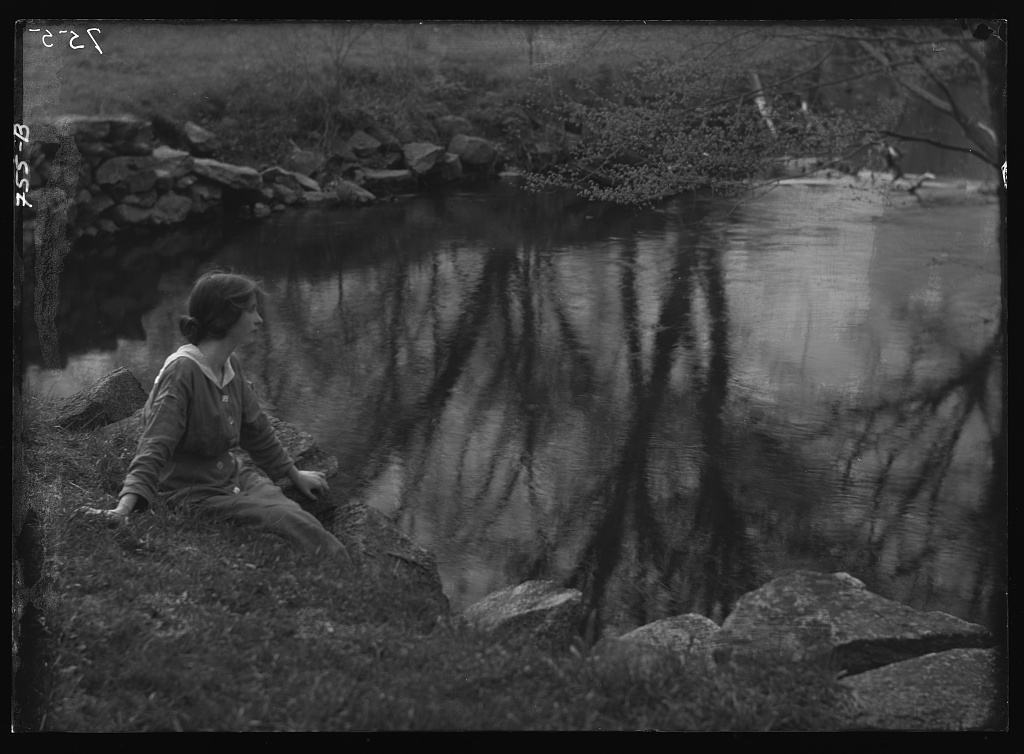
Millay by Pond (photo by Arnold Genthe, 1914)

[This entry is cross posted at ordinary-times.com]

Vyacheslav Volodin is the speaker of the Duma, and Reuter’s says he’s warning “that if the West gave permission for such [military] strikes deep into Russian territory then it would lead to a ‘global war with the use of nuclear weapons.’”

David Lammy, UK Secretary of State for Foreign, Commonwealth and Development Affairs and someone I’ve heard of, tells us global warming is “is systemic. Pervasive. And accelerating towards us.”

The Detroit Lions have a pretty good football team. Google “two headed goat” and find a world of images. George R.R. Martin isn’t even bothering to write the final book. It’s getting end-timey. Do you really want to squander your shrinking allotment by working?

Piss Off Early, Tomorrow’s Saturday. Get out and see the world while the world’s still there. And if David Lammy’s wrong, all the better. Have a great Friday afternoon. But first, some verse.

***

I made the mistake of reading an article about Rachmaninoff. It was a good article, “Rachmaninoff reigns” by David Dubal, The New Criterion, September 2023, but it contained the following:

“Studying his pianism is an exhilarating experience, and, although Rachmaninoff wrote for his own enormous hands, few pianists can resist reveling in the growths of his exotic pianistic gardens.”

Continue reading →

POETS Day! The Other Side of James Hogg

Allan, William; James Hogg (1770-1835), Poet (The Ettrick Shepherd) (The Ettrick Shepherd’s House Heating or The Celebration of his Birthday); National Galleries of Scotland

[This entry is cross posted at ordinary-times.com]

It’s almost another work week gone and there’s no sense in waiting for the official end. Call it a POET’S day and Piss Off Early, Tomorrow’s Saturday. There are books to read, people to meet, shows to catch. Shave a few hours off a Friday and enjoy.

First, a little verse for you.

***

I didn’t know he was a poet.

Until yesterday I knew James Hogg only as the author The Private Memoirs and Confessions of a Justified Sinner and I don’t know… a lack of curiosity or preoccupation with whatever shiny thing served as a diversion after reading that novel led me elsewhere. I’ll say that his book came to my attention in the first place when I was reading and reading about Muriel Spark’s The Prime of Miss Jean Brodie, a book that if you’re unfamiliar, either so fascinates you that a third or fourth reading still reveals something new, or you don’t like it much at all.

The mystery writer Ian Rankin wrote his thesis on Miss Jean Brodie and in an interview he said that the main character claimed to be a descendant of Willam Brodie, a respected 18th century cabinet-maker who socialized with all the right sorts of people and spent his evenings burgling Edinburgh. Apparently, locksmithing was folded into the expected duties of a cabinet man in Scotland during the Age of Enlightenment and he kept key copies. It was a scandal when he was caught and chattering about living a double life commenced. The affair was among the inspirations for Robert Louis Stevenson’s The Strange Case of Dr. Jekyll and Mr. Hyde. According to Stevenson, another was Confessions, a book he said “has always haunted and puzzled me.”

Continue reading →

POETS Day! Thoughts on Part IV of TS Eliot’s “Burnt Norton”

Sunflower in Bavaria, November 2020 – Kritzolina

[This entry is cross posted at ordinary-times.com]

Welcome once again to POETS Day, that wonderous day where we do our best to usher in Henry Ford’s greatest creation – the weekend – a few hours ahead of schedule by embracing the ethos of the day: Piss Off Early, Tomorrow’s Saturday.

Life’s too short for work, and nobody’s gonna notice if you hoof it mid-afternoon.

***

T.S. Eliot will with good reason be best known for The Waste Land, but it’s not uncommon to come across writings that hold up Four Quartets, considered as a whole, as the better work. The former was epochal. There is poetry before The Waste Land and poetry after, the full scope and impact being the subject of numerous heavy books. The Waste Land had the advantage of making a larger splash, not having been presaged by The Waste Land as Four Quartets was. I gladly claim agnosticism; “They can both be great,” and such. Being above the fray hides all manner of deficiencies in judgement.

“Burnt Norton” was the first of the Four Quartets, published in 1936 as part of Eliot’s Collected Poems 1909–1935. In the course of production or during the run up to his play, Murder In the Cathedral, a number of lines were discarded on advice of his director, E. Martin Browne. Eliot held Browne in some esteem – the two would continue to collaborate over the following two decades – and so deferred as to what was appropriate for the stage but he held on to the lines. He hated waste. James Matthew Wilson tells us in an informative video about “Burnt Norton” (one of four in a series on Four Quartets to which I’ll be referring to in this post – well worth your viewing time) that he was slow to write, or if not slow, frustratingly contemplative. “Constipated,” Eliot would say. It wasn’t his desire to waste what was painstakingly crafted, so a priest’s struck dialogue from Murder in the Cathedral begins his poem. In the gardens of Burnt Norton, a manor house Eliot once visited with Emily Hale, he says to her,

Time present and time past
Are both perhaps present in time future,
And time future contained in time past.

“Burnt Norton” is in five parts, as was The Waste Land and later the remaining of the Four Quartets. Eliot wrote extensively on Elizabethan drama and its five act structure is certainly being mirrored, but Wilson points out that Eliot was a devout man and this is a religious work so we see in the five parts the structure of mystical prayer. Here I’m paraphrasing, but first setting, then discovery or imagination of setting followed by a contemplation or inward turn. Fourth is a purgation, some sort of repentance or prayer of hope. Finally, we have a reconciliation.

Continue reading →