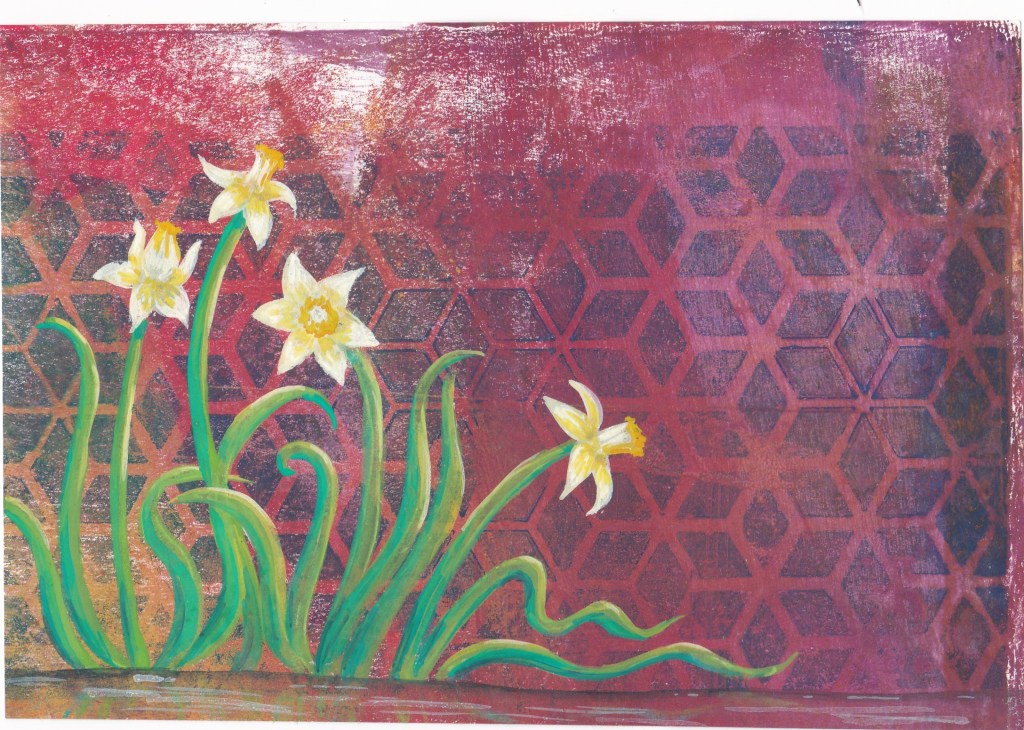
POETS Day! “Sunset” by e.e. cummings

Illustration by Rene Sears

[This entry is cross posted at ordinary-times.com]

It is rainy and depressing and awful here for those who like to go outside or look out windows. Has been for a week. It’s cold, too. I’m frustrated with my senses. I don’t know how cold. If I practice, say listening to music in a formal teaching setting, I suspect I’d know a C from an A from a C flat soon enough. I’ve been on this Earth for decades and still have to check a thermostat to see how cold it is. I know it’s cold, but if I say it’s in the forties it may well be in the fifties. What a weak and imprecise sensory apparatus we wear. Defective.

I don’t know what the weather is like where you are, either. But if it’s nice out, go enjoy it. Piss Off Early, Tomorrow’s Saturday. Friday afternoons are fun if you’re free.

First. A little verse.

***

“But first, a historical fragment, a digression: early in the century, Pound, poet of unsurpassable ear, declared war on the iamb. What followed, and indeed surrounded this act, was a period of enormous and profound linguistic discovery, not all of it directly related to Pound’s imperative, but all of it in some manner a shucking of constraints, all confident authority and easy bravura, as though the past were being dared to stop this inspired future. And certain of the tastes of the present moment can be traced to what we now call the Moderns, with that ominous upper case, principally our bias toward the incomplete, a taste that seems to treat the grammatical sentence as Pound treated the iamb: a soporific, a constriction, dangerously automatic and therefore unexamined.”

– Louise Glück, “Ersatz Thought,” American Originality: Essays on Poetry

I’m not a huge fan of Louise Glück’s poetry. If she were alive, I doubt she’d care one whit. People who give out the Pulitzer, the Bollinger, the Nobel, and name US Poet Laureates have already come down on her side of the taste equation. I should add that on this site I’ve held her up as a prominent practitioner of dreaded poets voice and managed not to detail any dreams resulting from Glück reading-induced narcolepsy.

That aside, I genuinely respect the woman as a poet and theorist. Her essays are brilliant, ranging things. She treats bits of process laity realizes as essential when brought up, hovered on the edge of should-have-know before. I went to the library wanting theories on American poetry: what defines it, what the rebels and revolutionaries like Whitman, Dickinson, Pound, Eliot, and Stevens were rebelling against. I have my own thoughts, but I wanted confirmations and challenges. My favorite librarian was off, but a new and yet unranked librarian suggested the above American Originality, by Glück. Strong debut for the new librarian.

Continue reading

POETS Day! “The Waste Land” Lees

Close up of the original draft of T.S. Eliot’s “The Waste Land” with annotations by Ezra Pound.

[This entry is cross posted at ordinary-times.com]

I went on longer than I’d planned this week, so to the point without preamble: Piss Off Early, Tomorrow’s Saturday. Get out of work. Run and be free. You’ve done your part, slaved the workweek throroughly enough. Escape the office and hit a happy hour, still sunlit park, catch a ball game, or ring up that attractive someone you’ve had a mind towards.

It’s POETS Day. Make the most of it.

But first, a little verse.

***

“I had thought of the Lycidas as a full-grown beauty—as springing up with all its parts absolute—till, in an evil hour, I was shown the original copy of it, together with the other minor poems of the author, in the library of Trinity, kept like some treasure to be proud of. I wish they had thrown them in the Cam, or sent them after the latter Cantos of Spenser, into the Irish Channel. How it staggered me to see the fine things in their ore! interlined corrected! as if their words were mortal, alterable, displaceable at pleasure! as if they might have been otherwise, and just as good! as if inspiration were made up of parts, and these fluctuating, successive, indifferent! I will never go into the workshop of any great artist again.”
– Charles Lamb, “Oxford in the Vacation”, kinda

I say “Kinda” because I’ve got lying eyes. I trust Cleanthe Brooks and Robert Penn Warren more than most. One of them wrote, in their coauthored classic Understanding Poetry, that Lamb wrote the above “in his essay ‘Oxford in the Vacation.’” The other one, no doubt, went over the final copy and approved. I read “Oxford in the Vacation,” and the quote was nowhere to be found. I ctrl F-ed it and tried to find “Lycides” on the page in case somehow a paragraph length distraction caused me to miss it. It wasn’t there.

Brooks or Warren was right, though, with the other also right but in an editorial capacity. I found an Atlantic article by Edmund Gosse in the May, 1900 issue, which the internet happened to have laying about. Gosse writes, “When Lamb came to read over these sentences, he was perhaps struck with their petulance, for they were omitted from the completed Essays of Elia [Lamb’s pen name] in 1823.” The original appeared in The London Magazine October 1820. It’s funny to me that a quotable quote about the mess of editing and rewriting was itself cut on consideration.

Were Lamb born a couple of centuries scant later, he’d wrestle with T.S. Eliot’s The Waste Land. I can’t say what opinion he’d have of the poem, only that he’d have one. The poem has been inescapable for those with poetic interests since its 1922 publication. What would he have made of The Waste Land, Centenary Edition in Full Color: A Facsimile & Transcript of the Original Drafts Including the Annotations of Ezra Pound from Liverwright, the original publisher of the poem in book form?

It’s one thing to read that Ezra Pound excised almost two thirds of Eliot’s manuscript, quite another to see reproductions of beige typewritten pages with pencil notes, slashes, suggestions sometimes themselves slashed and rewritten, and Pound’s querysome marginalia: “Vocative?” and “Vocative??”

Continue reading

POETS Day! Ovid and the Rape of Europa

Illustration by Rene Sears

[This entry is cross posted at ordinary-times.com]

My favorite librarian is missing. He’s been gone ever since I asked about a collection of James Dickey poetry. We couldn’t find it in the Jefferson County system or through inter-library loan systems with universities and other institutions (I have no idea what other institutions participate in library loan systems, but I’m told there are others). He said he owned a copy of the book personally and would let me borrow his copy. I haven’t seen him since.

Did he violate a librarian code? Do they have non-competes? Did they take him away for re-education? Are there really investigators like Mr. Bookman from that Seinfeld episode? It’s like he’s been shushed out of existence.

It’s POETS Day, so Piss Off Early, Tomorrow’s Saturday. Ditch work. There’s an afternoon of fun to be had, but first take a look and make sure any library books you’ve checked out aren’t late. Be safe.

***

There’s a very good article called “Ovid in exile” in last month’s New Criterion. Ovid’s out at Columbia University. I had a stumble when I came across the embedded quote by Lisa Libes, described as a “veteran of Literature Humanities” by article author David Lehman: “Ovid was sent on a three-year furlough, returning to the syllabus briefly in 2018 before being nixed entirely.” I stumbled wondering why a 2018 controversy, settled with seeming finality in 2021, showed up as consideration meat in the October 2025 issue, but the editors published it under the “Reflections” heading and Lehman, aside from being a poet and critic is the founder and series editor of The Best American Poetry anthologies, so he can bring up what he wants when he wants and we’re all the better for it.

Per Lehman, “In plain English, the students singled out the Metamorphoses because of the Greek and Roman god’s habit of coming to earth, pursuing mortal nymphs, and raping them.” He then lists the rapes of Perserpine by Pluto, Europa by Jupiter, Philomena by Terseus, and Apollo’s attempt at Daphne.

Continue reading

POETS Day! Edwin Muir’s “The Horses”

Illustrated by Rene Sears

[This entry is cross posted at ordinary-times.com]

Mississippi is where I pass on the right. Folks come from all round to make me pass them on the right in Mississippi. I saw tags from New York, and I passed them on the right in Mississippi. I saw tags from North Carolina driving 70 mph, and I passed them on the right in Mississippi. Someone driving in car with tags from neighboring Arkansas, seeing me pass him on the right in Mississippi, so loved being passed on the right in Mississippi that he let a whole train of fellow travelers dart past a slow truck in the right lane and pull up behind him before changing lanes to pass him on the right in Mississippi and then change lanes back again to pass a pick-up towing an empty trailer in the right lane some medium distance ahead. We all snaked.

I will never understand Mississippi. I read a Joan Didion novel in Louisiana. It was very good.

It’s POETS Day so Piss Off Early, Tomorrow’s Saturday. Get out of work mid afternoon. Live life in the fast lane (but actually drive fast.)

First, a little verse.

***

Edwin Muir published the piece of literary criticism, Scott and Scotland, in 1938. In it he argues if Scotland is to have a national literature, they must do away with far and wide dialects and decide on a common language.

“If Shakespeare had written in the dialect of Warwickshire, Spenser in Cockney, Ralegh in the broad Western English speech which he used, the future of English literature must have been very different, for it would have lacked a common language where all the thoughts and feelings of the English people could come together, add lustre to one another, and serve as a standard for one another.”

Glasgow sneered incomprehensibly, Edinburgh twanged nasally, and Aberdeen wore fuzzy boots.* The one language common to them all through radio, newspaper, and all the missives of empire, was English. He put it that Scots survived in nursery rhymes and “anonymous folk-song.” The old language as men lived in his time “expresses therefore only a fragment of the Scottish mind.” He made the case that the Scots, who already spoke English, needed to proceed in English in their literature. This made him very unpopular with Hugh MacDiarmid (M’Diarmid), whose “Lallan” movement, “Lallan” being a Scots pronunciation of “Lowlands,” was beating the curtains for kilts and cursing. Muir had no patience for nationalism.

Continue reading

POETS Day! Katharine Tynan

Section of portrait of Katharine Tynan by Jack Butler Years patterned up by Rene Sears

[This entry is cross posted at ordinary-times.com]

Smoking looks cool. The converse is true as well. Not smoking is awkward. P.J. O’Rourke wrote, “People who don’t smoke have a terrible time finding something polite to do with their lips.” I’d say the same about their hands. Few have the Italian gift for gesturing. If there’s a desk level piece of furniture, maybe a chair back, leaning takes care of one hand. The other? I don’t know. Roll the Chapstick in your pocket? A lot of the cool people died so we bought gum and got snippy with waiters for a while. Now we’re awkward and have, on average, ten more years to kill.

In 1955, roughly 57% of American adults smoked. That number is just over 11% now. Over the course of seventy years, we have reduced the smoking share of the population by 46% points. “Non-smoking” offices became all the rage somwhere in the 80s. Everyday, 57% of the smoking workforce stepped out for a ten minute commiseration with other smokers. How many times? Twice? Three times a day? The Industrial Revolution. The Computer Revolution. New methods of management. We’ve heard myriad ways we’ve increased worker productivity but over seven back-loaded decades more than half the workforce stops taking thirty minutes a day off and we hear nothing. Something’s not right.

They don’t notice. Half of it’s make-work anyway. Piss Off Early, Tomorrow’s Saturday. Start Friday afternoon a few hours before they tell you it’s okay. They really don’t notice.

First, a little verse.

***

“When Lionel Johnson and Katharine Tynan (as she was then), and I, myself, began to reform Irish poetry, we thought to keep unbroken the thread running up to Grattan which John O’Leary had put into our hands, though it might be our business to explore new paths of the labyrinth. We sought to make a more subtle rhythm, a more organic form, than that of the older Irish poets who wrote in English, but always to remember certain ardent ideas and high attitudes of mind which were the nation itself, to our belief, so far as a nation can be summarised in the intellect.”

– W.B. Yeats “Poetry and Tradition”

Yeats and Lionel Johnson were contemporary members of the Rhymers Club when Irish mythology and history was the talk, an association Yeats credited with deepening his interest and devotion to his home and its people. The two collaborated on Poetry and Ireland: Essays by W.B. Yeats and Lionel Johnson in 1908. It seems the two were friends, but it may have been that they shared a fascination and drive to preserve a vein from the literary past and develop its admiration that it would infuse future works.

Continue reading

POETS Day! EB White

Photo by Luc Viatour / https://Lucnix.be

[This entry is cross posted at ordinary-times.com]

In the Victorian Era, the Brits were very competent. They had dispatches and requisitioning to attend along with all the other mechanism of empire, but suddenly they had real mechanisms in unseen number as the Industrial Revolution gained… sorry… steam. To maintain competence, a person of import suddenly had to be conversant on things that in simpler recent times were shut up in clocks or behind organ cabinetry. Now they were bigger and populating sooty factories. Sprockets and springs, cogs and belts. A piston required precision casting in a way a pitchfork didn’t. Everything had to be just so.

The age was infected through and through with exactitude so it should be no surprise that women who, pace the Queen, were left out of warring, administrating, and engineering picked up the persnickety habits of their eminently measured husbands/brothers/fathers/Darcys/Wickhams. The societal mood infected society ladies. As a result, the laying of a 5.08 x 8.89 cm calling card, a Regency convenience supercharged and transformed by the fast paced 1800s, conveyed affronts, condolences, respect, disdain, attraction, or congratulations depending on how, when, and by whom it is delivered. The result was a great deal of foot traffic, gossip, and stationer’s children attending better schools than they once had.

Initially the secret Atreides battle language of an elite few, the coded missives transmitted by font, weight, and fold were revealed to a status hungry public by newspaper articles and pamphlets funded by Big Stationery. It’s antiquated nonsense now, but arcana makes for fun cocktail party chat. If deployed at the right moment to the right audience, demonstration of obscure knowledge can be devastatingly effective.

Take your business card and bend the bottom right corner inward and leave it on your boss’s desk. This signals that you, named on the card, are leaving for a trip and so the recipient, your boss, is relieved from the duty of a reciprocal call. And then leave.

You might get fired. Not everyone is up on Victorian etiquette or thinks such things cutesy, but that’s not what’s important. It’s Friday afternoon. Piss Off Early, Tomorrow’s Saturday. Enjoy the weekend.

First, a little verse.

***

I found E.B. White on the poetry shelves at my local library.* That he wrote poetry was something I didn’t know that I didn’t know, to borrow a phrase from Robert Gates. It surprised me.

Like I assume is the case with most, I know White primarily as an author of ubiquitous children’s books and have repeatedly said “Oh. I forgot that was the same guy,” when reminded that he was also the White of “Strunk & White,” the two last names a handy eponym for the famous guide written by William Strunk and later revised and expanded by White, The Elements of Style.

Continue reading

POETS Day! Emily Brontë

Illustration by Rene Sears

[This entry is cross posted at ordinary-times.com]

I have an uncle who is never bored. He’s always up to or up for something. One of the collateral benefits of restlessness is that he banks interesting places and activities he discovers wandering around. There’s rarely a “What do you want to do?” because he’s got a backlog of interesting half-explored outings nipping at his synapses.

He found a used book store in Fredrick, Maryland he says has more than its share of signed books. I bought signed copies of William F. Buckley’s The Unmaking of a Mayor and Dave Barry’s Greatest Hits (“Happy Birthday Frieda! Here’s a Useless Book!”) My uncle’s pretty sure there’s a bored or impish clerk with a sharpie, but I choose to believe otherwise.

Another time we went to NRA headquarters, but only partially to shoot. The night before, he told me about the strict protocols and double gun safe lock check ID frisk metal detector side eye you get when going in because they know more than any mass attrocity, an incident at the NRA home base would be the PR nightmare. We sat in the parking deck after we were done, guns locked and trunked, and riffed that despite all the guns in proximity, this place is a mugger’s dream of unarmed targets wandering around in the dark.

He’s always coming up with stupid, giggly fun like that.

Happy POETS Day! Piss Off Early, Tomorrow’s Saturday. There’s something off or silly in your town waiting to be found. Take a few hours away from work and make fun. Go do that.

First, verse.

***

I was of the assumption that all women read Emily Brontë as girls. The soon-to-be menfolk would retire to the parlour mad they aren’t yet old enough for brandy and cigars and read Treasure Island, Mark Twain, and Ivanhoe while the women retired to have pillow fights and to read Jane Austen and a Brontë or three wherever they went when the men were in the parlour. I never had cause to question.

Continue reading

POETS Day! Robert Bly

Illustrated by Rene Sears

The last time I had a flat tire, I took a picture. It’s still in my phone ready to be deployed should I be disastrously running late for something I can’t be understandable tardy for.

Years ago my wife got a call from work on a morning we’d forgotten to set the alarm. She darted awake and off the cuff railed about an Alabama Power truck blocking our drive. She’d be there as soon as possible, she said, and I heard sympathetic sounds from the other end. I’m not that quick. I need a plan. You should have a plan too.

It’s a close up shot showing only the tire and the road without any seasonal flourishes like golden leaves, sleet, or sandaled feet. Next time you get a flat, take a picture. Heck, if you see a stranded motorist, pull over and take one. Everybody has a phone and will have called a friend or relative so you’re in little danger of getting roped into actually helping. For POETS Day, an excuse to be late doesn’t help much. You want out for the day and a flat tire just means you won’t be back in from lunch or whatever for a few more minutes. Also, sending a picture unprompted is suspicious. It’s better attributed to another.

Pull up the picture when the time is right and tell your boss a daughter/neice/grandmother just sent it and needs help. They’re a ways out, but sitting safe in a diner or something. You can just make it out but by the time you get back… “I’ll make it up Monday. You’re great for understanding,” and out. Matinee, ball game, bar? Up to you. Piss Off Early, Tomorrow’s Saturday.

But first, a little verse.

***

I hadn’t thought of Robert Bly since college. I took an honors English seminar led by a New Aging professor focused on his manhood reclamation manifesto, Iron John: A Book about Men. I can’t remember the professor’s name, she taught non-fiction creative writing and I suppose the thinking went that as a renowned poet, Bly would serve up examples of poetic sensibilities pressed into argumentative prose service.

Continue reading

POETS Day! Katherine Mansfield

Section from Anne Estelle Rice’s Portrait of Katherine Mansfield

[This entry is cross posted at ordinary-times.com]

Is it birthday season where you live?

Lord, we have a passle of them going on right now. August is supposed to be the most popular month for U.S. births, but the bleed into September is more Romanov than slight. We’ve had four in the last two weeks with three on deck and that’s just in town immediate family that, though Catholic, doesn’t have a single nuclear branch that wouldn’t fit in an modest Protestant preferred sedan.

Statistics say your family clustered as much as ours, so Piss Off Early, Tomorrow’s Saturday. Skip out of work early and enjoy the afternoon/kick off the weekend early. It’s probably your birthday. Treat yourself. If it’s not yours, take a moment to wrap a present and sharpen a suddenly dulling cake knife. Maybe try to figure out why grade school kids shout “Eat more chicken” followed by an ever changing litany after the birthday song. (How do they know each week’s new variation? Those who aren’t parents of small children will have no idea what I’m talking about but kids add to the birthday song – my nephews from Albuquerque in sync with the kids here in Birmingham because they somehow know even though it changes from week to week, water park pavilion to pizzeria long table. They’re like druids receiving unwritten arcana.)

First, a little verse.

***

I thought about doing this week’s POETS Day about one of the Bloomsbury Group because I have a knee jerk dislike of them and I was feeling snarky. They were mean cool-kid gatekeepers. Nepotism involves relatives. Cronyism describes promoting friends. For the Bloomsbury clique I need a new word; one for promoting the person you’re having an affair with to make your spouse take notice and prove how cosmopolitan he or she is by sleeping with that person too, before, as a couple, dropping the promotee and pretending neither ever had anything to do with that middle class climber. I feel like the word should also convey mocking laughter in the direction of Roy Campbell. Nasty little hive of lit-rury hornets.

Wikipedia has a decent list of Bloomsbury members, satellites, and associates. You have to do a little digging to find out who was discarded for getting too clingy, but it’s a handy reference. What caught me was the few listed after the sentence “writers who were at some time close friends of Virginia Woolf, but who were distinctly not ‘Bloomsbury’.” T.S. Eliot was mentioned. Good man. As was the Campbell wife seducing Vita Sackville-West. Good story. I’d never heard of Katherine Mansfield, but she was listed among people of interest with the good sense to be distinctly not “Bloomsbury,” even if Vita was at the very least more than Bloomsbury-adjacent until she became a middle class climber. That’s despite Vita’s being a brilliant gardener and real-deal inbred baroness.

Continue reading

POETS Day! Yeats and Graves and the Moon

Illustration by Rene Sears

[This entry is cross posted at ordinary-times.com]

Years ago, I was writing a POETS Day about the Australian poet Judith Wright. I’ve written here that I’m a fan of Poetry Foundation’s website because they do a great job putting together mini-bios of poets with links to their works, etc. There wasn’t one for Wright even though they mention in the mini-bios of others that this poet or that was winner of the prestigious Arts Queensland Judith Wright Calanthe Award.

I sent an email to whoever the intern is that has to answer @info type email and surprisingly got a response. “Thank you for pointing out the oversight…”, “We need to rectify…”, etc. Most importantly, they asked me if I had any suggestions about which of her poems to feature along with her bio page.

There’s still no bio page, but that’s unimportant. Poetry Foundation is an outgrowth of the legendary Poetry magazine founded by Harriet Monroe. She had a bigger hand in shaping Modern Poetry than most; maybe than anyone. She consulted giants like T.S. Eliot and Ezra Pound. And now, through other means, her publication was consulting me. This led to my frequently making irrefutably truthful statements like, “Poetry magazine, which has sought editorial advice from people like Eliot, Pound, and me…”

Continue reading