POETS Day! At Home with Edna St Vincent Millay

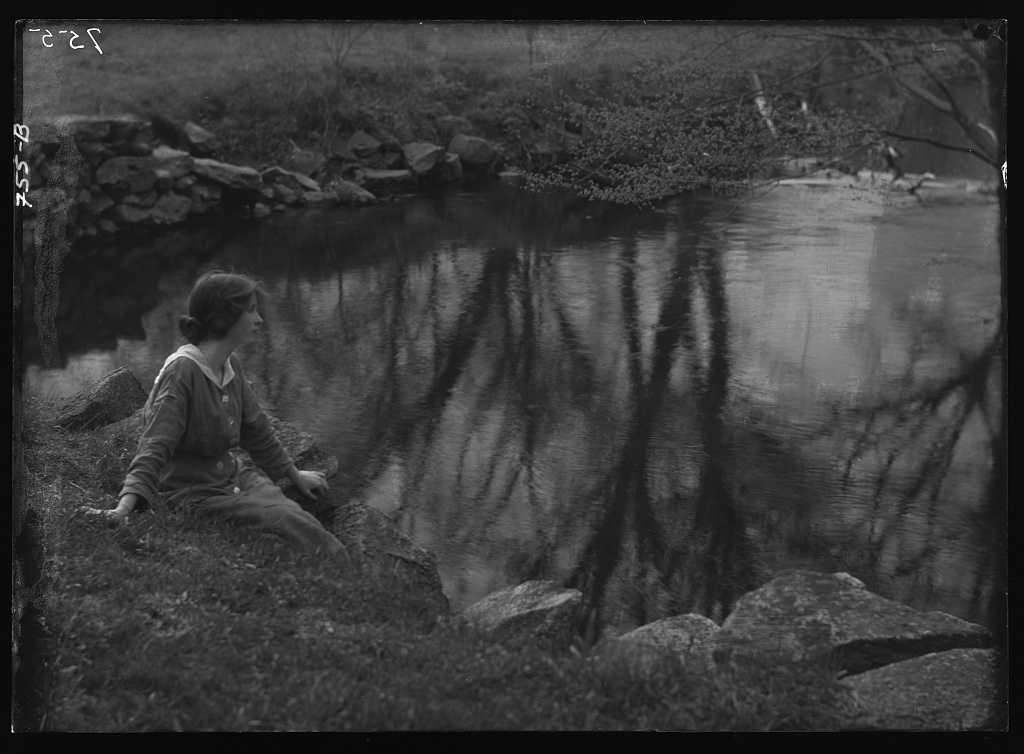
Millay by Pond (photo by Arnold Genthe, 1914)

[This entry is cross posted at ordinary-times.com]

Vyacheslav Volodin is the speaker of the Duma, and Reuter’s says he’s warning “that if the West gave permission for such [military] strikes deep into Russian territory then it would lead to a ‘global war with the use of nuclear weapons.’”

David Lammy, UK Secretary of State for Foreign, Commonwealth and Development Affairs and someone I’ve heard of, tells us global warming is “is systemic. Pervasive. And accelerating towards us.”

The Detroit Lions have a pretty good football team. Google “two headed goat” and find a world of images. George R.R. Martin isn’t even bothering to write the final book. It’s getting end-timey. Do you really want to squander your shrinking allotment by working?

Piss Off Early, Tomorrow’s Saturday. Get out and see the world while the world’s still there. And if David Lammy’s wrong, all the better. Have a great Friday afternoon. But first, some verse.

***

I made the mistake of reading an article about Rachmaninoff. It was a good article, “Rachmaninoff reigns” by David Dubal, The New Criterion, September 2023, but it contained the following:

“Studying his pianism is an exhilarating experience, and, although Rachmaninoff wrote for his own enormous hands, few pianists can resist reveling in the growths of his exotic pianistic gardens.”

Continue reading

POETS Day! The Other Side of James Hogg

Allan, William; James Hogg (1770-1835), Poet (The Ettrick Shepherd) (The Ettrick Shepherd’s House Heating or The Celebration of his Birthday); National Galleries of Scotland

[This entry is cross posted at ordinary-times.com]

It’s almost another work week gone and there’s no sense in waiting for the official end. Call it a POET’S day and Piss Off Early, Tomorrow’s Saturday. There are books to read, people to meet, shows to catch. Shave a few hours off a Friday and enjoy.

First, a little verse for you.

***

I didn’t know he was a poet.

Until yesterday I knew James Hogg only as the author The Private Memoirs and Confessions of a Justified Sinner and I don’t know… a lack of curiosity or preoccupation with whatever shiny thing served as a diversion after reading that novel led me elsewhere. I’ll say that his book came to my attention in the first place when I was reading and reading about Muriel Spark’s The Prime of Miss Jean Brodie, a book that if you’re unfamiliar, either so fascinates you that a third or fourth reading still reveals something new, or you don’t like it much at all.

The mystery writer Ian Rankin wrote his thesis on Miss Jean Brodie and in an interview he said that the main character claimed to be a descendant of Willam Brodie, a respected 18th century cabinet-maker who socialized with all the right sorts of people and spent his evenings burgling Edinburgh. Apparently, locksmithing was folded into the expected duties of a cabinet man in Scotland during the Age of Enlightenment and he kept key copies. It was a scandal when he was caught and chattering about living a double life commenced. The affair was among the inspirations for Robert Louis Stevenson’s The Strange Case of Dr. Jekyll and Mr. Hyde. According to Stevenson, another was Confessions, a book he said “has always haunted and puzzled me.”

Continue reading

POETS Day! Thoughts on Part IV of TS Eliot’s “Burnt Norton”

Sunflower in Bavaria, November 2020 – Kritzolina

[This entry is cross posted at ordinary-times.com]

Welcome once again to POETS Day, that wonderous day where we do our best to usher in Henry Ford’s greatest creation – the weekend – a few hours ahead of schedule by embracing the ethos of the day: Piss Off Early, Tomorrow’s Saturday.

Life’s too short for work, and nobody’s gonna notice if you hoof it mid-afternoon.

***

T.S. Eliot will with good reason be best known for The Waste Land, but it’s not uncommon to come across writings that hold up Four Quartets, considered as a whole, as the better work. The former was epochal. There is poetry before The Waste Land and poetry after, the full scope and impact being the subject of numerous heavy books. The Waste Land had the advantage of making a larger splash, not having been presaged by The Waste Land as Four Quartets was. I gladly claim agnosticism; “They can both be great,” and such. Being above the fray hides all manner of deficiencies in judgement.

“Burnt Norton” was the first of the Four Quartets, published in 1936 as part of Eliot’s Collected Poems 1909–1935. In the course of production or during the run up to his play, Murder In the Cathedral, a number of lines were discarded on advice of his director, E. Martin Browne. Eliot held Browne in some esteem – the two would continue to collaborate over the following two decades – and so deferred as to what was appropriate for the stage but he held on to the lines. He hated waste. James Matthew Wilson tells us in an informative video about “Burnt Norton” (one of four in a series on Four Quartets to which I’ll be referring to in this post – well worth your viewing time) that he was slow to write, or if not slow, frustratingly contemplative. “Constipated,” Eliot would say. It wasn’t his desire to waste what was painstakingly crafted, so a priest’s struck dialogue from Murder in the Cathedral begins his poem. In the gardens of Burnt Norton, a manor house Eliot once visited with Emily Hale, he says to her,

Time present and time past
Are both perhaps present in time future,
And time future contained in time past.

“Burnt Norton” is in five parts, as was The Waste Land and later the remaining of the Four Quartets. Eliot wrote extensively on Elizabethan drama and its five act structure is certainly being mirrored, but Wilson points out that Eliot was a devout man and this is a religious work so we see in the five parts the structure of mystical prayer. Here I’m paraphrasing, but first setting, then discovery or imagination of setting followed by a contemplation or inward turn. Fourth is a purgation, some sort of repentance or prayer of hope. Finally, we have a reconciliation.

Continue reading

Lines Written a Few Feet Away from My Television As and After I Flipped Through College Football Games – My Alabama Bias Is Part of the Mix

Every fan should invest in a laminator.

– Florida’s in trouble. They’re coach is on a short leash and they’ve got a four game stretch later this season of Georgia followed by Texas, LSU, and Ole Miss. Whatever momentum could have been gained in these early games was needed to face a month where LSU might be the easiest match up. They lost to Miami by an unredeemable amount today. There’s no silver lining and there’s no rose colored glasses or funny accents that make their future seem any less dire than it looks to me.

They’ll get a win against Samford and maybe FSU. Their four sequential games above are all losses. Texas A&M is probably a loss. Ditto Tennessee. UCF, MSU, and KY are all toss ups. I’ll be impressed if they get five wins. They could go 1-11. Meanwhile, their biology and chemistry departments continue to impress and my assessment of the football team in no way has bearing on my regard of the university as an excellent and praiseworthy center of learning and innovation; something to keep in mind when reviewing my son’s application.

Napier seems like a nice guy, but he was trouble with fans and boosters coming into the season after two seven loss years. I’m betting he doesn’t last the semester.

Continue reading

POETS Day! Anthony Hecht

© OpenStreetMap-Mitwirkende, openstreetmap.org, CC BY-SA 2.0.

[This entry is cross posted at ordinary-times.com]

I used to work for a wine distributor. I’d carry open bottles around in my shoulder strap cooler and pour a taste for buyers and employees at restaurants and wine shops, take orders, and treat people who bought a lot or used to buy a lot but had slipped recently to lunch. It was fun at first, but after a while it became like any other job. The idea of working “in wine” is great and all, but given time and it loses its luster. You’re moving product. Might as well be shoes.

The bonus was the built in POETS Day. You didn’t need to make a “Piss Off Early, Tomorrow’s Saturday” type declaration, because if all went as planned, trucks checked in that deliveries were made to all your accounts by one or two Friday afternoon and that was that. The wine buyers had weekend diners to plan for, cases to help party throwers carry to their cars, etc. And, you had whatever dregs of tasting wine was left in the shoulder bag to sip with friends. Long lunches that bled into weekends were the norm. Expected.

Continue reading

POETS Day! Useful Lines and a Favorite from Pound

[This entry is cross posted at ordinary-times.com]

There is a new Inspector Rebus TV adaptation out, at least if you’re in England or Australia. We can’t watch yet, but I have Brit Box, so hope springs. I misread the release date for the new novel. Midnight and Blue, the twenty-fifth book in the series, comes out on October 15th. Not August 15th, as I was anticipating. I am bereft.

I named my dog Rebus, if that gives any idea of how much I enjoy the books. He’s a good dog, considerate but determined when he wants something and not above cutting corners, much like his namesake. Sir Ian Rankin, the series author, responded on Twitter with wishes to a picture of him chewing on his birthday toy one year, and a birthday wish again the following two – prompted, but still. That may be the only interaction I’ve had with a peer.

It was in those books that I first came across the POETS Day concept. Rebus and Siobhan, who’s gone from supporting role to near co-protagonist, were calling it a day one Friday afternoon. POETS Day isn’t an invention of Rankin’s. Apparently, the idea has been around long enough for lost origins. But I first heard is called such by John Rebus. Piss Off Early, Tomorrow’s Saturday.

I can’t believe I have to wait another two months for that book. Time for some verse.

***

I use a line – overuse, my children might say – from Yeats whenever the opportunity pops up; “O saddest harp in all the world.”

Continue reading

POETS Day! A.E. Housman’s A Shropshire Lad

[This entry is cross posted at ordinary-times.com]

School has started abominably early. This is the first Friday of the new school year for one of my children and I’m disgusted by overreach. The other starts next week. A proper summer vacation starts on Memorial Day and ends on Labor Day. Anything else is a presumption on liberty. Piss Off Early, Tomorrow’s Saturday.

Listen to Roger Waters, and if you don’t know what I mean by that, piss off early and stream Pink Floyd’s The Wall. Learn something worth learning. But first, a little verse.

***

The very popularity of Housman’s poems poses something of a problem, an embarrassment, for literary critics, who are more comfortable explaining the glories of the obscure than extolling the virtues of the accessible.
– “The tragi-comedy of A. E. Housman” by Anthony Daniels, 
The New Criterion, March 2014

Alfred Edward Housman was a classics scholar, and a great one; “beyond serious dispute, among the greatest of all time,” according to Shakleton Bailey, apparently an impressive classics scholar himself, in the pages of a 1959 Listener magazine. He failed to get his degree at St. John’s College, Oxford. The hindsight view is that he focused too much on the lines of study that interested him to the detriment of the whole required to graduate. I’ve also read that he spent too much time with friends.

Continue reading

POETS Day! Alan Seeger

Cover of Above the Trenches by Nathan Hale, illustrated by Nathan Hale

[This entry is cross posted at ordinary-times.com]

I try to provide whatever help I can in escaping work. Not always a plan, but at the very least a little encouragement. Piss Off Early, Tomorrow’s Saturday! Don’t translate desire into action and then it’s poets day; just another Friday. I don’t know how useful today’s opening will be towards that end for most.

Have you considered calling in drunk?

In ‘98 I worked with a bartender named Chris. He was as direct in conversation as you can get without coming across as rude. He went right up to that line with rapid-fire questions and clipped phrases strung together into long answers. He was a bartender, and a good one, so he had a separate personality for the public, but when not in character he was a conversational Gatling gun.

He was not exactly a manager because he was rumored, and at a later point confirmed, to have a pretty healthy drug habit, but he had some scheduling responsibilities and was the phone guy when higher ups were otherwise occupied.

Continue reading

POETS Day! Harriet Monroe

[This entry is cross posted at ordinary-times.com]

It’s late at night because Trump made it so. I write this part last and now I want sleep. I didn’t expect him to go on so long. Maybe you can use that. Piss Off Early, Tomorrow’s Saturday. Tell the boss you were up late watching tv as a civic duty because democracy dies in darkness? If you watched it, grab an afternoon nap. If not, pretend you did and go to a bar or something fun. The speech ended around eleven thirty or so Central, in case you’re asked.

If you live in California, I don’t think this works as a POETS Day hooky excuse. You guys are so far behind the RNC was still pre-empting Judge Judy and the like. Sorry. Tell them your probiotics are out of alignment or something. That might work.

Enjoy the weekend.

***

I’m a fan of James May. Top Gear, obviously, but his other stuff too: James May’s Toy Stories, James May’s Man Lab, James May: Our Man In… I’ve got the cookbook from James May: Oh Cook! He’s impish and once got fired from a magazine for a naughty acrostic.

Continue reading

POETS Day! Judith Wright, Who’s from Australia

[This entry is cross posted at ordinary-times.com]

Piss Off Early, Tomorrow’s Saturday?

The idea…

***

Poetry Foundation, and so Poetry magazine by extension or implication depending on which is now considered the over company, has a beef with Judith Wright. To be fair, they positively reviewed her collection, Birds, in the December 1964 issue, writing that “The form is conventional, the tone often that of a skillful, rhyming bird-lover. But the observation is acute and uncompromising and there is sometimes a surprising vigor in the transmission.” It’s praise as contrast to what is not said, but praise. And then, nothing.

Wright is among the more celebrated poets in Australia. If you’re just breaking into the Australian literary scene you’d be lucky to be considered for the Judith Wright Poetry Award for New and Emerging Poets. Got a new book out? There’s the Judith Wright Award for poetry collection by Australians. Alternately, your book or “poem of substantial length,” says Wikipedia, may qualify for the Judith Wright Calanthe Award, given each year at the Queensland Premier’s Literary Awards. I’ve found descriptions and pictures of monuments praising her work for indigenous people, the extent and form of which I’m ignorant but it’s at least cleared the start-small-construction bar of worthiness. She worked to save the Great Barrier Reef in addition to playing a part in other environmental efforts. According to Wikipedia, “With some of her friends, she helped found one of the earliest nature conservation movements,” which is vague enough to conjure all manner of questions I’ll not need answered for the moment if ever but I’m sure you can read all about it at the Judith Wright Arts Centre in the Fortitude Valley suburb of Brisbane. She’s kind of a big deal.

Continue reading