Officially, the work week’s nearly done; barely a few hours. What are you doing? You’re not getting anything done between now and then. Cut it out and stop pretending. Piss Off Early, Tomorrow’s Saturday.
First, a little verse.
***
My favorite librarian passed away. I didn’t seen him the last few times I was in, but I never divined his comings and goings well enough to know his days off. Poor health caught up to him. I don’t know what to say other than I’ll miss chatting with him. A few falls ago, I mentioned a Muriel Spark book I picked up. He recommended a few of hers he liked. They were the odd ones people didn’t talk about that often. His co-workers put up a memorial photo of him over a shelf filled with his recommendations. There’s a stack of printed sheets listing his “LOST Classics of the 20th Century,” for the interested, in the spirit of his Sparks recommendations: lesser-known books picked from respected but not bankable authors, for the most part. It’s an idiosyncratic list. That fits. Godspeed.
Last September, he and I were talking about the poets to come out of Vanderbilt University in the years surrounding World War II. He mentioned James Dickey. I knew Dickey was Poet Laureate back when they still called the office holder Consultant in Poetry to the Library of Congress, but I didn’t know much more beyond. We had to read Deliverance in 9th grade and as 9th graders, we watched the movie in addition and made 9th grade “Squeeeel like a pig!” jokes, but ignorance beyond that.
I went on longer than I’d planned this week, so to the point without preamble: Piss Off Early, Tomorrow’s Saturday. Get out of work. Run and be free. You’ve done your part, slaved the workweek throroughly enough. Escape the office and hit a happy hour, still sunlit park, catch a ball game, or ring up that attractive someone you’ve had a mind towards.
It’s POETS Day. Make the most of it.
But first, a little verse.
***
“I had thought of the Lycidas as a full-grown beauty—as springing up with all its parts absolute—till, in an evil hour, I was shown the original copy of it, together with the other minor poems of the author, in the library of Trinity, kept like some treasure to be proud of. I wish they had thrown them in the Cam, or sent them after the latter Cantos of Spenser, into the Irish Channel. How it staggered me to see the fine things in their ore! interlined corrected! as if their words were mortal, alterable, displaceable at pleasure! as if they might have been otherwise, and just as good! as if inspiration were made up of parts, and these fluctuating, successive, indifferent! I will never go into the workshop of any great artist again.” – Charles Lamb, “Oxford in the Vacation”, kinda
I say “Kinda” because I’ve got lying eyes. I trust Cleanthe Brooks and Robert Penn Warren more than most. One of them wrote, in their coauthored classic Understanding Poetry, that Lamb wrote the above “in his essay ‘Oxford in the Vacation.’” The other one, no doubt, went over the final copy and approved. I read “Oxford in the Vacation,” and the quote was nowhere to be found. I ctrl F-ed it and tried to find “Lycides” on the page in case somehow a paragraph length distraction caused me to miss it. It wasn’t there.
Brooks or Warren was right, though, with the other also right but in an editorial capacity. I found an Atlantic article by Edmund Gosse in the May, 1900 issue, which the internet happened to have laying about. Gosse writes, “When Lamb came to read over these sentences, he was perhaps struck with their petulance, for they were omitted from the completed Essays of Elia [Lamb’s pen name] in 1823.” The original appeared in The London Magazine October 1820. It’s funny to me that a quotable quote about the mess of editing and rewriting was itself cut on consideration.
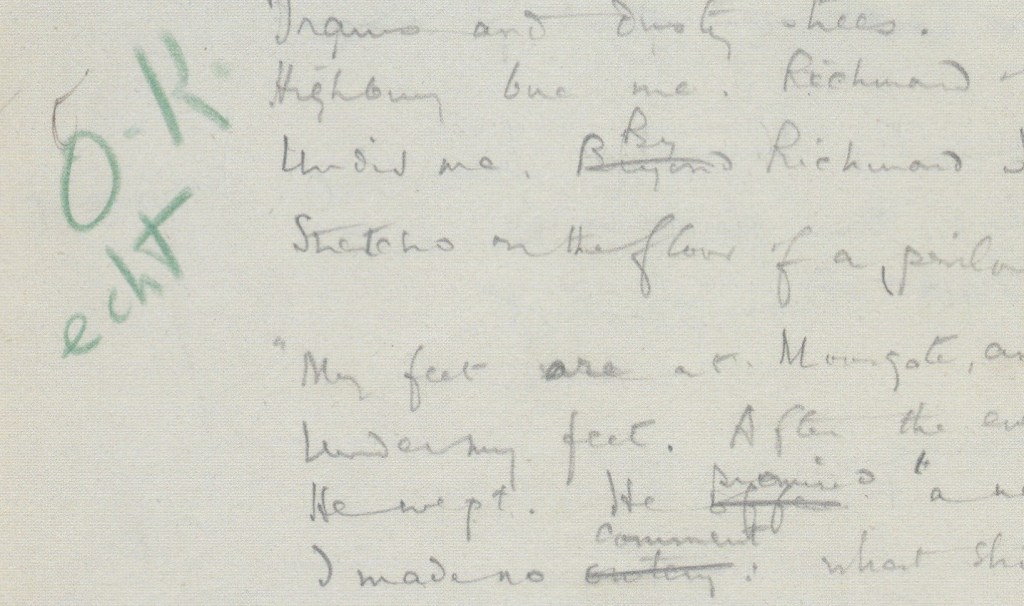
Were Lamb born a couple of centuries scant later, he’d wrestle with T.S. Eliot’s The Waste Land. I can’t say what opinion he’d have of the poem, only that he’d have one. The poem has been inescapable for those with poetic interests since its 1922 publication. What would he have made of The Waste Land, Centenary Edition in Full Color: A Facsimile & Transcript of the Original Drafts Including the Annotations of Ezra Pound from Liverwright, the original publisher of the poem in book form?
It’s one thing to read that Ezra Pound excised almost two thirds of Eliot’s manuscript, quite another to see reproductions of beige typewritten pages with pencil notes, slashes, suggestions sometimes themselves slashed and rewritten, and Pound’s querysome marginalia: “Vocative?” and “Vocative??”
I’m listening to a book about free speech and the necessity of, and the author went on for a few minutes about punishments meted out for violations of English law in Colonial America. It was amazing stuff. They’d cut off your ears for offending the Crown’s reputation, even for questioning it. Lucky loudmouths might get off with a cropping where they’d just trim off the ear tops. Tongues were bored, ears were nailed to pillories, many whippings of designated number and severity were prescribed.
One sorry SOB had his tongue bored, his arms broken, and then with his arms “dangling,” according to the author Jonathan Turley, was forced to run a gauntlet as men beat him with rifle butts.
What the hell did he say?
I hope he said it loudly. Clearly and from a high place on a stark, windy day. I hope his wind aided preferably bass voice carried across the land and turned the head of every man, woman, and child. I don’t know the content, but I hope he got the most from it.
This isn’t a segue to slippery slopes and non-crime hate incidents. It’s POETS Day. Piss Off Early, Tomorrow’s Saturday. Get out of work and read a book. There are a lot of them out there. I’m enjoying Against the Country, by Ben Metcalf. Listening to a book, as I’m doing in the car with Jonathan Turley’s The Indispensable Right: Free Speech in an Age of Rage, doesn’t count. That’s not really reading, even if it is fun. Maybe read the Turley book, though. I’ve heard good things.
In any case, take time for a little verse first.
***
ITEM:
On May 4, 1380, Cecelia Chaumpaigne signed a quitclaim releasing Geoffrey Chaucer from “all manner of actions related to my raptus.” That’s a translation. The entire statement was recorded in Latin, as was customary. The word “raptus” is left untranslated and italicized as no one was quite sure exactly which of its uses common as legal terms at the time was intended in this case.
I think you call this a “study,” so this is a study on Louis Édouard Fournier’s “The Funeral of Shelley” as painted by Rene Sears. That’s Hunt in the middle of the trio.
My nephew’s twelve years old. He just started little league practice for the spring season. That sounds crazy to me because it’s not baseball weather. It’s not even Valentine’s Day. Now, kids’ sports require commitment that was never asked of me when I was young. Whether or not youth athletics are too structured or too demanding is an interesting question, but not one I’m planning on addressing right now.
I bring up my nephew because he’s frogspawn, blossoms, buzzing bees, and W-2s in the mail: a sign of coming spring. He’s at practice, the herald signaling greater things and right on cue, MLB pitchers and catchers started reporting. The Cubs were the first to get going on the 9th. By the 13th, every battery in the league is scheduled for post-workout ice baths; by the 18th, full squads.
POETS Day is never purposeless, but soon – maybe not soon, but in the foreseeable future – you’ll Piss Off Early, Tomorrow’s Saturday, and there’s a Friday afternoon game on. Thinnest line on the horizon. Barely in sight. It’s beginning though, and a little league shall lead them.
Take off, enjoy the anticipation and the afternoon. First some verse.
***
In 1844, Leigh Hunt published a collection of essays called Imagination and Fancy. I couldn’t find a copy of it online. It seems like something Project Gutenberg would have, but no. us.archive.org has Essays of Leigh Hunt: Selected and Edited by Reginald Brimley Johnson. It doesn’t contain the whole 1844 collection, but it has the essay “An Answer to the Question, What is Poetry?” I was after. That’s the one where, I’ve read, he famously lays out his philosophy of poetry. Reginald Brimley Johnson was kind enough to select and edit that one.
I’m making meatballs for the weekend, and like all the best meatball recipes, the key ingredient in mine is lies. There’s a lot of time spent between minimal exertions of effort. It really is easy, but there’s a fine tradition of pretending to pretend that you didn’t mind cooking – which you barely did – at all. You have to master saying “Oh, it was nothing,” when it really was nothing so it sounds like it you were saying it was nothing when we all know it was something, but you guys are worth it. Oh, Stop it. Really.
I wrote about the recipe and duplicitous grandmotherly types at OT almost a year ago. Feel free to give it a go, but if you’re going to pretend to take a long time putting dinner together, you’d best cover your tracks and get work complicit in the cover story by ducking out of the job mid-Friday. That way, if anybody doubts you spent all day slaving over a hot stove instead of mixing stuff up in a bowl, popping it in the oven while you do gods know what, and then briefly checking in to finish things off with a few hours of unattended simmering, you can say, “Oh yeah? Well, I wasn’t at work, though I’d prefer you not check because then they might think I wasn’t really sick.”
It’s POETS Day. Piss Off Early, Tomorrow’s Saturday. Mangia!
But first, some verse.
***
I could have sworn I’d already done a POETS Day on Keats. This week I’ve been reading about him with a mindset intent on shutting out basic biography I must have covered previously. I figured that, mistakenly but mistakenly was ascendant, having done Keats I’d done “Ode on a Grecian Urn” because that’s the one you have to do even if you’re going through the motions to have it behind you, field cleared for stuff people might not already know.
You may have to shop. If you get too much from Amazon, they know. The thought actually counts and a bit of wear on your shoe leather should be on display.
It’s like wrapping. A perfect bow with the curly ribbons you get from running a scissor along the length real quick like you’re pull starting a chainsaw is wonderful to look at, but if you’re a twenty year old college guy with stylishly unkempt hair and smell like cherry vape, everyone knows you didn’t wrap that gift yourself. Small tears on the corners and a piece of masking tape, because the scotch tape ran out, lets grandma know you care.
That doesn’t mean shopping should impinge on regularly scheduled loafing time. Take a POETS Day. Piss Off Early, Tomorrow’s Saturday. Skip out of a useless lame duck Friday afternoon. Shopping isn’t fun, but getting out of work always is.
Before you do, take a minute for some verse.
***
“Many reviewers greeted John Clare with enthusiasm, hoping for a noble savage, an uncomplicated mind, freed from the artificial systems inculcated by formal education. Such fanciful suggestions of his isolation from the world of books have proved remarkably persistent. His eagerness to see his work in print has too often been forgotten in the various dubious attempts to portray him as innocent of the vicious preoccupations of the publishing trade.” – Paul Chirico
Several things had happened. In 1800, Robert Bloomfield erupted from seemingly nowhere selling a quick twenty-five thousand copies of The Farmer’s Boy; a labor class (labour in la lingua anglaise) kid whose little formal education but increased talent folded into a public taste bent towards Wordsworth and his Romanticism. The idea that poetry sprung from nature, pure and unadulterated by aristocratic letters was heady stuff in the early 1800s. The even larger eruption of George Gordon, Lord Byron on the scene in 1819, showed a public thirsty for, and kindled the concept of, stardom.
Do what you must. Lie to your boss. Fake a cough at school. Invite Jamaal Bowman to do his thing. Nothing productive gets done on a Friday after lunch anyway.
Piss Off Early, Tomorrow’s Saturday.
But first, take time for a little verse.
***
“As for ‘free verse’, I expressed my view twenty-five years ago by saying that no verse is free for the man who wants to do a good job. No one has better cause to know than I, that a great deal of bad prose has been written under the name of free verse; though whether its authors wrote bad prose or bad verse, or bad verse in one style or in another, seems to me a matter of indifference. But only a bad poet could welcome free verse as a liberation from form. It was a revolt against dead form, and a preparation for new form or for the renewal of the old; it was an insistence upon the inner unity which is unique to every poem, against the outer unity which is typical. The poem comes before form, in the sense that a form grows out of the attempt of somebody to say something; just as a system of prosody is only a formulation of the identities in the rhythms of a succession of poets influenced by each other.” – T.S. Eliot “The Music of Poetry”
I very much enjoyed Paul Johnson’s book, The Quest for God: A Personal Pilgrimage. I took a great deal from it but one of the things I most remember coming away with was an admiration for his practical appreciation of Catholicism.
He was very fond of the age and history of the Church, the scholarship and arguments – even those about angels and pin heads, which is a punch line though it shouldn’t be – of two thousand years. He felt a weight lifted. There may be facets and tenets that made no sense or seemed at odds to him, but he could put doubts aside and rest easy, secure in the knowledge that wiser and more learned heads than his had considered, deliberated, and concluded. He found faith.
EnterpriseAppsToday’s web site has a number of statistics related to work place time wasting. It’s eye opening. Some selected bits – a few iotum or datum if you know not much latin:
In the United States, during 8 hours of working time, employees waste an average of 2.9 hours by doing no effective work.
31% of workers waste a minimum of 1 hour each workday.
6% of employees waste around 3 hours each day at work.
4% of workers claim they waste at least 4 hours daily in the workplace.
If employees in general waste 2.9 hours each, but only 6% waste 3 hours and 4% waste 4 hours, and 31% waste 1 hour, then the remaining 59% have to waste 3.89 hours a day. I don’t think people present 6% at 3 hours and 4% at 4 hours when there’s a whopping 59% at 3.89 hours going unmentioned. That’s not how you present facts. If you’re trying to show that time wasting at work is rampant, do you leave out the biggest cohort at almost the highest time waste rate but leave in 6% at a measly 3 hours? No. They made all of that up.
Even the people who compile employee time wasting figures aren’t giving the matter proper attention. Don’t feel bad skipping out of work early. Nothing’s getting done there anyway. Have a POETS Day. Piss Off Early, Tomorrow’s Saturday.
First though, take a minute for some verse.
***
Suetonius writes that Quintus Horatius Flaccus, known to most of us as Horace, was military tribune under Brutus. This was two years after the assassination of Julius Caesar, so there was no “Shocked!” moment or questions about honor when Horace took up arms with the man. He was at Philippi for Octavian’s victory and would later claim to have left his shield behind and fled, but running off without a shield was an act claimed by Greek poets he admired and was probably a joke.
The lyrics to Lindsey Buckingham’s “Holiday Road” are
I found out long ago It’s a long way down the Holiday Road
and
Jack be nimble, Jack be quick Take a ride on a West Coast kick
with the phrase “Holiday Road” thrown in repeatedly. The beat doesn’t change – bouncy bass and a metronomic drum with two guitar riffs that loop. One of the four lines he bothered to write was ripped from tradition; not even Mother Goose tried to claim that one as her own.
It’s not a lazy song. It’s colorful. An anthem for someone with places to go and a copy of Republican Party Reptile hidden under his mattress. And there’s a dog barking at the end.
It’s a POETS Day masterpiece. Piss Off Early, Tomorrow’s Saturday.
But first, some verse.
***
When I worked as a sommelier we’d get travelers from various patches of wine country all the time hocking wares and buying lunch. It was a pretty good gig for a lot of reasons, but the lunches in particular commended themselves. These travelers would be winemakers, owners, sons and daughters of owners, national or regional sales managers, whatever. They wanted their wine on my list and, like dimpled pharma reps feting doctors, they filled us full of food and booze, hosting myself and two or three like-employed at some of the city’s best spots.






 The Columbo Game