POETS Day! Some Sonnets with 14 Lines

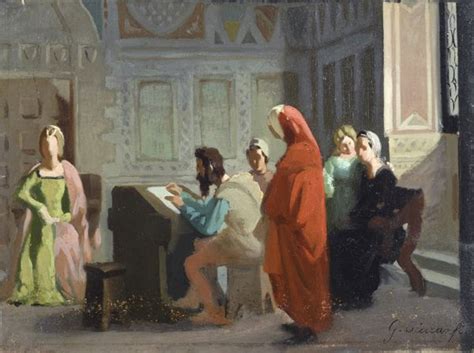
Petrarch observing Simone Martini while painting a portrait of Laura – Giuseppe Ciaranfi (1818-1902)

[This entry is cross posted at ordinary-times.com]

“Piss Off Early, Tomorrow’s Saturday” as usual and enjoy the weekend, but I got caught this week and ran short of time. This week’s is gonna be a quick one.

I was looking to do something on George Meredith’s sonnet series called Modern Love. He’s known for his novels. At least he was. I think The Egoist is the only one many would recognize these days, and I’ll wager few have read it. Modern Love is the story of a marriage as it falls apart told over the course of fifty sixteen-line sonnets. The story is engrossing as only the best soap opera like guilty pleasures no one admits to can be. I very much want to do a post on it in the future, but I got caught up by the idea of a sixteen-line sonnet. Can you do that?

I was of the impression that the sonnet was a set form. It’s usually a thought posited in an octave with a volta, or turn, taken in a sestet that may or may not resolve the thought. It doesn’t have to be laid out with a break that way. You can set stanzas in various ways or leave it all as one beautiful verse lump. There are plenty of rhyme schemes to choose from. The one thing I’d never seen as anything but a constant is that a sonnet has fourteen lines. When defining the form, length is the characteristic that first pops to mind. I’d be surprised if I’m alone in that.

Continue reading
Unprovoked Rant

I’m reading A Survey of Modernist Poetry by Laura Riding and Robert Graves. This struck me:

“Yet the sonnet theory can be provoked in Shakespeare’s sonnets as all pre-Shakespearian dramatic theories can be provoked in his plays.”

The sentence is in service of the authors view that it’s not enough to present as evidence of experimentation an excellent poem as excellent poems may have in them borrowings as well as innovations. I very much liked the use of “provoked.”

Continue reading

POETS Day! William Wordsworth

[This entry is cross posted at ordinary-times.com]

Welcome to POETS Day! Piss Off Early, Tomorrow’s Saturday, and you’ll surely want to oblige the acronym as this week is the special Slipped Into Curmudgeonlyness edition so get audibly frustrated with an underling’s inability to help you sign into your email, blow your top over the sadistically icy 68° thermostat setting, cough a menacing “I’m sick and I’m going to bring you all down with me” cough, call at least two people Bill even though they are not named Bill, leave a tip for the guy from the mail room but no more than a nickel; in general, be so annoying that when you declare that your patience with the people around you has reached its limit and storm out no one will follow.

Now feel free to move about the weekend, your normally kind and ebullient self, having been momentarily overtaken by a cantankerous pensioner, once more assertive and dominant. Think happy thoughts and enjoy happy hour.

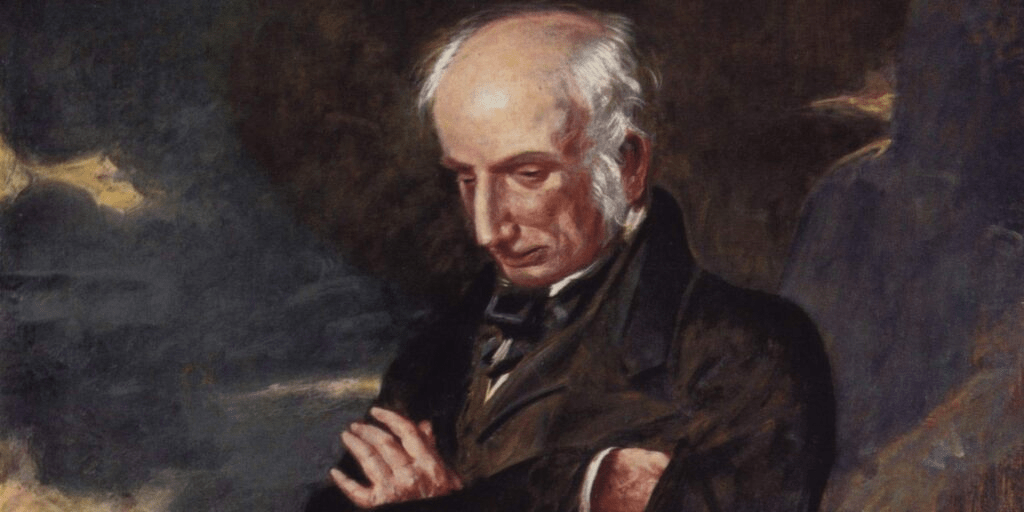
William Wordsworth lived to the ripe age of eighty, but at the age of thirty-two he couldn’t have known that. The life expectancy in England’s cities then was only between twenty-five and thirty years old. Out in the county where he spent most of his years the average time from womb to tomb increased significantly to forty-one. Still, at thirty-two he wouldn’t be faulted if he felt he was getting’ up there, so he had an old man’s “Get Off of My Wafting with Natures Glory Lawn!” moment.

Continue reading