P.O.E.T.S. Day! Hart Crane

[This entry is cross posted at ordinary-times.com]

Just when you thought it would never end, classical mechanics saves the day. We’ve spun through another week and that blessed moment when the whistle blows, it’s time to punch out, and traffic swells is almost upon us. Why wait? It’s P.O.E.T.S. Day. Piss Off Early, Tomorrow’s Saturday. There’s no reason to stick around when even the boss has mentally gone fishing. You’re not going to get anything done. At least not done well. Get out of there. Dissemble, obfuscate, ignore the niceties that lubricate the engine of society. There are mid-major basketball games to watch. Head on down to the bar a few hours before you’re “allowed” and have a happy hour beer. No one’s going to notice. Head to the park or the zoo. Browse a book store with a sleeved cup of that overpriced coffee they sell there. I wouldn’t go fishing because the boss might decide to slip out early too and that could get awkward, but hey, it’s your time. Take it. Do with it as you will. That said, may I suggest in homage to the mighty acronym, setting aside a moment for a little verse? It’s a particularly good way to pass time waiting on friends who may not run as roughshod over the niceties and were not as successful as you were in engineering an early exit.

***

This week’s poet is Hart Crane and his poetry can be a bit hard to grasp. That’s not just me being obtuse. Harrison Smith from the publishing house Harcourt, Brace wrote “I feel certain you are a genuine poet-and there are not many genuine poets lying around these days. . . . It really is the most perplexing kind of poetry. One reads it with a growing irritation, not at you but at himself, for the denseness of one’s own intellect.” The critic Edmund Wilson wrote he had “a style that is strikingly original—almost something like a great style, if there could be such a thing as a great style which was … not … applied to any subject at all.”

It was though. His style was applied to a great many things as he aptly explained to Harriet Monroe, editor of Poetry magazine in the 1920s, in a letter responding to her concerns about his submission, this week’s featured poem, “At Melville’s Tomb.” Previously Marianne Moore wrote to him, when rejecting an earlier poem for publication in Dial, “its multiform content accounts, I suppose, for what seems to us a lack of simplicity and cumulative force.” T.S. Eliot passed on the same poem for The Criterion. I imagine Crane jumped at the opportunity Monroe offered to explain his poetic choices, or his “rationale of metaphor,” to the editor of one of the more influential periodicals.

Continue reading

Commenting Right Up

I just wrote a 426 word comment on someone’s opinion post. It took me all of a few minutes and that’s while watching Bologna disappoint me again, this time against Monza which is new for me as I haven’t seen them play each other before. There was some deleting and rewriting because I’m an absurd on-the-fly editor when I get to typing but it went relatively quickly. Why the hell does it take me so damn long to write when I’m expected to?

I remember a bon voyage and thanks for all you’ve done article years ago by Jonah Goldberg on the occasion of Florence King’s retirement from regular contributor and whatever editorial duties she had. He was jovial and kind and obviously in awe of her but he did tease about the four or so hours she always took to complete a one thousand word piece. (Dammit. Monza won… Sorry. I mean “Dammit. [SPOILER] Monza won.])

Continue reading

POETS Day! William Carlos Williams

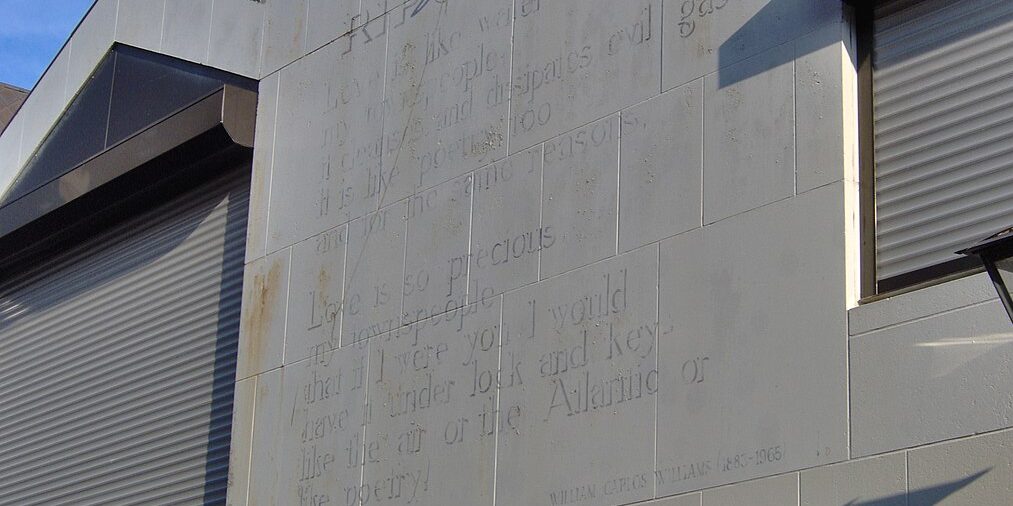
The poet Riposte of the American poet William Carlos Williams on a wall of the building at Breestraat 81, Leiden, The Netherlands, currently hardly visible because of its bad condition. Photo by Tubantia, CC BY-SA 3.0 , via Wikimedia Commons

[This entry is cross posted at ordinary-times.com]

I was in the shed pulling out all my POETS Day yard decorations in anticipation and I couldn’t help think but what a gosh darn special thing we got going here. I mean, golly. I know how much people hate those last few hours of work before the weekend because they make us the worst us we can be. There we are focusing on the crummy negative of being stuck in the ole grist mill when we should be pleased as punch that Henry Ford thought about us, the little guys, and invented the weekend so we can goof around with the fellas and have a few pops, go for a stroll in the park with our best girl (or guy,) or maybe take in a picture. I don’t want to be called a Holiday Harry, but that day is here again so I’ll say it: Piss Off Early, Tomorrow’s Saturday. Staying at work doesn’t do anybody any good. Show your boss how productive you’ve been this week and promise to work even harder next week. Bosses aren’t such a bad sort. Then you can walk out a few hours before the usual time, free as a bird. Maybe send him (or her) a picture of all the fun you’re having instead of sitting around the office like a gloomy Gus. If you’re up for advice I’d spend some of my bonus time in thanks to that swell holiday acronym and read some verse. You’ll be glad for it!

***

Loudon Wainwright III has a great song called TSMNWA (They Spelled My Name Wrong Again) where he sings about the frustrations of having a weird name. I can’t help hearing his voice whenever I read about or meet someone who goes by something unusual even if it’s just mildly odd: “My parents should shoulder some blame/For calling their kid a strange name.” I’m sure that William Carlos Williams wanted to have a discussion with mom and dad. “You named me William Williams?” he would ask, not without cause, though I’ve read his parents brought him up in a rigid atmosphere so maybe he passed on demanding an explanation and settled in to a lifetime of long signatures. Considering some of the anachronistic tongue-stumbler family surnames that wind up some unsuspecting kids’ middle names, that “Carlos” to break things up must have seemed a godsend.

Continue reading

Spicy Pineapple Collard Greens and The Great Vowel Shift

[This entry is cross posted at ordinary-times.com]

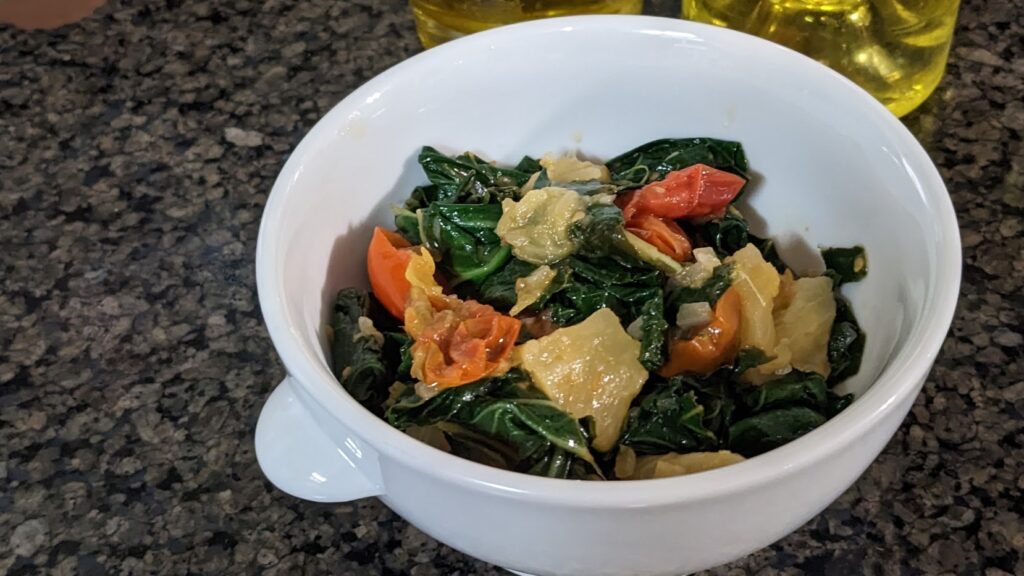
I wasn’t a very good vegetable eater as a kid. My sister was. She was evil about it. I’d be midway through the go-to opening pea deployment – a spread with a rise towards the plate edge, a scooped out crater in the middle, and a spread of green dots like a monochrome Pollock painting whisping along the curvature cunningly contrived to make it appear as there were less peas than before – as that little shrew was asking for seconds she didn’t really want. She didn’t just want to be Mom and Dad’s good little eater. She wanted to highlight that I wasn’t. A stray dog bit her once when we were playing in the woods and she had to endure a painful series of injections “just in case.” The rabies shots and the venal display she put on mugging for vegetable praise are probably unrelated. Contrary to popular usage, karma doesn’t act within the same incarnation so she won’t get hers until the next life. But she will get hers.

My oldest son claims to love veggies, but he’s got a narrow definition of them that includes French fries, pickles, and corn on the cob and excludes everything else. His younger brother will eat his brother’s list plus anything we’ve grown in the garden. It doesn’t have to be from our garden, it just has to be a variety of edible plant he’s seen come out of our garden at some point or a bell pepper, which isn’t really a vegetable but gets lumped in with them like tomatoes, cucumbers, squash, and a lot of the things I immediately think of when I think of vegetables but aren’t. Both turn their noses up at the bulk of our dinner sides.

Continue reading

I Read a Book! Kingsley Amis’s One Fat Englishman

The English Novel, 1740-1820

The open road winds down from Wilson’s farm
To neat lawns and a gilt-edged paradise
Where Pamela walks out on Darcy’s arm,
And Fanny Goodwill bobs to Fanny Price.

               – Kingsley Amis

Until last summer Kingsley Amis was an author I felt I should have read. Note the “should have.” I was never possessed by an urge to actually read anything of his. I just felt like knowledge of his works was something I should have in my quiver. Lucky Jim upset all the type of people I think should be regularly upset so I finally gave in and picked it up sometime in July. I’ve read two more of his novels since along with a collection of essays on science fiction, a decent amount of poetry, and thumbed through a roguish reference book on English usage. There’s another of his novels and his collected poems on my “to read” stack. I really should have gotten around to his stuff earlier.

The reviews of One Fat Englishman fall into one of two categories: those where the reviewer says that he thought the book was okay but not nearly up to the standard set by Amis in his other novels or those where the reviewer says that he thought the book was okay but not nearly up to the standard set by Amis in his other novels until for whatever reason the reviewer picked up the book for a second reading some years after the first and realized he badly misjudged this sardonically cutting and brilliant work. I’ve read it twice in the span of a month and enjoyed it thoroughly both times so I’m only a reliable judge of literary worth half of the time. Reader beware.

Continue reading

Sad and Drunk Beats Sad and Cold, but I’ve Only Seen The Sad and Cold TV Show

I’m a fan of Ian Rankin’s detective novels, so much so that I named my dog Rebus after his Inspector John Rebus, so I have to fall into the Sad and Drunk camp although I really enjoyed Wallander with Kenneth Branaugh. I got the distinctive Wallander ring tone for my phone because I’m a geek. I can’t claim Wallander fandom on the same level as I do Rebus fandom because watching TV (television) doesn’t bring the same intimacy and understanding of a character as reading does. Shows have their own up-sides, but I connect better on a page. I own a Wallander book but as of now it’s stored unread on my kindle where it keeps getting bumped back on the “To Read” list by The New Great Thing. If the show is anything to go by, that is one Sad and Cold Scandinavian.

Continue reading

Walking and Thinking: The Divine Soda Jerk

“Notice, too, their idea of God ‘making religion simple’; as if ‘religion’ were something God invented, and not His statements to us of certain quite unalterable facts about His own nature.”
               – C.S. Lewis,
Mere Christianity

I was thinking about C.S. Lewis’s claim that God didn’t invent religion while I was walking today. I have to say that I can see where Lewis can make a semantic case but there is a substantive one to be made for the other side. For Lewis to be right, only the elemental can be from God. I don’t think that tracks. God created man who created the ice cream sundae. The ice cream sundae is still a part of God’s creation and so still created by God. If you make the argument that insubstantial things are of a separate creation then you run into trouble with physics and mathematics and other measures by which we see material creation bound. Did God create the rules of the dice game Einstein says he doesn’t play, so to speak?

One of the great pleasures of walk thoughts is that they wander. The sundae got me thinking about the details involved in creating a universe and what an early riser it must require. What are the machinations? What we may see as roundabout may be the most direct and perfect route. We look at the sundae as a minor result of a greater plan. What if it was the goal?

Continue reading

Notes from Reading Sylvia Plath for POETS Day

The Unexpectedness of the poppies
their gratuitous beauty in
her own frozen life
               – Unknown Annotator

I checked out Sylvia Plath’s collections The Colossus and other poems and Ariel from The Emmet O’Neal Library in Mountain Brook, Alabama a week or so ago. Rather, I checked out Sylvia Plath’s collections The Colossus and other poems and Ariel from O’Neal Library, formerly The Emmet O’Neal Library until Emmet’s views on segregation that no one knew or knows about were dug up and found to be too embarrassing to city council public relations people but not so embarrassing that the O’Neal family’s, gracious benefactors it seems, name suffer as well, in Mountain Brook, Alabama a week or so ago. Someone got to Ariel before I did. Actually, lots of people got to Ariel before I did. At least I assume so. The earliest stamped date in the book, copyrighted 1966, appears to be May 7, 1987. A lot of people likely signed their name from the card that used to be in the check out sleave adhered to the last page. It’s all computerized now, of course, so the card is no more. Some library books still have them and I like to see how many people read the book, or at least took it home, before me. Not Ariel. The card is gone. I know at least one person checked it out though, because she wrote all over the place. That’s the someone I’m focusing on, because that someone went from being a someone to being someone.

Continue reading

POETS Day! Sylvia Plath

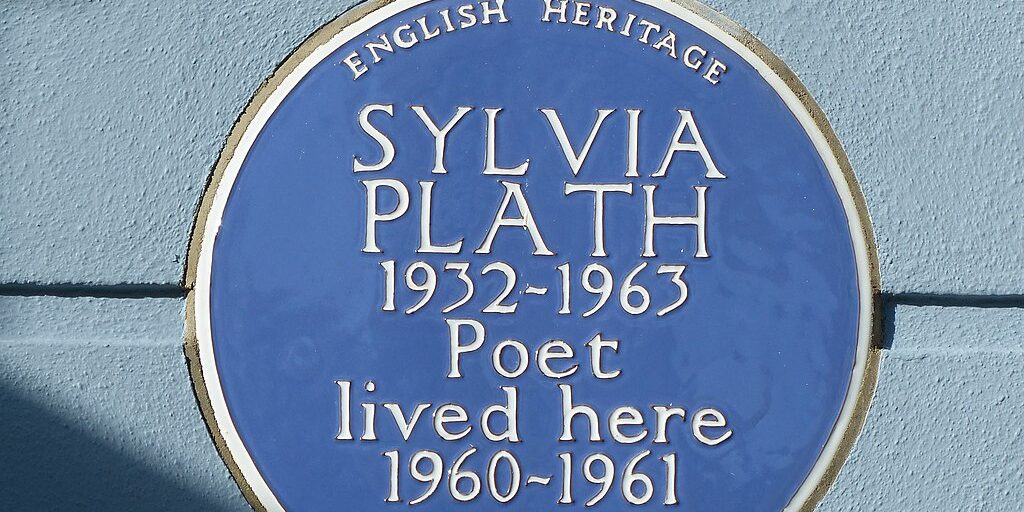
Photo by Megalit, CC BY-SA 4.0 , via Wikimedia Commons

[This entry is cross posted at ordinary-times.com]

Welcome to POET’S Day of the second week in Ordinary Time. Today we try to make anguish take wing, be a light for those in the land of gloom, and bring abundant joy by encouraging you to usher in the weekend a few hours early. Why wait until Friday evening when a slight bending of the truth can get you out of work in the middle of the afternoon? It’s POET’S Day by God’s sake. Piss Off Early, Tomorrow’s Saturday. Dissemble, obfuscate, and gleefully trespass the norms that preserve our hopefully durable civilization, but be as pious about it as you can this time. Be humble and thankful at this opportunity to escape the sultry bonds of employment you’ve been given. Use the time wisely. Marvel at natures grandeur in a local park. Join in fellowship at a local watering hole before happy hour even has a chance to kick off. You deserve it. No matter how you end up spending your gotten free time (remember, stealing hours from work are only “ill gotten” if you fake being sick) maybe take a moment to enjoy a little verse.

***

This week’s POET’S Day poet is Sylvia Plath which makes banishing anguish, bringing light and abundant joy a thing of the weekend activity rather than the poem. Sorry about the bait and switch. I won’t go into her background because I want to do something different this time and break this week’s featured poem down stanza by stanza. Plath was mentally ill. She described her manic depression in a 1958 journal “It is as if my life were magically run by two electric currents: joyous positive and despairing negative—whichever is running at the moment dominates my life, floods it.” In January of 1963 she told her doctor that she had been deeply depressed for six or seven months. In February of that year she put her head in a gas oven and died of carbon monoxide poisoning.

In the months before her death she wrote poems that would be posthumously collected along with a few of her previously published but uncollected works and titled Ariel, released in 1965. In the introduction, poet Robert Lowell wrote that these were composed at a furious pace, “often rushed out at the rate of two or three a day.” She and Lowell were among those known as “The Confessional Poets” with Elizabeth Bishop and John Berryman among others. None of them were fond of the moniker. In The Wounded Surgeon, Adam Kirsch writes that “Plath scorned the notion of poetry as ‘some kind of therapeutic public purge or excretion.’” Not that it mattered. They all were heavily autobiographical. In Ariel Plath writes of her past suicide attempts, resentments towards her father and husband, and carbon monoxide poisoning should there be any doubts that her suicide wasn’t considered long before it’s execution.

Continue reading