[This entry is cross posted at ordinary-times.com]
You still at work? What do you think you’re getting done between now and quitting time? Cut out and stop pretending. Piss Off Early, Tomorrow’s Saturday.
First, a little verse.
***
Before JRR Tolkien’s Gandalf, there was William Morris’s King Gandolf. Before Tolkien wrote about the horse Shadowfax, Morris wrote about the horse Silverfax. Morris introduced both of the latters in his just-under-the-wire-not-posthumous 1896 novel, The Well at the World’s End. Tolkien didn’t steal. Theft in literature is generally more interesting than something that direct, but neither Gand-whatever nor whatever-fax were properly owned to begin with. Tolkien was doubtlessly inspired by Morris’s popular book, but both authors took names from Norse and Icelandic myth. They heard the same stories.
Plugged in fans and obsessives—I say that lovingly—of the genre credit Morris as one of the fathers of modern High Fantasy. Tolkien takes all the laurels, and deservedly so, for standing on earlier shoulders and leaping as high into the air as possible. Two of those shoulders were Morris’s; David Byrne shoulders.
These days, Morris is best known for textiles and design. He was an vocal socialist; important enough that those who take interest in the development of socialism, at least in England, have been at work on his Wikipedia page. Among the signs of ardents tinkering: his mother is described as “descended from a wealthy bourgeois family.” As an artist and artisan, he catered to what most outside of the struggle session green room call the middle and upper classes. His furniture was, and maybe still is, in St. James Palace and the Duke of Westminster’s Eaton Hall. Per the biographer Fiona MacCarthy, he decried such work as “ministering to the swinish luxury of the rich.” But minister on he did, soldiering his way to increasing an already solid inherited fortune.
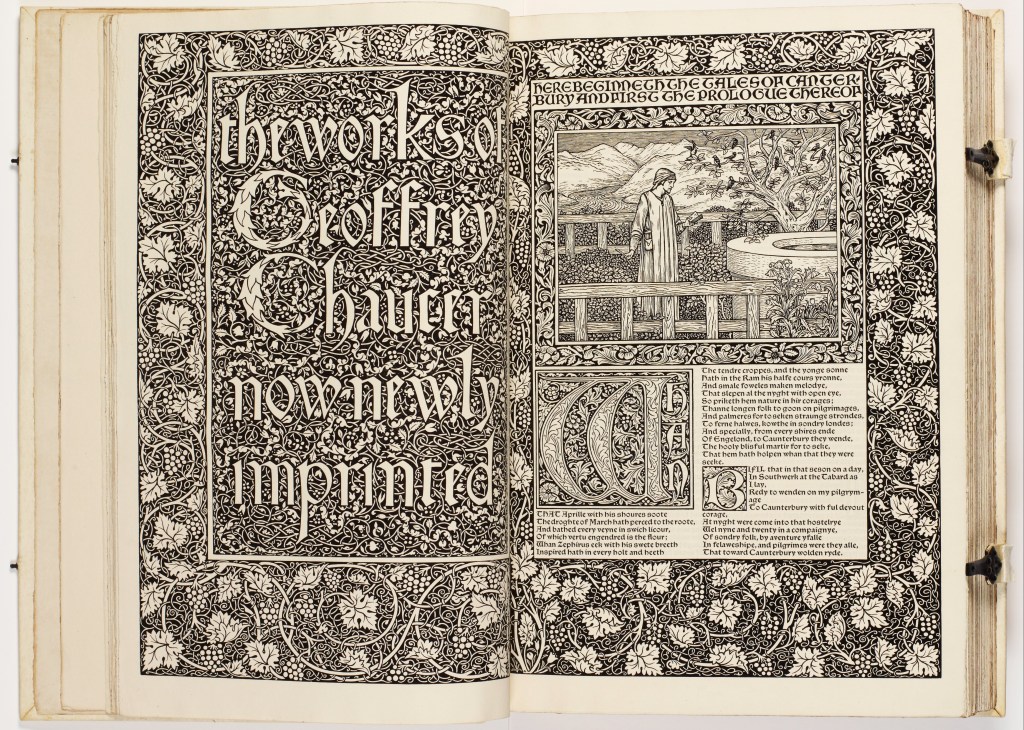
He took what was functional and added beauty. That doesn’t sound like much of a revolution, but he lived in post-Industrial Revolution England. Function held sway. His patterns, busy to modern tastes, adorned rugs, wallpaper, and book covers. Through his printing operation, the Kelmscott Press, he published the intricate Kelmscott Chaucer, a collection of Chaucer’s work decorated with Morris’s typography, layout, borders, and illumination and with illustrations by his partner and frequent collaborator Edward Burne-Jones. The two men worked on the volume on weekends together over the course of four years. Yeats called it “the most beautiful of all printed books.”
During his lifetime, there were those who knew him as a socialist. He’d tell any audience willing to listen all about his political and economic leanings. There were others who knew him as a designer. He was quite the name among those in the market. Primarily, he was known as a poet. As hard as it would be for one of his contemporaries to believe, he’s almost forgotten in that role now. This was the man Victoria offered the Laureate position after the death of Tennyson.
We prefer short lyrics these days. He went long. Here’s one of his few quick ones.
Pomona
William Morris (1834-1896)I am the ancient Apple-Queen,
As once I was so am I now.
For evermore a hope unseen,
Betwixt the blossom and the bough.Ah, where’s the river’s hidden Gold!
And where the windy grave of Troy?
Yet come I as I came of old,
From out the heart of Summer’s joy.
From that you get that he can be whimsical and you’d be correct in extrapolating that he works in traditional meter with rhyme. The bulk of his output was more involved. He wrote long, epic works, often Arthurian themed.
Below is an excerpt from one of his most popular works, “The Haystack in the Floods,” from his 1858 book The Defence of Guenevere, and Other Poems. The poem is set in withdrawal from the Battle of Poitiers during the Hundred Years War. Sir Robert de Marny, the only historical figure in the poem, though one whose manner of death is fictionalized by Morris, and his mistress Jehane are traveling with a small contingent when set upon and captured by the Frenchman Godmar and his men.
from The Haystack in the Floods
Along the dripping leafless woods,
The stirrup touching either shoe,
She rode astride as troopers do;
With kirtle kilted to her knee,
To which the mus splashed wretchedly:
And the wet dripped from every tree
Upon her head and heavy hair,
And on her eyelids broad and fair;
The tears and rain an down her face.
By fits and starts they rode apace,
And very often was his place
Far off from her; he had to ride
Ahead, to see what might betide
When the roads crossed; and sometimes, when
There rose a murmuring from his men,
Had to turn back with promises;
Ah me! She had but little ease;
And often for pure doubt and dread
She sobbed, made giddy in the head
By swift riding; while, for cold,
Her slender fingers scarce could hold
The wet reins; yea, and scarcely, too,
She felt the foot within her shoe
Against the stirrup: all for this,
To part at last without a kiss
Beside the haystack in the floods.
Godmar offers to spare Robert’s life if Jehane agrees to be his concubine. She refuses. Robert is killed and she faces a short life in prison before death by drowning in the Seine. It’s about true love and sacrifice; Poetic and Romantic and ideal in ways Morris’s own love life was not.
He was an early member of the Pre-Raphaelite movement and, at least initially, great friends with the movement’s most famous painter, Dante Gabriel Rossetti. In 1857, Morris met and was smitten with Jane Burden. Rossetti, at the same time, asked her to model for him, a phrase I assume carried more meaning in this instance than others. Morris married her. Rossetti continued to paint her.
Thanks to Rossetti, her face is immortal. He had many models, but if I were to say “She’s the woman besides his sister that he painted over and over again,” a passing fan of his would know who I meant. In his work she is Aurelia, Lady Lilith, Beatrice, Pandora, and more. The model and artist traveled together, attended events, and dined together. At one point Rossetti moved in with the couple. People talked. Whatever estrangements and tensions between Rossetti and Morris existed, this apparent affair was an accepted fact of life. Morris may have had a friend too, but one he cozied to after his wife’s modeling proved less a passing thing.
Aglaia Coronio and Morris wrote letters to each other. It’s assumed more, but there’s not more than suspicion. In fact there’s not much more than appearances and suspicion behind the Rossetti and Burden affair. Burden once said she never loved her husband. Even so, we speculate that she did love Rossetti. The Pre-Raphaelites were so much more circumspect than the Bloomsbury Group.
The Kelmscott Chaucer was only one expression of Morris’s fascination with Geoffrey Chaucer. He incorporated scenes from The Canterbury Tales into designs for furniture and murals. As a poetic homage, he wrote “The Earthly Paradise,” a single work with a prologue and, as described by The Norton Anthology of Poetry, “twenty-four tales on classical and medieval—especially Norse—subjects.”
These are the third and fourth stanzas from the poem’s six stanza dedication. It’s woeful, sung by a poet “born out of my due time” but he doesn’t despair. These aren’t futile lines.
from The Earthly Paradise
The heavy trouble, the bewildering care
That weighs us down who live and earn our bread,
These idle verses have no power to bear;
So let me sing of names rememberéd,
Because they, living not, can ne’er be dead,
Or long time take their memory quite away
From us poor singers of an empty day.Dreamer of dreams, born out of my due time,
Why should I strive to set the crooked straight?
Let it suffice me that my murmuring rhyme
Beats with light wing against the ivory gate,
Telling a tale not too importunate
To those who in the sleepy region stay,
Lulled by the singer of an empty day.
I include this last poem because something about it struck me. It doesn’t fit in sound with other entries in the collection in which I found it: the same 1891 book, Poems By the Way which included the above “Pomona.” The stresses are compressed and rapid. The vocabulary is anachronistic, as are the contractions. It put me in mind of Gerard Manley Hopkins.
Hopkins used Anglo-Saxon poetic devices; fierce alliteration, stresses measured per line rather than per place, and hard consonants for emphasis. That seems similar to what Morris does in “The Day of Days.” Hopkins was an obscure figure, contemporary with Morris but for all intents and purposes unknown until posthumous publication in 1918, well after Morris passed. It’s possible that Morris read Hopkins’ work, but unlikely. Did Morris find in his Norse research threads of the same poetics Hopkins found in his Anglo-Saxon dives? Instead of influence from one to the other, could Morris have tapped the same older Germanic root as Hopkins? As Tolkien tapped the same Norse roots as Morris found his Gandalf? Am I imagining things?
I can’t say, but it struck me.
The Day of Days
Each eve earth falleth down the dark,
As though its hope were o’er;
Yet lurks the sun when day is done
Behind to-morrow’s door.Grey grows the dawn while men-folk sleep,
Unseen spreads on the light,
Till the thrush sings to the coloured things,
And earth forgets the night.No otherwise wends on our Hope:
E’en as a tale that’s told
Are fair lives lost, and all the cost
Of wise and true and bold.We’ve toiled and failed; we spake the word;
None hearkened; dumb we lie;
Our Hope is dead, the seed we spread
Fell o’er the earth to die.What’s this? For joy our hearts stand still,
And life is loved and dear,
The lost and found the Cause hath crowned,
The Day of Days is here.

