[This entry is cross posted at ordinary-times.com]
Officially, the work week’s gonna be over in a few hours. What are you doing? You’re not getting anything done between now and then. Cut it out and stop pretending. Piss Off Early, Tomorrow’s Saturday.
First, a little verse.
***
Boys play seriously. Words used metaphorically by noncommisioned adults, words like “scout” and “reconnoiter,” carry a punch in their youthful declarations implying duty or professionalism.
For a brief stretch of years, they patrol the neighborhood with pant legs tucked in galoshes on the lookout for good sticks, skipable rocks, animal tracks, and fossils. If they’re lucky enough to live near slate deposits or any shale that cleaves, “arrow heads” abound.
My wife and I walk roughly the same path everyday, weather permitting, along our creek. The city is making improvements no one wants. They cut ten foot paths through grass and laid asphalt pathways intermittently. Then they stopped. Debris containing construction fences have been in place for ten months now. The wiffle golf players don’t come out any more, nor do the Russian card players, though one of their chairs litters a fenced off section near the put in. The old foot worn paths remain. Neighbors ignore the city’s trails and keep on as habit and sense dictates, but the city paths wind. They snake in such a way that all the clearings that hosted croquet and touch football are intruded upon.
Every so often something happens. A truck comes by and people in reflective vests get out and wander around for a while. Usually, right after they leave, we see spray painted notes on our walks. Orange “ATT Clear”, day-glo green “Spire GAS”, and white “Elec” presumably meant to alert future crews as to the owner or purpose of nearby poles or what pipes or lines lay beneath, but they spray paint on fallen leaves. The next day it’s all wind scattered, leaving the place looking a like safety hued Jackson Pollock. A few weeks later, a truck comes by and people in reflective vests get out and wander for a while. Right after they leave, we see spray painted notes on our walks… They don’t seem to tire of the game.
A month ago, we got a bridge over a gully and then a few days later, another over a small feeder stream. I’ve yet to find a neighbor who saw them built or saw any build up to seeing them built. One day there was a bridge. Then there was another. Neither is finished nor has been worked on since its appearance, but it’s a step closer to improving the grass and trees that everybody liked just fine before.
It’s still a walk and there’s still a creek. The mess is so far a few distope units from overwhelming the sounds and sights of water and all its pleasantries. It’s just frustrating.
To our youngest son, tractors are cool, especially unattended tractors left for days so anyone—no matter how many lawyers his parents know—can climb up on the topside tracks, sit in the cockpit, make vrrrr-choom noises while they pretend to drive, and level tank guns towards enemy artillery position on the crest.
None of the creek park inconveniences take away, from his perspective. Skateboards go faster on asphalt than grass. If they were meant to keep him out, the debris fences would have been made taller. Bikes make dramatic skid marks in gravel.
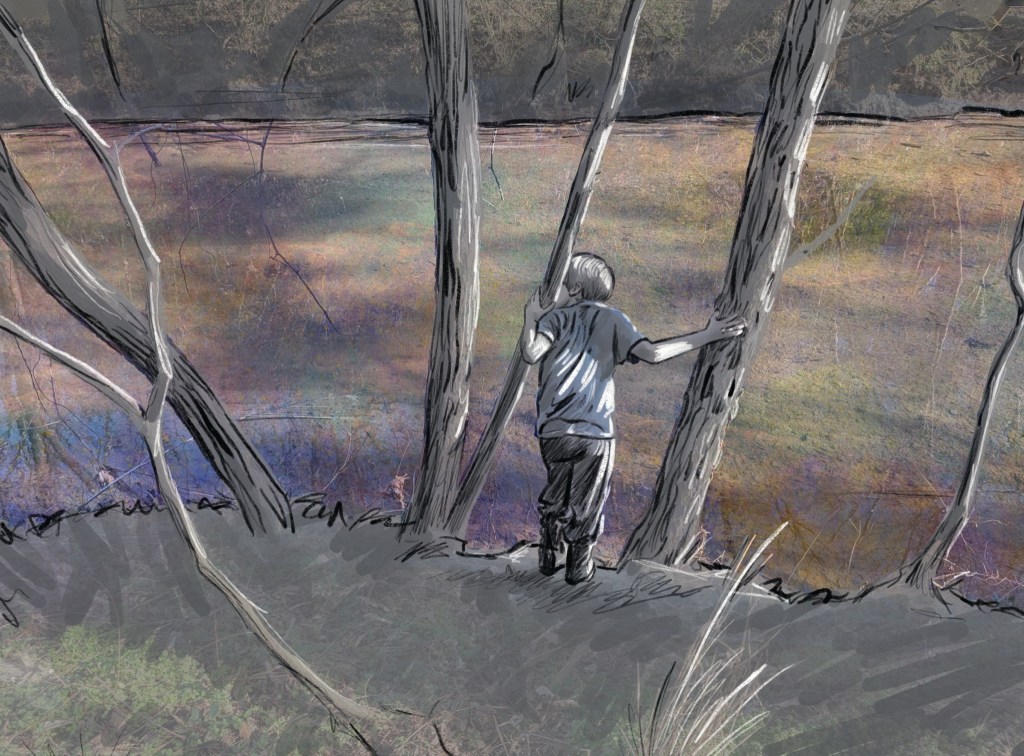
The world is his archaeological site. There are clues if you’re young enough to look. Every clearing is a meeting place for some unknown cabal even if it’s just where Matt from up the street sits and reads. Every worn path has strategic value. Yesterday he showed me a plank pressed up against two trees with rock piles on both ends keeping it upright. He found it scouting the lower banks. There doesn’t seem to be a much sense to the arrangement, but he tells me it’s probably for watching fish. I have no idea why that would be, but I took his word for it.
I recognize all of this from somewhere else. There was a time before I discovered girls and beer when I ranged a similar landscape. It’s not long till he moves on as well.
In wistful moments, these are remembered as carefree times. They weren’t. Boys play seriously in the woods; canteens, flashlights, compasses, all stowed in backpacks incongruously covered in superhero or video game patches. I think it’s especially true that it’s serious when the kid himself thinks he’s growing out of the age where pretending is appropriate, where he thinks he might get made fun of for acting like a kid. Mine doesn’t carry his backpack with him on his ventures out anymore. He doesn’t let on so much, but I’ll see him, from the house, crouching behind a bush or flat against a tree trunk, risking a peek at nonexistent enemies.
I thought of Robert Frost. He’d be the one to capture innocence playing at knowing. America’s Grampa wrote about rural life in New England and I figured he’d surely touched on what it was like to be a boy let loose on the countryside. I didn’t find anything in his first collection, A Boy’s Will, which I assumed, for not very hard to guess reasons, would be the most likely place to find his expressions on the sentiment. The closest I came to finding what I expected was in “Birches,” from his third collection. And then, the subject is touched on very briefly in a longer poem.
from Birches
Robert Frost (1874-1963)I should prefer to have some boy bend them
As he went out and in to fetch the cows—
Some boy too far from town to learn baseball,
Whose only play was what he found himself,
Summer or winter, and could play alone.
That surprised me a bit. What didn’t surprise at all was how succinctly he conveyed independence, creativity, and burgeoning responsibility.
The second poet I’d pressed my assumption on delivered.
Pirate Story
Robert Louis Stevenson (1850-1894)Three of us afloat in the meadow by the swing,
Three of us aboard in the basket on the lea.
Winds are in the air, they are blowing in the spring,
And waves are on the meadow like the waves there are at sea.Where shall we adventure, to-day that we’re afloat,
Wary of the weather and steering by a star?
Shall it be to Africa, a-steering of the boat,
To Providence, or Babylon, or off to Malabar?Hi! but here’s a squadron a-rowing on the sea—
Cattle on the meadow a-charging with a roar!
Quick, and we’ll escape them, they’re as mad as they can be,
The wicket is the harbour and the garden is the shore.
Robert Louis Stevenson’s name is tied to children’s adventure stories. I’d say synonymous, but he played adult mind games in his classic Dr Jekyll and Mr Hyde. I remember Kidnapped as the book report assignment that served as vehicle for the nuns’ imposition of the five paragraph essay stricture: “Tell me what you’re going to tell me. Tell me. Tell me what you told me.” Either of those titles may be his best known novel. I don’t know how to pick apart his popularity, but if I had to guess, I’d say the pirate book rules them all.
In 1881, he amused his twelve-year-old stepson with a tale of pirates and adventure. The story grew, was serialized in Young Folks magazine and eventually published as Treasure Island. The N.C. Wyeth’s* illustrations were added to popular editions in 1911, seventeen years after Stevenson’s death. It’s hard for me to imagine one without the other, but the book was a smashing success before. He was the one who came up with X marking the spot and pirates with peg legs and parrots. He made the Jolly Roger ubiquitous, convinced us that buccaneers risked life and limb for piles of treasure they buried instead of spent.
In addition to prose, he wrote a great many poems for adults and children including, as I’d hope to find, a great many for adults recalling adventures imagined as children.
This last is full of daring at nursie’s side.
My Treasures
These nuts, that I keep in the back of the nest,
Where all my tin soldiers are lying at rest,
Were gathered in Autumn by nursie and me
In a wood with a well by the side of the sea.This whistle we made (and how clearly it sounds!)
By the side of a field at the end of the grounds.
Of a branch of a plane, with a knife of my own,
It was nursie who made it, and nursie alone!The stone, with the white and the yellow and grey,
We discovered I cannot tell how far away;
And I carried it back although weary and cold,
For though father denies it, I’m sure it is gold.But of all my treasures the last is the king,
For there’s very few children possess such a thing;
And that is a chisel, both handle and blade,
Which a man who was really a carpenter made.
*Wyeth regretted his work illustration Stevenson’s novel. Per Wikipedia, “By 1914, Wyeth loathed the commercialism upon which he became dependent, and for the rest of his life he battled internally over his capitulation, accusing himself of having “bitched myself with the accursed success in skin-deep pictures and illustrations.” I have no idea why the phrase “bitched myself” fell out of usage but can’t imagine not using myself going forward.
 The Columbo Game