[This entry is cross posted at ordinary-times.com]
The work week is gonna be over now, or it’s gonna be over in a few hours. What are you doing? You’re not getting anything done. Cut it out and stop pretending. Piss Off Early, Tomorrow’s Saturday.
First, a little verse.
***
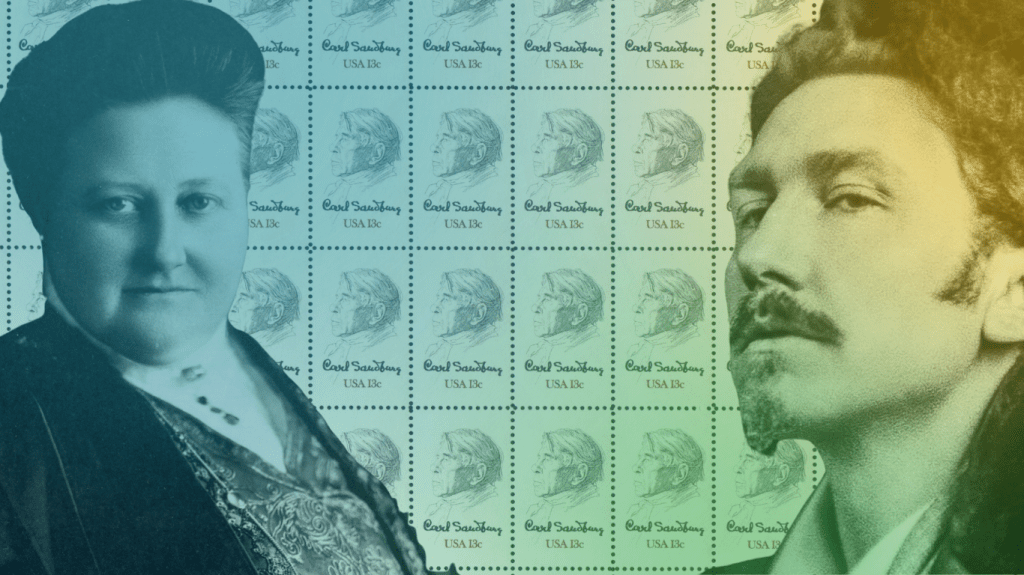
Carl Sandburg was posthumously honored with a postage stamp bearing a sketch of the poet done by his friend William A. Smith and the poet’s “distinctive autograph.” The “distinctive autograph” language comes from Wikipedia which appears to have gotten it from the world stamp authority, Scott Catalogue. Who doesn’t have a distinctive autograph? Signatures are supposed to be distinctive.
Before this week, I didn’t know much about Sandburg beyond a handful of poems I really liked and a handful I really didn’t. I knew he was a major figure in American letters, but didn’t realize the scope. In short, I was aware of his poetry and impact on that discipline, vaguely aware that he’d written Lincoln biographies, and think I’d heard somewhere that he helped preserve and widen the audience for American folk music. I didn’t realize how beloved he was in his time. Rather, I didn’t realize how large a figure he was in his time, because for all that he was beloved, he was scorned too.
Reports run hot and cold. The slights seem more rancorous than necessary. The hagiographies exalt quotidian stuff, shades of the distinctive autograph (His fingerprints were one of a kind!). It’s hard to get a handle on the man.
He’s probably best known poetically for the opening of “Chicago,” the first poem in his collection, Chicago Poems.
from Chicago
Hog Butcher for the World,
Tool Maker, Stacker of Wheat,
Player with Railroads and the Nation’s Freight Handler;
Stormy, husky, brawling,
City of the Big Shoulders:
In the author intro for Sandburg in The Norton Anthology of Modern and Contemporary Poetry, Vol 1, the editors tell us “Some readers of his Chicago Poems (1916) objected to his delight in violence and attributed to his socialist politics.” In a letter to Amy Lowell he claimed, per Norton, his intention wasn’t to “propound theories of the Industrial Workers of the World, but ‘to sing, blab, chortle yodel, like people, and people in the sense of human beings subtracted from formal doctrines.” He’s hailed as Whitman-esque by many. He’s hailed as having, maybe more than any American before him, done as Wordsworth declared a poet should: speak in the words of the common man.
Norton’s also tells us that William Carlos Williams “regretted that Sandburg ‘deliberately invited’ failure by inattention to the demands of craft.” Robert Frost said Sandburg was a fraud.
Ezra Pound seemed to like his work. There’s an out of print anthology he put together in 1915, right before Chicago Poems was published, called Catholic Anthology, 1914-1915. It was Pound’s spiteful rebuke, a collection published to compete with and to overshadow the forthcoming Some Imagist Poets: An Annual Anthology – the first publication since Amy Lowell’s hijacking (Whether she did or not, that’s how he saw it.) of his Imagiste movement under the Imagism banner. Awful copy/pastes of Catholic Anthology are scattered about dusty corners of the internet; indentations mangled and poems half deleted. There’s a very good scan at HathiTrust.
Pound really didn’t like Lowell. As I wrote on these electronic pages a couple of years ago:
He marched around at one of her parties with a metal wash tub on his head making fun of her poem “The Bath.” The eponym “hippopoetess” was coined by the poet Witter Bynner, but Pound wasn’t shy about using it freely to describe the five foot tall, two-hundred and fifty pound, cigar chomping Lowell.
It appears that in order to make her look as bad as possible while simultaneously making himself look as magnificent as possible, Pound pulled out all the stops. Her book was good, but his book opened with Yeats, the time’s major poet, and featured the first book-bound printing of Eliot’s “The Love Song of J. Alfred Prufrock.” William Carlos Williams is in there. Despite the title’s 1914-1915 claim, Pound reprinted from his own 1913 hit series, “Contemporania.”
In total, sixteen poets contributed. It’s a tremendous collection. Perhaps the most interesting entry is the single poem by Harriet Monroe. I like the poem a great deal, but it doesn’t jump out because of its merits. Monroe was the founder and editor of Poetry magazine and as such, one of the most influential people in English language poetry at the time. Maybe the most influential. I think her poem, “A Letter from Peking,” served as a middle finger aimed right at Lowell. Pound marking territory.
In this most important salvo of a book meant to humble Lowell’s stewardship of Pound’s Imagism movement (which he took to calling “Amygism” with all its obscene connotations), Sandburg offers two from his then upcoming Chicago Poems: “The Harbor” and “The Road and the End.”
The Harbor
Passing through huddled and ugly walls,
By doorways where women haggard
Looked from their hunger-deep eyes,
Haunted with shadows of hunger-hands,
Out from the huddled and ugly walls,
I came sudden, at the city’s edge,
On a blue burst of lake,
Long lake waves breaking under the sun
On a spray-flung curve of shore;
And a fluttering storm of gulls,
Masses of great gray wings
And flying white bellies
Veering and wheeling free in the open.
Without meter he builds alliteration followed by hard consonants to set beats; H, G, and D in the first half and G, L, FL, and WH in the second. Fixed walls and drained people give way to “burst,” “breaking,” and “spray-flung” – a release.
Sandburg wrote two multi-volume biographies of Abraham Lincoln. Or he didn’t, depending on who you listen to. Abraham Lincoln: The Prairie Years was published in two volumes in 1926, Abraham Lincoln: The War Years in four volumes, in 1939. The Pulitzer committee certainly loved the latter, but they have a standing rule against awarding biographies of Washington and Lincoln for some reason. They gave him, instead, a Pulitzer Prize for History. This was possible because of criticism that his works, while brilliantly written and informative, didn’t contain any new scholarship. He didn’t do the work of a biographer. To those holding that opinion, he wrote a history. In either case, the books were smashing successes.
Having read “Notes for a Preface,” which despite the title serves as preface for his Complete Poems of Carl Sandburg, I can understand why any faults in the Lincoln books were easily passed over. He’s an engaging prose writer even when, as a reader, you are at odds with his argument. Which, in the case of the preface, I am.
In it, he confronts criticisms claiming his poetry is not, in fact, poetry, writing that poetry is beyond form:
There is formal poetry perfect only in form, “all dressed up and no where to go.” The number of syllables, the designated and required stresses of accent, the rhymes if wanted—they come off with the skill of a solved crossword puzzle. Yet its animation and connotation are less than that of “a dead mackerel in the moonshine,” the latter even as an extinct form reporting that once it was a living fish aswim in bright waters.
That’s not very satisfying. That bad poetry exists should surprise no one. If rising to a threshold of excitement or serenity is what makes a poem, should prose writers restrain themselves lest they accidentally bump their novel into the realm of poetry?
His 1928 collection Good Morning begins with “Tentative (First Model) Definitions of Poetry.” I don’t know his body of work well enough to claim a pattern, but with “Notes for a Preface,” that’s twice he’s begun a book with an offering claiming to be a draft. If that’s the extent of it, it’s amusing. He’s showing that his thoughts are ever evolving. I hope he didn’t beat the idea into the ground.
Some of the definition, italics his:
Poetry is the report of nuance between two moments, when people say, ‘Listen!’ and ‘Did you see it?’ ‘Did you hear it? What was it?’
and
Poetry is a sky dark with a wild-duck migration.
and
Poetry is the establishment of a metaphorical link between white butterfly-wings and the scraps of torn-up love-letters.
There are thirty-eight of them. I think he’s protesting too much, trying to establish that inspiration for poetry makes craft unnecessary, as if the same inspiration could be a painting but for the paint, a novel but for the story, or a symphony but for the music.
No matter what definition of poetry you adhere to, he’s fun to read.
In addition to poetry, history/biography, and prose, Sandburg was known for music. In 1929 he released a book of folk music titled, American Songbag. A hit on the lecture circuit, he showcased his many talents with talks, poetry reading, sang, and played guitar. Apparently he played guitar extremely well, having studied under the legendary classical guitarist Andrés Segovia. Poetry Foundation’s not-celebrated-enough mini biographers describe him as “an author accepted as a personality” in the vein of Mark Twain, a touring celebrity.
He did a lot. He put out a lot, so even if, like me, you don’t like the whole, there’s slivers enough of really good material to make Sandburg worth reading. He is agile.
Here’s the second of Sandburg’s from Pound’s anthology. I should note that Amy Lowell was impressed by Chicago Poems, calling it “one of the most original books this age has produced.”
The Road and the End
I shall foot it
Down the roadway in the dusk,
Where shapes of hunger wander
And the fugitives of pain go by.
I shall foot it
In the silence of the morning,
See the night slur into dawn,
Hear the slow great winds arise
Where tall trees flank the way
And shoulder toward the sky.The broken boulders by the road
Shall not commemorate my ruin.
Regret shall be the gravel under foot.
I shall watch for
Slim birds swift of wing
That go where wind and ranks of thunder
Drive the wild processionals of rain.The dust of the travelled road
Shall touch my hands and face.
 The Columbo Game