POETS Day! Allen Ginsberg

De Amerikaanse dichter Allen Ginsberg in 1979 in de Gentse Poëziewinkel.

[This entry is cross posted at ordinary-times.com]

A friend of mine owns a restaurant and just had to let two waitresses go for absenteeism. They called the health department as petty revenge and inflicted a spot check by a blue gloved inspector. I’m pretty sure it was them.

The word “Tomorrow” matters. POETS Day stands for Piss Off Early, Tomorrow’s Saturday. Escape from work on Friday. This should be obvious. Don’t call in ten minutes before work on a Tuesday and have your roommate who works with you call in right after. That’s mean. Someone is going to have to fill in for you. Someone with plans.

The point is to get a head start on the weekend rather than support the lie that anything gets done in the twilight workweek hours; make a statement and stand up for truth and other good stuff. Don’t disrupt the weekend funding mechanism. That’s Bad Practices.

The petty revenge failed. The score post-spot inspection is three points higher than the score pre. On a related note, if you’re in the Birmingham area and want to enjoy a pizza or some pasta in a setting recently confirmed to be clean, I have a suggestion. Sit at the bar and read a bit of verse. Come in on a Friday afternoon and you might catch a fellow patron aglow with the light of a POETS Day properly respected and enjoyed.

Continue reading

Inspired by Jessica Hornik

I read Jessica Hornik’s poem “Evening, Lake St. Catherine” in the latest National Review (August 14, 2023). I wish I could reprint it (here it is behind a paywall if you subscribe,) but she’s getting a well-deserved payday and that’s a good thing. It’s a wonderful poem about the highlights of a day folding in towards a moment of reflection or relaxation.

The shape of it is interesting. I’ve been reading about poetic form and function with just enough understanding to make hedged observations. Reading too much into things is a toy I brought with me, but couple that with some gleenings from a well written book, and I’m practically an expert, or the nearest you’re likely to find on the subject in my kitchen at this moment.

The poem is thirteen lines of blank verse set in couplets excepting the last standalone line. The opening line is eight syllables and the next is seven. Then seven then eight, then seven then eight or nine depending on how you pronounce “chocolate.” Nine/seven, five/eight, eight/four, and all alone a ten. There doesn’t seem to be regulation but it follows a mostly iambic music with breaks and me not knowing if a dropped stress is a concession to sense or if she’s shifted to a three syllable foot here and there. Or is it free verse and I’m seeing pieces where there’s a whole? I lack a fluency I wish I had.

I have this issue all the time when reading something that breaks a simple repeated meter. if I see un-st/un-st/un-st/un-st in the first line I say “Iambic tetrameter. If the next line gives me un-st/un-st/un-st/un, what is that? Is that three iambs with an unattached or dropped syllable? Two iambs with an un-st-un foot I looked up so I could call an amphibranch? Is this something poets don’t care about or shrug at?

Continue reading

POETS Day! Elizabethan Carpentry

[This entry is cross posted at ordinary-times.com]

David Letterman used to talk about windchill factor. A former weatherman, he thought it was goofy that a cold temperature was announced and then amended accounting for windchill making it the equivalent of a colder measurement rather than just saying the final, adjusted temperature. He’d call windchill fake but quickly add “Now humidity. That’s real.”

I’m with him. Humidity alone isn’t that bad. I don’t think I’ve ever complained about it in the winter. It needs heat to angry it up, but once you get those droplets riled the air’s venomous.

My phone reports the day’s temperature with a “Feels like” when it’s humid too, but that’s wrong. Completely wrong. Humidity isn’t an aspect of heat and doesn’t express as an increase of it. Saying “It’s 92° but with 70% humidity it feels like 103°,” assumes a flow towards equilibrium that’s not there. It would be more apt to say “It’s 92° but with 70% humidity it feels like 92° and you just dropped a cast iron skillet on your foot.” Humidity’s a separate and more immediate discomfort. In freeze-dried lasagna lore a frog in a pot of water over high heat doesn’t notice the slowly increasing temperature and keeps swimming about until he boils. Boils, not drowns. No one would believe the cautionary tale if he doesn’t go up for air. When you’re surrounded by water, heat is secondary.

Continue reading

Tomato Jam (Extended Jam)

[This entry is cross posted at ordinary-times.com]

… in which nothing was pressed.

In 1991, I went to a party in Lexington, VA, a place I was told at the time was the hot spot for inbreeding in the United States. My dad had recently been to Australia, and flying across that countrinent, he read an article in the in-flight magazine about a restaurant in Perth that was hailed as “The Best Restaurant in Australia.” It was near enough to his hotel so he went. “I’ve never been to the best restaurant in a country before,” he told me.

Being in the most inbred, per capita, city in a country is perfectly safe if you observe from a place of safety like an anthropologist in a blind or an oceanographer in a windowed diving bell. I was visiting a friend at Washington & Lee, so it was kind of like that. I don’t remember the party details. We went to a concert in a small columned structure and my friend was a first semester freshman, so I doubt it was Greek sponsored. It was private. I’m sure of that because there were only three or four hundred people in the hall and the headliner was a Robbie Robertson-less The Band. My friend was cute so she could get into any party. No idea why I was allowed in.

I’d never heard of the opening band. They were good, but fifteen minutes into their set I was pretty sure that they were still on their first song. I’d seen jam bands before. I saw The Grateful Dead when it was still jarring to see Bruce Hornsby out of his “and The Range” role. I laid in the grass at Oak Mountain Amphitheater twice while the Allman Brother played “Whipping Post” for two hours with brief side trips to other songs. It was just weird to hear an unknown band assume people liked a song they didn’t know and wanted to hear it riffed, dissected, and reassembled.

I know it was a small venue, but if the band asked me to play with them, I’d take the opportunity to showcase the breadth of what I can do; cast a wide net. These guys played one song – I’m pretty sure – for forty-five minutes. It was unexpected, but great.

I asked about them later. They were some guys from Georgia who were starting to get national attention: Widespread Panic.

Continue reading

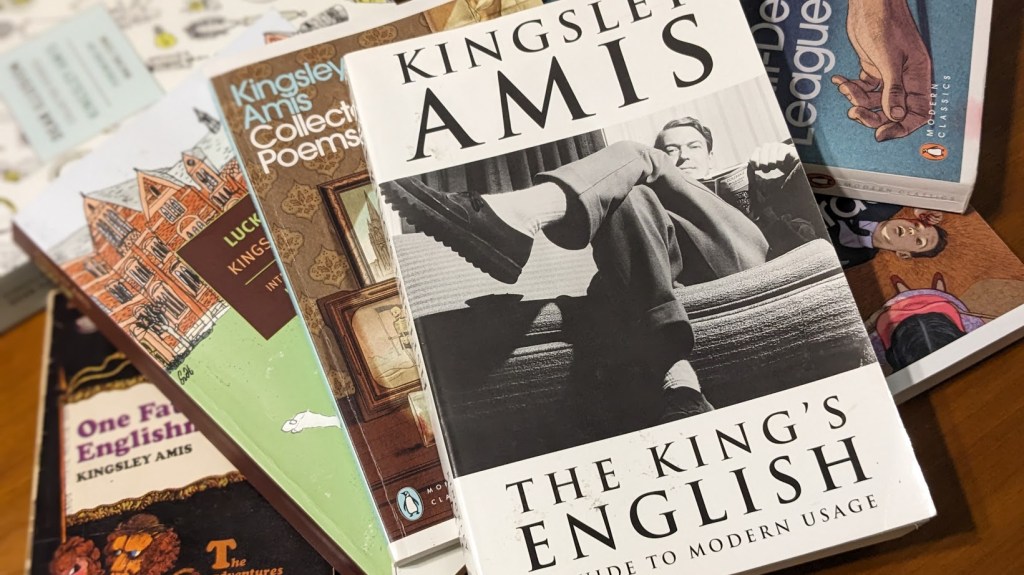
POETS Day! “Against Romanticism” by Kingsley Amis

[This entry is cross posted at ordinary-times.com]

My son started school today, August 8. That’s absurdly early. Back in 2012 Obama’s Education Secretary Arne Duncan tried to start a conversation about extending the school year by shortening summer vacation. There were arguments about students forgetting lessons between grades and valuable time wasted getting them back up to speed.

The conversation never went anywhere, but it wasn’t meant to. The Department of Education being a bureaucracy, the lack of pushback against an idea most didn’t take seriously meant no impediment to its inertia. So here we are.

I’m dying to say something snarky like “The more time kids are kept away from our public school system the better,” but I’m afraid, especially if I point to political speeches from both sides of the aisle over the course of decades lamenting the sorry state of education in America or mention unacceptable test scores impervious to decades of hand wringing to bolster my point, my friends with a wife/husband/son/daughter who’s a teacher might think I’m blaming a political party or theory of education or even a bloated nameless bureaucracy when really I’m saying that the entire decrepit mess is the fault of their wife/husband/son/daughter whose been trying to score Brownie points with that “I have to buy or sell (or whatever* it is she’s doing) art supplies with my own money,” sob story since We had a President who knew how to throw out an opening pitch.

Continue reading

POETS Day! Muriel Rukeyser’s The Book of the Dead

[This entry is cross posted at ordinary-times.com]

It’s a stormy afternoon where I’m writing from. Loud and creeping grey. Not the kind of rain you sing in. There’ll be no park strolling or quarry swimming today. Flashes through the window tempt the unwary with the notion that the workplace is more sanctuary than prison, but that’s a lie. These are the POETS Days that try men’s souls. Freedom is won. It’s an assertion. Step out the door. Face the elements. Start your weekend early. Piss Off Early, Tomorrow’s Saturday. Be Lieutenant Dan, but in homage to the mighty acronym may I suggest setting aside a moment for a little verse?

***

This is the most audacious landscape. The gangster’s
stance with his gun smoking and out is not so
vicious as this commercial field, its hill of glass.
– Muriel Rukeyser, “The Book of the Dead: Alloy”

In 1930, Rinehart and Dennis contracted to build a tunnel through Gauley Mountain near Gauley Bridge, West Virginia for New Kanawha Power Company, a subsidiary of the Union Carbide and Carbon Company, to divert the New River towards a hydroelectric plant.

Of the five thousand men employed to work on the project, some twenty-nine hundred toiled underground in ten to fifteen hour shifts. The project, completion estimated at four years from ground break, was finished in eighteen months. The mountain was composed of remarkably pure silica, so in compliance with safety regulations only wet drilling, a process that cut down on breathable silica in the air, was strictly adhered to when inspectors were on site. The rest of the time they dry drilled.

Continue reading