
Marjoram: Asking About the Work That Americans Won’t Do.

I want to get a better sense of marjoram. I’m moderately familiar with it but only just begun spelling it with an “a” instead of a “u” if that gives you a sense of where I am. I’ve used dried and been – not underwhelmed. Underwhelmed would imply that I could pick it out at all. It didn’t distinguish itself from other herbs I was using.

It’s often confused with oregano and I’ve used it, again dried, in its place but that was as part of a larger recipe. The difference is that oregano gets it’s aroma from an oil containing the antioxidant called carvacrol and an antitoxin called thymol while marjoram smells as it does because it was handled by Aphrodite. Now my wife has a plant; a Mother’s Day gift from me in the tradition of my kids’ (when they were younger) “Let’s get something we can do together!” attempts to highjack other people’s present receiving.

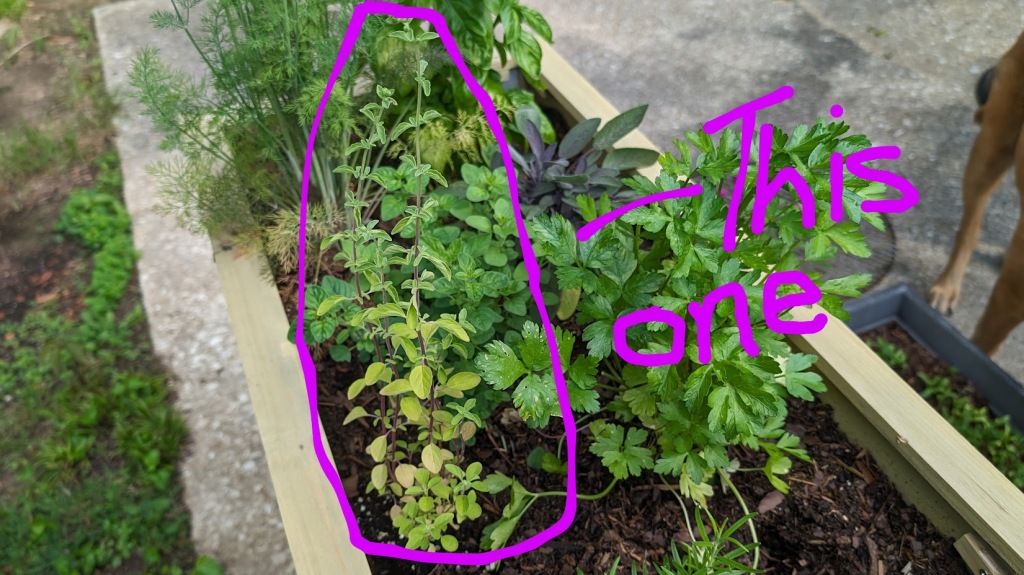
I want to use it in the sauce I posted for pork Milanese (recipe here) in place of thyme. I’ll hold out bay leaf too just to be sure I know what I’m tasting. The issue is that I know nothing about the plant. As you can see it looks spindly. I don’t know if it is. When I search for images I see big bushy things, but does that means my plant is lesser or do people who aren’t me only post pictures of blue-ribbon plants?

I want to pick a few leaves for dinner but in its state am I stunting future growth? This ends with me obsessing. So far, I’ve learned that Shakespeare called it “the herb of grace” but Elizabethans were more likely to call oregano marjoram than to have real marjoram and St. Hildegarde thought it caused leprosy.

Should I harvest now or wait until the plant has filled out, assuming this is a plant that will fill out?
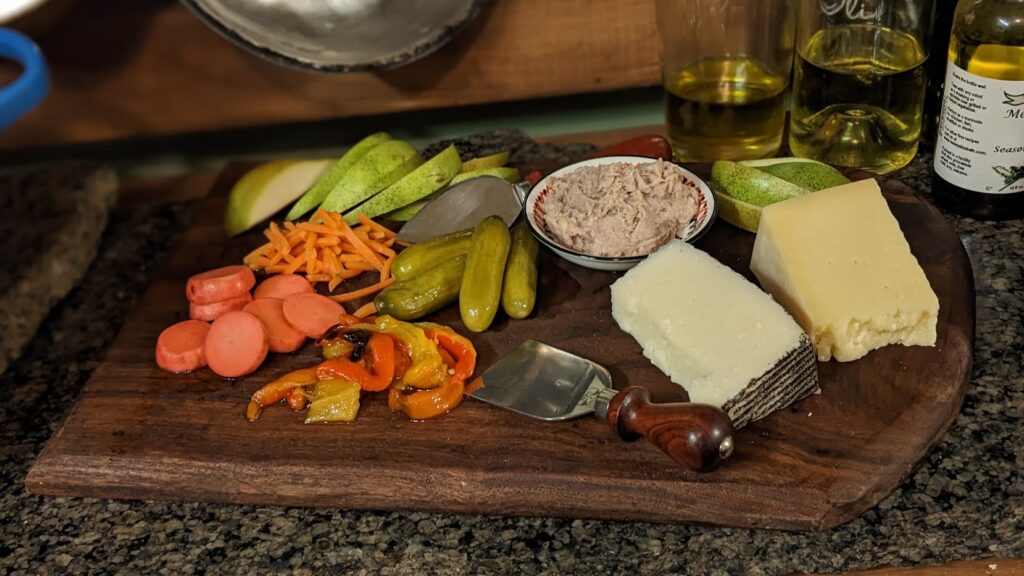
Rillette and Other Things That Start with “P”

[This entry is cross posted at ordinary-times.com]

I can’t be alone in occasionally wishing to forget all my troubles and become a wizened old half of a Boston marriage with leathery skin and piercing blue eyes. How comforting would it be to know the names of all the birds you hear singing while you press bits of colored glass into fresh concrete steppingstones in the side garden. Oh, the scarves I would own. When I told people it’s a waste to flush when they just “make water” I wouldn’t even blush. My home would be a shrine to rugged DIY projects and stuff with beads. People would look to each other and say of all manner of things, “I don’t know how to do that, but I bet that composting lady can show you.”

Of course, there’s no wand or Subaru dealership that magically conveys the air of brisk assurance I’m seeking, but if you want to feel as one with “all the violet tiaras, braided rosebuds, dill and crocus” there’s always putting food in decorative yet practical jars. I can do that.

I want to be clear that when I put food in practical jars I’m not doing so for practical ends. That involves precision. I’m doing it for a psychosomatic taste enhancing aesthetic that serves no other purpose using Tupperware could not achieve.

Continue reading

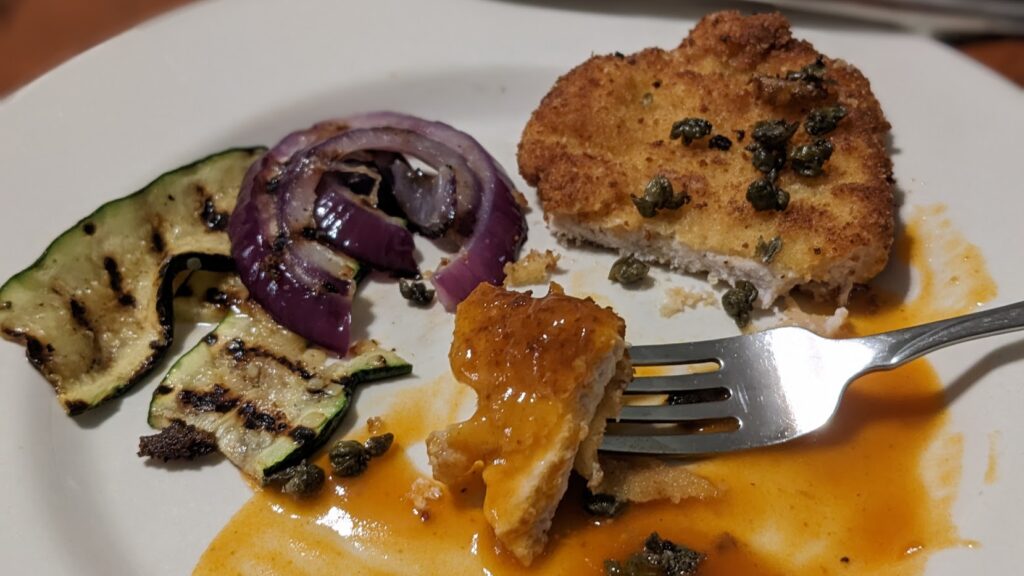
Pork Chops alla Milanese

[This entry is cross posted at ordinary-times.com]

“Outside Italy, these are known as ‘Viennese chops’ (Wiener schnitzel). It is difficult to know who gave the recipe to whom; Lombardy was in fact under Austrian domination for a long period.”
– The Complete Italy: The Beautiful Cookbook, Patrizia Passigli, Fred Plotkin – Harper Collins

The Italians have cotoletta alla Milanese and the Austrians have Wiener schnitzel. Both are simple dishes of pounded veal, breaded and lightly fried. Both claim that their dish came first and was borrowed by the other.

As evidence of Lombardi origin, the Italians cite a letter written to Emperor Franz Joseph by his aide-de-camp Count Attems extolling a Milanese veal preparation and suggesting the Emperor introduce the recipe at court. The Austrians rightly counter that the letter in which Count Attems mentions the Italian version doesn’t exist and that there was never an aide-de-camp from the Attems family attendant to Franz Joseph. They show that the dish existed in Austria as early as the publication of a popular German language cookbook in 1831. Point: Austria.

I get the feeling that the Count Attems letter was a feint by the Italians to force a misstep by the German speakers because once they fixed 1831 as a near enough date of the Austrian version’s first appearance, the giggling Italians slapped down a copy of Pietro Verri’s History of Milan, published in 1783, which recounts from available records a menu from a feast given at the Basilica Sant’Ambrogio in 1134 featuring lombolos cum panitio which is an obvious ancestor of cotoletta alla Milanese. Point: Italy.

They should probably get a bonus point for going medieval.

Continue reading