
Meatballs with Sausages: Breaking the Code of Silence

[This entry is cross posted at ordinary-times.com]

They must live within a lie. They need not accept the lie. It is enough for them to have accepted their life with it and in it. For by this very fact, individuals confirm the system, fulfill the system, make the system, are the system.  – Vaclav Havel, The Power of the Powerless

This is going to take a minute, so if you’re just here for the recipe feel free to skip on down.

I got my first job at sixteen in an Italian restaurant/pizzeria owned by the people who lived across the street from us. The place was a retirement of sorts. The mister was formerly of the stock market, Alabama bred but with a mid-American accent learned out of professional necessity. Get him laughing and Gadsden came out. The missus was from Brazil. They both spoke English, Spanish, and Portuguese. She added French, German, and a bit of Italian. Their son who helped run the place spoke all of those but German.

They were all clever as can be. (And still are. I see them almost weekly, but this is a nostalgic anecdote and there’s power in “were.” It creates for the reader a sense of being transported, and once frame of reference is changed the experience is more immersive.) There’s an old saying that a gentleman is someone who’s as comfortable in the company of pirates as of kings. As a trader, he spent time with New York financial power players. She was practically Rio aristocracy. They could pull off Ma and Pa shop keeper. No problem.

I remember one afternoon, the missus complimented a woman on her purse. The woman, in her thirties and from the over-the-mountain community (we know because she managed to get that in), was working out whatever insecurities she needed to work out by implying that (a) yes it is a nice purse, (b) you’ll never be able to afford one, and (c) what would a shop keeper know about fashion accessories anyway. The missus gave a Brazilian smile and nodded. “It really is nice, though.”

Continue reading
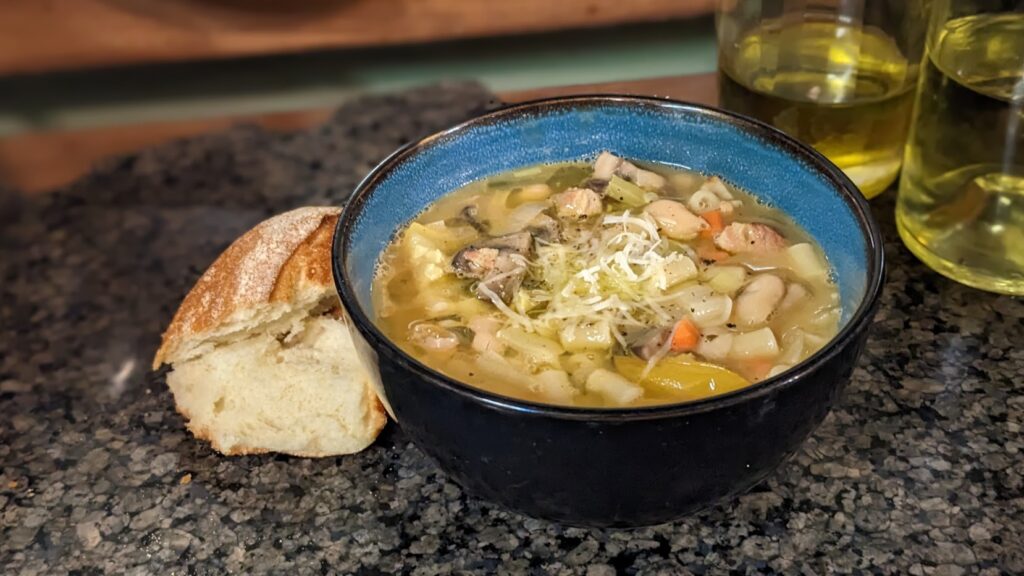
Spring Minestrone

[This entry is cross posted at ordinary-times.com]

“The natural progression from boiling water to boiling water with something in it can hardly be avoided, and in most cases is heartily to be wished for.”
– M.F.K. Fisher

The Ligurians invented ravioli, kinda. They claim cooks on ships out of Genoa collected leftovers to pack in little pasta pouches for the next day’s meals. The culinary world seems content to go along with the Genoese and pretend that their 14th century concoction is somehow different from the stuffed pasta envelopes mentioned in a French document dated 1228 or the raviolis mentioned in Venice and England around the same time as the Ligurians were supposedly revolutionizing the putting stuff inside of other stuff industry. Malta’s had a version going back farther still, but the Maltese don’t get conquered as much when people forget their island exists so they won’t be voicing any challenges.

The truth is that we let Ligurians get away with big talk about “their” pasta because we feel sorry for them and nobody really cares anyway. The Basque fishermen kept their favored sites off the coast of ur-Canada a secret and Leif Erickson had shitty PR so the Genoese defaulted their way into discovering America even though people named it after that buttinski Florentine. Eventually, though, it was decided that you can’t discover something that you didn’t know existed so newer text books took away their claim to fame. As a palliative, people figured “Sure. You can have ravioli.”

Continue reading

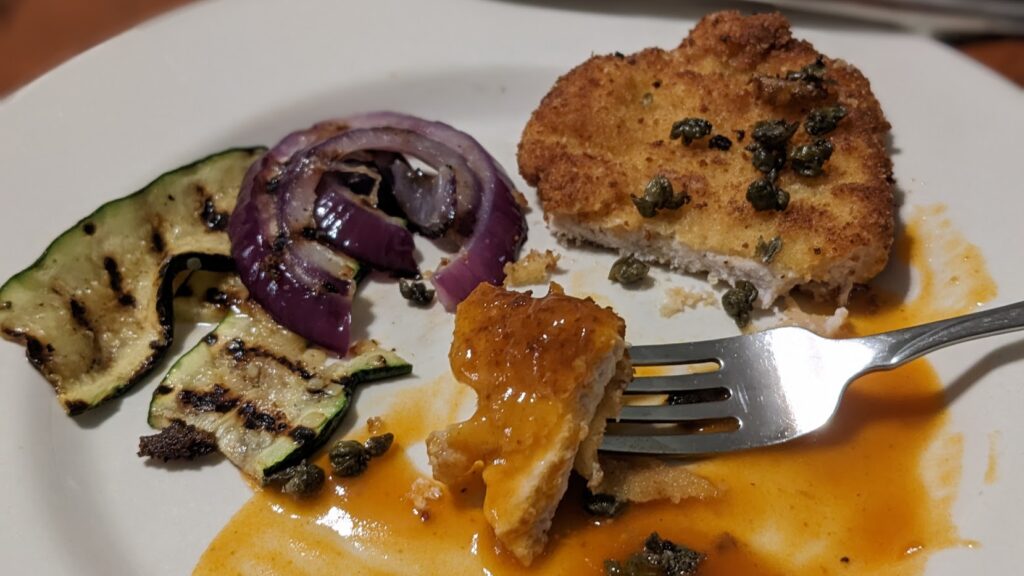
Pork Chops alla Milanese

[This entry is cross posted at ordinary-times.com]

“Outside Italy, these are known as ‘Viennese chops’ (Wiener schnitzel). It is difficult to know who gave the recipe to whom; Lombardy was in fact under Austrian domination for a long period.”
– The Complete Italy: The Beautiful Cookbook, Patrizia Passigli, Fred Plotkin – Harper Collins

The Italians have cotoletta alla Milanese and the Austrians have Wiener schnitzel. Both are simple dishes of pounded veal, breaded and lightly fried. Both claim that their dish came first and was borrowed by the other.

As evidence of Lombardi origin, the Italians cite a letter written to Emperor Franz Joseph by his aide-de-camp Count Attems extolling a Milanese veal preparation and suggesting the Emperor introduce the recipe at court. The Austrians rightly counter that the letter in which Count Attems mentions the Italian version doesn’t exist and that there was never an aide-de-camp from the Attems family attendant to Franz Joseph. They show that the dish existed in Austria as early as the publication of a popular German language cookbook in 1831. Point: Austria.

I get the feeling that the Count Attems letter was a feint by the Italians to force a misstep by the German speakers because once they fixed 1831 as a near enough date of the Austrian version’s first appearance, the giggling Italians slapped down a copy of Pietro Verri’s History of Milan, published in 1783, which recounts from available records a menu from a feast given at the Basilica Sant’Ambrogio in 1134 featuring lombolos cum panitio which is an obvious ancestor of cotoletta alla Milanese. Point: Italy.

They should probably get a bonus point for going medieval.

Continue reading