
Marjoram: Asking About the Work That Americans Won’t Do.

I want to get a better sense of marjoram. I’m moderately familiar with it but only just begun spelling it with an “a” instead of a “u” if that gives you a sense of where I am. I’ve used dried and been – not underwhelmed. Underwhelmed would imply that I could pick it out at all. It didn’t distinguish itself from other herbs I was using.

It’s often confused with oregano and I’ve used it, again dried, in its place but that was as part of a larger recipe. The difference is that oregano gets it’s aroma from an oil containing the antioxidant called carvacrol and an antitoxin called thymol while marjoram smells as it does because it was handled by Aphrodite. Now my wife has a plant; a Mother’s Day gift from me in the tradition of my kids’ (when they were younger) “Let’s get something we can do together!” attempts to highjack other people’s present receiving.

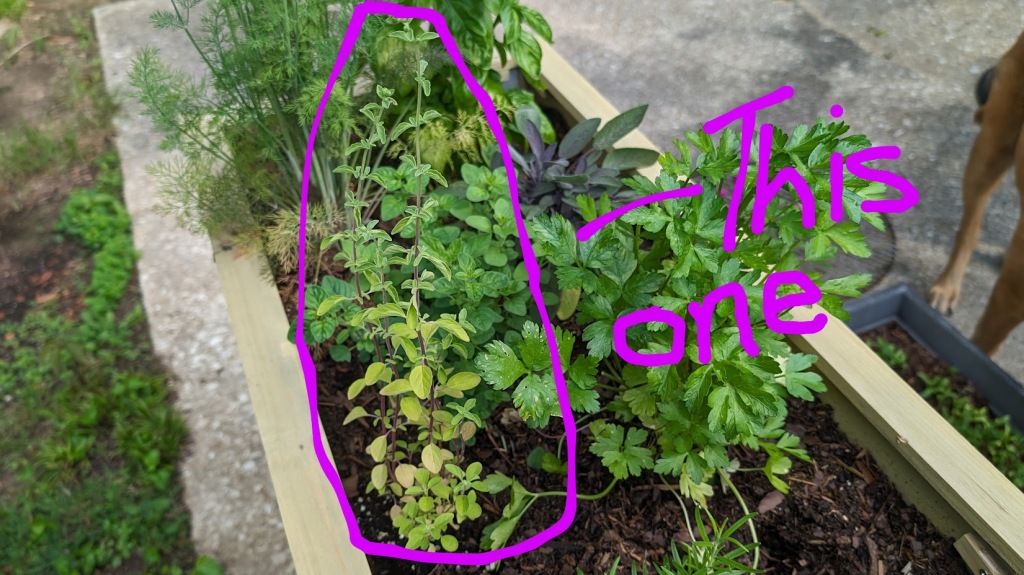
I want to use it in the sauce I posted for pork Milanese (recipe here) in place of thyme. I’ll hold out bay leaf too just to be sure I know what I’m tasting. The issue is that I know nothing about the plant. As you can see it looks spindly. I don’t know if it is. When I search for images I see big bushy things, but does that means my plant is lesser or do people who aren’t me only post pictures of blue-ribbon plants?

I want to pick a few leaves for dinner but in its state am I stunting future growth? This ends with me obsessing. So far, I’ve learned that Shakespeare called it “the herb of grace” but Elizabethans were more likely to call oregano marjoram than to have real marjoram and St. Hildegarde thought it caused leprosy.

Should I harvest now or wait until the plant has filled out, assuming this is a plant that will fill out?

Spring Lamb from a Once Noisy Rock

[This entry is cross posted at ordinary-times.com]

Silla used to be Scylla. Those were heady days. When the Greeks were in charge this was a mighty place. Sailors knew: “but that is the den of Skylla, where she yaps / abominably, a newborn whelp’s cry, / though she is huge and monstrous.” Six heads of monstrous per Homer, who knew a bit about showmanship, with “triple serried rows of fangs and deep / gullets of black death.” The place had a buzz.

Opposite the rocks that lore named Scylla was Charibdis; a Sicily-adjacent whirlpool, impassible. To risk the whirlpool was to lose your ship. The rocks meant a sacrifice of six crewmen, “from every ship, one man for every gullet.” It was the original hard place.

Further south along the toe’s coast, you find Palmi, with views across the Tyrrhenian of the Aeolian Islands’s Mt. Stromboli to the northish and across the Strait of Messina of Mt. Etna to the southwest. There aren’t many places in the world from where you can see two active volcanoes. Keep going with the sea to your right and olive trees to your left to reach Reggio Calabria, the provincial capital (Overly simplified: Italians say regions when Canadians would say provinces and their provinces are what we’d call counties.)

The most interesting thing about Reggio Calabria to me right now is that it’s listed as the 100th most populous city in Europe by Wikipedia. Not 99th. Not 117th. What are the odds that the city I read about last night and decided to look into further this morning would hold such a decidistinction? In grade school I was told that Mt. Everest was found to be 29,000 feet tall but reported as 29,001 because the statisticians didn’t think anyone would believe the round finding. “Latest measurements” put it at 29,032 feet. Better lasers than in Hillary’s time, I suppose.

Continue reading

Meatballs with Sausages: Breaking the Code of Silence

[This entry is cross posted at ordinary-times.com]

They must live within a lie. They need not accept the lie. It is enough for them to have accepted their life with it and in it. For by this very fact, individuals confirm the system, fulfill the system, make the system, are the system.  – Vaclav Havel, The Power of the Powerless

This is going to take a minute, so if you’re just here for the recipe feel free to skip on down.

I got my first job at sixteen in an Italian restaurant/pizzeria owned by the people who lived across the street from us. The place was a retirement of sorts. The mister was formerly of the stock market, Alabama bred but with a mid-American accent learned out of professional necessity. Get him laughing and Gadsden came out. The missus was from Brazil. They both spoke English, Spanish, and Portuguese. She added French, German, and a bit of Italian. Their son who helped run the place spoke all of those but German.

They were all clever as can be. (And still are. I see them almost weekly, but this is a nostalgic anecdote and there’s power in “were.” It creates for the reader a sense of being transported, and once frame of reference is changed the experience is more immersive.) There’s an old saying that a gentleman is someone who’s as comfortable in the company of pirates as of kings. As a trader, he spent time with New York financial power players. She was practically Rio aristocracy. They could pull off Ma and Pa shop keeper. No problem.

I remember one afternoon, the missus complimented a woman on her purse. The woman, in her thirties and from the over-the-mountain community (we know because she managed to get that in), was working out whatever insecurities she needed to work out by implying that (a) yes it is a nice purse, (b) you’ll never be able to afford one, and (c) what would a shop keeper know about fashion accessories anyway. The missus gave a Brazilian smile and nodded. “It really is nice, though.”

Continue reading

Recipe: Deconstructed Salisbury Steak

[This entry is cross posted at ordinary-times.com]

“Eat the muscle pulp of lean beef made into cakes and broiled. This pulp should be as free as possible from connective or glue tissue, fat and cartilage…..The pulp should not be pressed too firmly together before broiling, or it will taste livery. Simply press it sufficiently to hold it together. Make the cakes from half an inch to an inch thick. Broil slowly and moderately well over a fire free from blaze and smoke. When cooked, put it on a hot plate and season to taste with butter, pepper, salt; also use either Worcestershire or Halford sauce, mustard, horseradish or lemon juice on the meat if desired.”
– Dr. James Henry Salisbury (1823-1905)

Don’t do that.

Before Bob Atkins, there was James Henry Salisbury. He got lost in the Victorian Era nutritionist craze. John Harvey Kellog promoted a vegetarian, cereal-heavy diet supplemented by yogurt enemas. Sylvester Graham made people sleep on hard beds, take cold baths, and lie about masturbating. Those were the heavy hitters. It was a fascinating time peopled by fascinating people.

As with Kellog, Salisbury was an early voice suggesting germs had a part in sickness and infections. He got made fun of a good bit for that before being proven right. Both men probably got away with a lot of crackpottery after that. Salisbury promoted a diet of beef cakes as described above, three times a day washed down with hot water. Why hot I’m unsure, but he warned against ever drinking other liquids at other temperatures. Fruits and vegetables were chock full of poisons and the cause of “summer complaints.” Pace Kellog and Graham, plants were relegated to a rounding error; no more than one percent of the Salisbury diet.

Continue reading

Improbable Tomato Sauce that Sounds Too Simple to Work and Other Sunday Afternoon Stuff

  • 28 ounces canned plum tomatoes, with their juices and torn apart by hand
  • 1 yellow onion, don’t worry about its size
  • 5 T unsalted butter
  • Salt to taste

This is a recipe that the well versed tomato sauce maker will look at and scoff. I didn’t believe it but it came from a Marcella Hazan (her name be praised) cookbook so it was invested with hours upon years of good will, so I gave it a try. In one sense it’s amazing. In another it’s a disappointment.

Continue reading