The work week is gonna be over now, or it’s gonna be over in a few hours. What are you doing? You’re not getting anything done. Cut it out and stop pretending. Piss Off Early, Tomorrow’s Saturday.
First, a little verse.
***
Carl Sandburg was posthumously honored with a postage stamp bearing a sketch of the poet done by his friend William A. Smith and the poet’s “distinctive autograph.” The “distinctive autograph” language comes from Wikipedia which appears to have gotten it from the world stamp authority, Scott Catalogue. Who doesn’t have a distinctive autograph? Signatures are supposed to be distinctive.
Before this week, I didn’t know much about Sandburg beyond a handful of poems I really liked and a handful I really didn’t. I knew he was a major figure in American letters, but didn’t realize the scope. In short, I was aware of his poetry and impact on that discipline, vaguely aware that he’d written Lincoln biographies, and think I’d heard somewhere that he helped preserve and widen the audience for American folk music. I didn’t realize how beloved he was in his time. Rather, I didn’t realize how large a figure he was in his time, because for all that he was beloved, he was scorned too.
I went on longer than I’d planned this week, so to the point without preamble: Piss Off Early, Tomorrow’s Saturday. Get out of work. Run and be free. You’ve done your part, slaved the workweek throroughly enough. Escape the office and hit a happy hour, still sunlit park, catch a ball game, or ring up that attractive someone you’ve had a mind towards.
It’s POETS Day. Make the most of it.
But first, a little verse.
***
“I had thought of the Lycidas as a full-grown beauty—as springing up with all its parts absolute—till, in an evil hour, I was shown the original copy of it, together with the other minor poems of the author, in the library of Trinity, kept like some treasure to be proud of. I wish they had thrown them in the Cam, or sent them after the latter Cantos of Spenser, into the Irish Channel. How it staggered me to see the fine things in their ore! interlined corrected! as if their words were mortal, alterable, displaceable at pleasure! as if they might have been otherwise, and just as good! as if inspiration were made up of parts, and these fluctuating, successive, indifferent! I will never go into the workshop of any great artist again.” – Charles Lamb, “Oxford in the Vacation”, kinda
I say “Kinda” because I’ve got lying eyes. I trust Cleanthe Brooks and Robert Penn Warren more than most. One of them wrote, in their coauthored classic Understanding Poetry, that Lamb wrote the above “in his essay ‘Oxford in the Vacation.’” The other one, no doubt, went over the final copy and approved. I read “Oxford in the Vacation,” and the quote was nowhere to be found. I ctrl F-ed it and tried to find “Lycides” on the page in case somehow a paragraph length distraction caused me to miss it. It wasn’t there.
Brooks or Warren was right, though, with the other also right but in an editorial capacity. I found an Atlantic article by Edmund Gosse in the May, 1900 issue, which the internet happened to have laying about. Gosse writes, “When Lamb came to read over these sentences, he was perhaps struck with their petulance, for they were omitted from the completed Essays of Elia [Lamb’s pen name] in 1823.” The original appeared in The London Magazine October 1820. It’s funny to me that a quotable quote about the mess of editing and rewriting was itself cut on consideration.
Were Lamb born a couple of centuries scant later, he’d wrestle with T.S. Eliot’s The Waste Land. I can’t say what opinion he’d have of the poem, only that he’d have one. The poem has been inescapable for those with poetic interests since its 1922 publication. What would he have made of The Waste Land, Centenary Edition in Full Color: A Facsimile & Transcript of the Original Drafts Including the Annotations of Ezra Pound from Liverwright, the original publisher of the poem in book form?
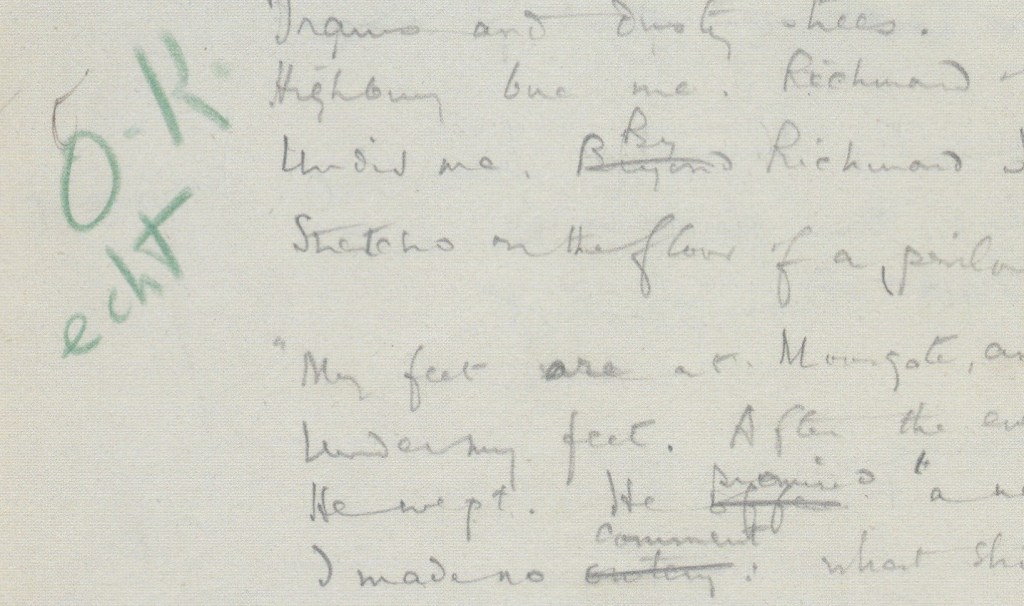
It’s one thing to read that Ezra Pound excised almost two thirds of Eliot’s manuscript, quite another to see reproductions of beige typewritten pages with pencil notes, slashes, suggestions sometimes themselves slashed and rewritten, and Pound’s querysome marginalia: “Vocative?” and “Vocative??”
People who read a lot mispronounce words. There are a lot more opportunities to read obscurities than to hear them said. Rather than be embarrassed at the mangling, they should be proud at knowing how to use a word they’ve never heard. They’ve expanded beyond the town square. That’s good. But people still get embarrassed.
To help, there are thousands of ten- to fifteen-second YouTube videos titled something along the lines of “How to Say Qatar” or “How to Pronounce Siobhan.” Handy stuff.
The other day I was reading and came across synecdoche, which isn’t tossed around at the lunch counter all that often. I’ve been all over that word for years, throwing stress forward and backward. I finally went to YouTube’s “How to Pronounce Synecdoche” and it made me so happy. You have to go listen.
Piss Off Early, Tomorrow’s Saturday. Don’t waste a Friday afternoon working. Go do that. Put something funny somewhere to catch people unaware. Be an acid free merry prankster. Synecdoche.
First, some verse.
***
Paterson is William Carlos Williams’s great work. He initially planned four books, added a fifth, and died with a sixth in the works. The poem is set in Paterson, New Jersey, with a one-third-dropped Nicene conception of Paterson as man and city, separate and inseparable depending on book or stanza, as the protagonist.
Most towns were not founded by Alexander Hamilton. Paterson comports with the majority, but Hamilton envisioned the city as an industrial center with the falls as its early engine and encouraged its growth into such. Hamilton got D.C. designer Peter L’Enfant involved and though there was some disagreement causing L’Enfant’s departure, his plan to harness the river’s power was implemented. Immigrants followed, more so than to most of the rest of the country: Germans, a bunch of English, Scots, and many, many Irish.
The Passaic River flows through the town, in whose midst lies Paterson Great Falls State Park, green for a block or so spreading from each bank. The Passaic Falls strikes just east of where Wayne Avenue and Maple Street intersect, if Google Maps is true. Assuming I’ve read properly, the settlement began below the falls and spread south, east, and west before eventually engulfing the wilderness to the north. Williams presents a beautiful image of water drawn from disparate sources in that wilderness, mixing violently, but running towards something common. Past eddies, shore lapping, with impediment rocks washed away long ago, right before the falls every drop is of a singular energy.
Birmingham may have gone out over its skis and declared a POETS Day pre-emptively. We don’t have snowplows, our shovels are sewing scissor-esque in that they’re solely for burying kin, and nobody can find the other glove. An inch of snow will paralyze us. The schools shut down and no one can get to work except liquor store owners who’ll do three Christmases and a mid-week Valantine’s Day worth of business in twelve hours. There’s a prediction of one to two inches by tomorrow morning.
I got the closing notice for my youngest’s school yesterday. My eldest’s sent an email this morning (I’m writing this on Thursday night) with an ominous pair of sentences about on-line assignments to follow (Mwu-hah-hah!). I can’t blame them for being overly cautious after the flash blizzard (three inches) of 2012 left teachers and students (not mine) stranded overnight. Rare snows put us in a bind, but I’ve been at home through more dire warnings that didn’t pan out as expected than I can count, leaving a city of day drinking dog walkers.
Nobody in my neck of the woods needs a POETS Day plan. We can’t Piss Off Early even though Tomorrow’s Saturday, because we’ll already be home. Good luck to the rest of you and your Northern ways. Fake a cough, maybe?
Whatever you gotta do, get out and have fun. But take time for a little verse first.
***
I’m pretty sure we all had the same initial thought, but this week’s featured poem was published in 1914 and the World War I biplane made by Sopwith and named the Camel due to an aerodynamic hump over the guns in the original design, wasn’t introduced until 1917. The similarity had no effect on Cannéll’s poetry; no resentment at being teased or bravado from a name evoking brief air superiority for a three year period before rapid development of technology tempered by the pressures of war led to predictable obsolescence.
Do what you must. Lie to your boss. Fake a cough at school. Invite Jamaal Bowman to do his thing. Nothing productive gets done on a Friday after lunch anyway.
Piss Off Early, Tomorrow’s Saturday.
But first, take time for a little verse.
***
“As for ‘free verse’, I expressed my view twenty-five years ago by saying that no verse is free for the man who wants to do a good job. No one has better cause to know than I, that a great deal of bad prose has been written under the name of free verse; though whether its authors wrote bad prose or bad verse, or bad verse in one style or in another, seems to me a matter of indifference. But only a bad poet could welcome free verse as a liberation from form. It was a revolt against dead form, and a preparation for new form or for the renewal of the old; it was an insistence upon the inner unity which is unique to every poem, against the outer unity which is typical. The poem comes before form, in the sense that a form grows out of the attempt of somebody to say something; just as a system of prosody is only a formulation of the identities in the rhythms of a succession of poets influenced by each other.” – T.S. Eliot “The Music of Poetry”
I very much enjoyed Paul Johnson’s book, The Quest for God: A Personal Pilgrimage. I took a great deal from it but one of the things I most remember coming away with was an admiration for his practical appreciation of Catholicism.
He was very fond of the age and history of the Church, the scholarship and arguments – even those about angels and pin heads, which is a punch line though it shouldn’t be – of two thousand years. He felt a weight lifted. There may be facets and tenets that made no sense or seemed at odds to him, but he could put doubts aside and rest easy, secure in the knowledge that wiser and more learned heads than his had considered, deliberated, and concluded. He found faith.
EnterpriseAppsToday’s web site has a number of statistics related to work place time wasting. It’s eye opening. Some selected bits – a few iotum or datum if you know not much latin:
In the United States, during 8 hours of working time, employees waste an average of 2.9 hours by doing no effective work.
31% of workers waste a minimum of 1 hour each workday.
6% of employees waste around 3 hours each day at work.
4% of workers claim they waste at least 4 hours daily in the workplace.
If employees in general waste 2.9 hours each, but only 6% waste 3 hours and 4% waste 4 hours, and 31% waste 1 hour, then the remaining 59% have to waste 3.89 hours a day. I don’t think people present 6% at 3 hours and 4% at 4 hours when there’s a whopping 59% at 3.89 hours going unmentioned. That’s not how you present facts. If you’re trying to show that time wasting at work is rampant, do you leave out the biggest cohort at almost the highest time waste rate but leave in 6% at a measly 3 hours? No. They made all of that up.
Even the people who compile employee time wasting figures aren’t giving the matter proper attention. Don’t feel bad skipping out of work early. Nothing’s getting done there anyway. Have a POETS Day. Piss Off Early, Tomorrow’s Saturday.
First though, take a minute for some verse.
***
Suetonius writes that Quintus Horatius Flaccus, known to most of us as Horace, was military tribune under Brutus. This was two years after the assassination of Julius Caesar, so there was no “Shocked!” moment or questions about honor when Horace took up arms with the man. He was at Philippi for Octavian’s victory and would later claim to have left his shield behind and fled, but running off without a shield was an act claimed by Greek poets he admired and was probably a joke.
There is a new Inspector Rebus TV adaptation out, at least if you’re in England or Australia. We can’t watch yet, but I have Brit Box, so hope springs. I misread the release date for the new novel. Midnight and Blue, the twenty-fifth book in the series, comes out on October 15th. Not August 15th, as I was anticipating. I am bereft.
I named my dog Rebus, if that gives any idea of how much I enjoy the books. He’s a good dog, considerate but determined when he wants something and not above cutting corners, much like his namesake. Sir Ian Rankin, the series author, responded on Twitter with wishes to a picture of him chewing on his birthday toy one year, and a birthday wish again the following two – prompted, but still. That may be the only interaction I’ve had with a peer.
It was in those books that I first came across the POETS Day concept. Rebus and Siobhan, who’s gone from supporting role to near co-protagonist, were calling it a day one Friday afternoon. POETS Day isn’t an invention of Rankin’s. Apparently, the idea has been around long enough for lost origins. But I first heard is called such by John Rebus. Piss Off Early, Tomorrow’s Saturday.
I can’t believe I have to wait another two months for that book. Time for some verse.
***
I use a line – overuse, my children might say – from Yeats whenever the opportunity pops up; “O saddest harp in all the world.”
It’s late at night because Trump made it so. I write this part last and now I want sleep. I didn’t expect him to go on so long. Maybe you can use that. Piss Off Early, Tomorrow’s Saturday. Tell the boss you were up late watching tv as a civic duty because democracy dies in darkness? If you watched it, grab an afternoon nap. If not, pretend you did and go to a bar or something fun. The speech ended around eleven thirty or so Central, in case you’re asked.
If you live in California, I don’t think this works as a POETS Day hooky excuse. You guys are so far behind the RNC was still pre-empting Judge Judy and the like. Sorry. Tell them your probiotics are out of alignment or something. That might work.
Enjoy the weekend.
***
I’m a fan of James May. Top Gear, obviously, but his other stuff too: James May’s Toy Stories, James May’s Man Lab, James May: Our Man In… I’ve got the cookbook from James May: Oh Cook! He’s impish and once got fired from a magazine for a naughty acrostic.
I live in a city that is not prepared for cold weather. My northerly relatives laugh when we shut down for snow or icy conditions but we don’t have all the toys they have. If these were regular enough occurrences to justify a snowplow corps or whatever you call the truck that salts the road, we’d have one. But they aren’t. So we don’t. Or maybe we wouldn’t.
The truth is, we like the snow days – “snow days” being a catch all for any day off due to snow, freezing rain, or because James Spann or one of the lesser weatherfolks says there might be snow or freezing rain. Nobody can get to work except the people who own a liquor store and everybody can get to the liquor store. Kids, in particular, love snow days. Every so often we get a real event where cars are abandoned on highways and schools have to host impromptu sleep overs in the gym. Those are important because they give cover when the county preemptively calls a for closings when the weather forecast indicates the chance of something threatening and everybody wants a day off to go to the liquor store. “Better safe that sorry,” says the thirsty school board.
I was talking about the POETS Day, “Piss Off Early, Tomorrow’s Saturday,” ethos with somebody the other day and she brought up the French and their four-day thirty-five-hour work week as aspirational for the movement. I’m not certain the French four-day work week exists even in the tiny corners of their economy where I suspect it would make its home.
Between headlines about French youth rioting because they won’t get to retire at forty-whatever there are conflicting accounts of what constitutes a job over there. Forbes tells us “France famously has a legally mandated 35-hour work week, enshrined in law since 2000,” but in the Snippets of Paris article “France’s famous Myth: the 35-hour French Work Week” (parsing the capitalization decisions in that headline will keep me up for days) we’re asked “Think the French only work 35 hours a week? Perhaps the French are just not good at keeping track of their hours.”
Whether they do, whether they don’t is unimportant. My well-meaning friend misses the point of POETS Day. It’s not about accumulating time off. It’s about enjoying something illicit.



 The Columbo Game