[This entry is cross posted at ordinary-times.com]
Officially, the work week’s nearly done; barely a few hours. What are you doing? You’re not getting anything done between now and then. Cut it out and stop pretending. Piss Off Early, Tomorrow’s Saturday.
First, a little verse.
***
My favorite librarian passed away. I didn’t seen him the last few times I was in, but I never divined his comings and goings well enough to know his days off. Poor health caught up to him. I don’t know what to say other than I’ll miss chatting with him. A few falls ago, I mentioned a Muriel Spark book I picked up. He recommended a few of hers he liked. They were the odd ones people didn’t talk about that often. His co-workers put up a memorial photo of him over a shelf filled with his recommendations. There’s a stack of printed sheets listing his “LOST Classics of the 20th Century,” for the interested, in the spirit of his Sparks recommendations: lesser-known books picked from respected but not bankable authors, for the most part. It’s an idiosyncratic list. That fits. Godspeed.
Last September, he and I were talking about the poets to come out of Vanderbilt University in the years surrounding World War II. He mentioned James Dickey. I knew Dickey was Poet Laureate back when they still called the office holder Consultant in Poetry to the Library of Congress, but I didn’t know much more beyond. We had to read Deliverance in 9th grade and as 9th graders, we watched the movie in addition and made 9th grade “Squeeeel like a pig!” jokes, but ignorance beyond that.
The library didn’t have the Dickey poetry collection he thought I should read. It wasn’t in the county system or inter-library either so he told me he’d bring his copy from home and lend it to me. He didn’t lower his voice or whisper as he said that, which surprised me. He should be sneakier when he’s running a competing racket from within the beast. Enforcers from the library Monopolist Division are listening. Maybe they took him aside and had a talk or maybe he forgot about it. He never brought the book in and I never pressed. It was a nice offer.
The library still doesn’t have any of Dickey’s poetry. I found an e-copy of James Dickey Poems, 1957-1967 on Amazon for $2.99, so now I have a Kindle Dickey, which is fun to say. So here’s James Dickey, as recommended by Gregory.
A Birth
James Dickey (1923-1997)Inventing a story with grass,
I find a young horse deep inside it.
I cannot nail wires around him;
My fence posts fail to be solid,And he is free, strangely, without me.
With his head still browsing the greenness,
He walks slowly out of the pasture
To enter the sun of his story.My mind freed of its own creature,
I find myself deep in my life
In a room with my child and my mother,
When I feel the sun climbing my shoulderChange, to include a new horse.
That poem is an outlier as it’s the only one in the collection that doesn’t go on for pages. He missed the spirit of Auden, I suppose. This is a disaster for my purposes. We aren’t pulping for paper, but these electronic pages still have a length and form to pretend to. Rather than distinguish itself by merit, “A Birth” self selected in fine Cinderella fashion. It fit. Characteristics of Dickey’s poetry that I’ve read appear in his work throughout his career are found in the poem. According to the honorable anonymous biographers at Poetry Foundation, Dickey “blurred dreams and reality in an attempt to accommodate the irrational, ‘country surrealism.’” Nature lurks beneath civilization, ready to break out. He doesn’t observe the qualities of a thing so much as set it in motion and note the ripples produced.
A meta tale where a character breaks from narrative, chooses the wild, and stirs something primal in the teller. It’s all there, and told simply.
Like most guys whose cause of death can be discovered written between the lines as complications due to alcoholism, there looks to be a window where he was a blast to be around.
He didn’t do well in high school. Darlington School in Rome, Georgia offered a postgraduate year for upwardly mobile ne’er-do-wells as a last ditch to right the ship. The biographer, Henry Hart, writes in James Dickey: The World as a Lie “Dickey’s parents sent him to Rome because he was frittering his time away with Atlanta girls and because he needed further preparation so he could go to a reputable college.”
Fat lot of good that did. No matter what mom and dad thought he got up to under their watch, he was under their watch. In Rome, he was free. There were girls in Rome, too. Again, from Hart, “—at the high school, at Shorter College, and at Berry College—and Dickey took advantage of whatever romantic opportunities came his way.” He went back to his hometown frequently too, presumably without the fetters of mom and dad and curfews and such. After one 1942 Atlanta weekend trip, out of the blue he told a friend at track practice, “I got my first piece of tail this week-end.” Maybe credit the upright and virtuous nature of Southern maidens, maybe say the world was different before Buddy Holly and his Rock and Roll youth corrupting shenanigans, or maybe feel bad for mom and dad. They thought they raised a hellion, but he didn’t get up to that when they were in charge.
No matter what liberties Darlington allowed and what milestones those liberties allowed him to reach, Dickey was not a fan of his time there. My father-in-law wrote “F___ O___!” on a Duke alumni fundraising letter and mailed it to their office of student dollar bilking. He’d been a consistent donor to the university since graduating, but the way they handled the Lacrosse scandal set his Juris Doctorate to rage. I don’t know specifically what caused Dickey to respond in a similar way to a Darlington fundraising campaign, but lacking my father-in-law’s succinctness, he achieves the same effect.
Dickey’s response is found, again, in Hart. I include it here because it’s wonderful.
“Let me make myself quite plain on this matter. Anything pertaining to Darlington School, past, present or future, is thoroughly abhorrent to me. I was there one year, and a more disgusting combination of cant, hypocrisy, cruelty, class privilege and inanity I have never since encountered at any human institution. The school is such an insipid place that it really shouldn’t call forth reactions as strong as the above, but when the functionaries of a place whose memory I so thoroughly detest came to me, quite literally, hat in hand, asking me for money to help support such a bastion of snobbery and privilege, such emotions do arise, perhaps unfortunately but quite authentically.
I hope this note will serve to get me forever off your mailing list. And if possible, please expunge me also from your rolls, if that is possible, as I wish I could do with the recollection of the place that I have.
You may print this if you like.”
Darlington served him, though. After his awful year of fiddling about, he was able to enroll at Clemson where he became a full-fledged, uniform wearing Clempson Tiger as a running back, but only for a year. He enlisted with the U.S. Army Air Force to fight in World War II.
I should note that Hart interviewed a Darlington classmate who said Dickey was “an absolute aristocrat, on par with kings.” The classmate called his response to the fundraising letter Ironic. It looked to Hart as if Dickey was practicing at myth making or image crafting, “trying to expunge the memory of his privileged upbringing in [the Atlanta suburb] Buckhead.”
Poetry Foundation tells us he flew more than one hundred combat missions in the Pacific Theater. Official records and his son’s memoir put the number flown at thirty-eight. Norton Anthology of Modern and Contemporary Poetry Vol. II says “Although he claimed to have flown a hundred combat missions, he washed out during flight training and instead operated radar equipment during flights in the Pacific.” There are two issues. The first is a distinction I didn’t realize existed. In my mind you claim a combat mission if you were not the guy manning the stick. A few minutes poking around the internet finds multiple examples of gunners et al credited as having “flown.” The second is stickier. In interviews, Dickey claimed to have been a pilot and per his telling, the number of missions hovered around or exceeded one hundred. I haven’t read it, but apparently in the memoir I mentioned, Summer of Deliverance, Christopher Dickey describes feeling betrayed on discovering his father’s exaggerations.
I have to wonder why he exaggerated at all. He served bravely, earned five Bronze Stars, and when Korea erupted, he served as a radar instructor for the next wave of non-pilots who nonetheless served bravely. I don’t know what kept him from celebrating his record as it was.
One further: In between wars, he took a degree at Vanderbilt and began teaching after his time in the military. He carried on lecturing for the rest of his life, but while at the University of Florida, he became disillusioned with the profession. He knew writers with half his talent making a fortune in advertising, figured it would be easy enough, and got himself fired. That’s the assumption. Leaving academia for advertising sounds cretinous. Better to be fired for his art and decry the institutions, so he read the salacious poem “The Father’s Body” to the American Pen’s Women’s Society, got indignant when told to apologize, and walked off to write copy for Coca-Cola and Lay’s Potato Chips rather than compromise his artistic sensibilities. I have to stand and applaud the maneuver.
He said he wrote drivel during the day to make money and wrote serious poetry and fiction in the evenings. “I was selling my soul to the devil all day… and trying to buy it back at night.” Except he wasn’t. Not exactly. The advertising agency fired him for spending too much office time writing poetry.
I don’t know how much all the biographical embellishments helped. He was a very successful poet. As I mentioned above, Consultant in Poetry to the Library of Congress. ABC hired him to compose an original poem to mark the Apollo 11 moon landing and recite it on air the day of. (Occasion poem are rarely all that good – the moment is already momentous – and his isn’t the exception, but you can read watch his ABC scene here.) I don’t know that people dismiss “arresting and powerful” verse, per Norton, because the poet only flew thirty-eight missions.
He erupted in popular literature beyond poetry with Deliverance; wrote the screenplay and made a cameo as a sheriff. Poetry remained his first love. From a 1981 interview (as quoted by Poetry Foundation):
“Poetry is, I think, the highest medium that mankind has ever come up with. It’s language itself, which is a miraculous medium which makes everything else that man has ever done possible.”
Below is a longer poem than I normally print here, but I like Dickey, and I really like the poem. Besides, as I mentioned, he didn’t write many short ones. It’s full of movement, of nature forcing itself through to civilization, and, just like in “A Birth” something is awakened. I honestly can’t figure out why thiry-eight wasn’t enough.
Kudzu
Japan invades. Far Eastern vines
Run from the clay banks they areSupposed to keep from eroding,
Up telephone poles,
Which rear, half out of leafage,
As though they would shriek,
Like things smothered by their own
Green, mindless, unkillable ghosts.
In Georgia, the legend says
That you must close your windowsAt night to keep it out of the house.
The glass is tinged with green, even so,As the tendrils crawl over the fields.
The night the kudzu has
Your pasture, you sleep like the dead.
Silence has grown Oriental
And you cannot step upon ground:
Your leg plunges somewhere
It should not, it never should be,
Disappears, and waits to be struckAnywhere between sole and kneecap:
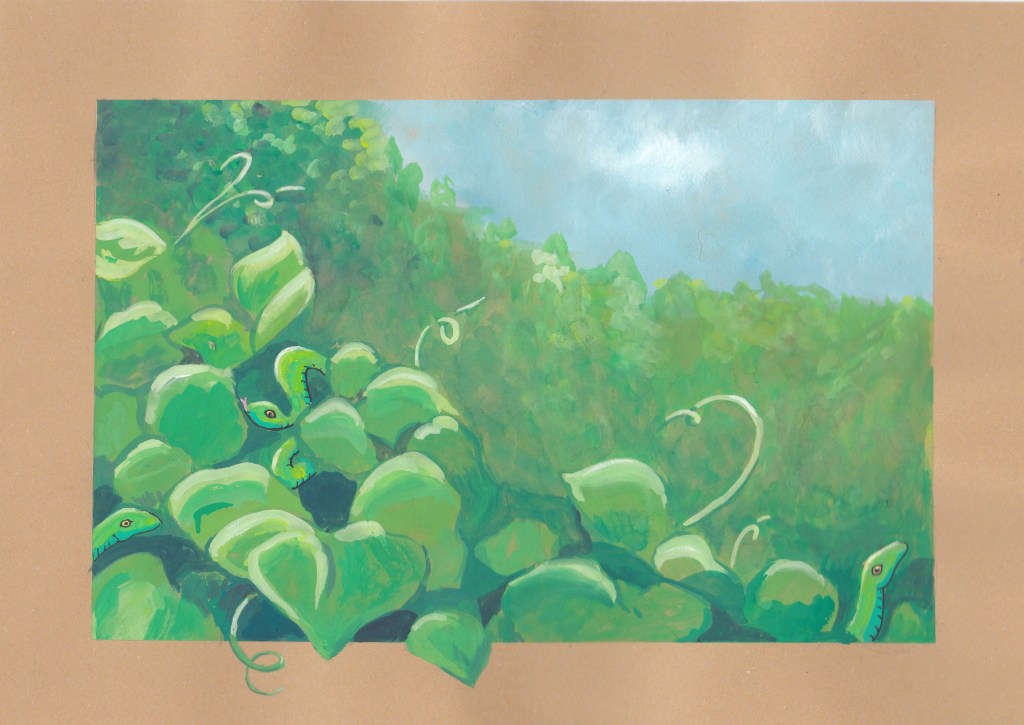
For when the kudzu comes,The snakes do, and weave themselves
Among its lengthening vines,
Their spade heads resting on leaves,
Growing also, in earthly power
And the huge circumstance of concealment.
One by one the cows stumble in,
Drooling a hot green froth,
And die, seeing the wood of their stallsStrain to break into leaf.
In your closed house, with the vineTapping your window like lightning,
You remember what tactics to use.
In the wrong yellow fog-light of dawn
You herd them in, the hogs,
Head down in their hairy fat,
The meaty troops, to the pasture.
The leaves of the kudzu quake
With the serpents’ fear, insideThe meadow ringed with men
Holding sticks, on the country roads.The hogs disappear in the leaves.
The sound is intense, subhuman,
Nearly human with purposive rage.
There is no terror
Sound from the snakes.
No one can see the desperate, futile
Striking under the leaf heads.
Now and then, the flash of a longLiving vine, a cold belly,
Leaps up, torn apart, then falls
Under the tussling surface.
You have won, and wait for frost,
When, at the merest touch
Of cold, the kudzu turns
Black, withers inward and dies,
Leaving a mass of brown strings
Like the wires of a gigantic switchboard.
You open your windows,With the lightning restored to the sky
And no leaves rising to buryYou alive inside your frail house,
And you think, in the opened cold,
Of the surface of things and its terrors,
And of the mistaken, mortal
Arrogance of the snakes
As the vines, growing insanely, sent
Great powers into their bodies
And the freedom to strike without warning:From them, though they killed
Your cattle, such energy also flowedTo you from the knee-high meadow
(It was as though you had
A green sword twined among
The veins of your growing right arm—
Such strength as you would not believe
If you stood alone in a proper
Shaved field among your safe cows—):
Came in through your closedLeafy windows and almighty sleep
And prospered, till rooted out.
 The Columbo Game