[This entry is cross posted at ordinary-times.com]
Officially, the work week’s gonna be over in a few hours. What are you doing? You’re not getting anything done between now and then. Cut it out and stop pretending. Piss Off Early, Tomorrow’s Saturday.
First, a little verse.
***
John Millington Synge is gross. Not really. At least not as far as I know. I was reading The Oxford Book of Modern Verse and got caught without a bookmark. J.M. Synge starts on page 144, so that was my little mnemonic: “John Millington Synge is gross.”
Synge was a great Irish playwright who wrote poetry, but very little of it. At least, he published very little of it. As best I can tell his sole collection is Poems and Translations. It contains twenty-two original poems, all short and mostly light and amusing. In addition are translations of poems by Petrarch and Villon, but they’re prose translations of the original author’s verse. I don’t find those terribly interesting.
The twenty-two seem more from a man who wanted to play with an amusing thought that channel a muse. Yeats was fastidious after perfection. Heaney feared frogs. Gogarty swashbuckled. Irish poets have great origin stories. Synge was wickedly clever and insightful, but I don’t get the sense he envisioned himself as a poetic force. That’s not to say he didn’t think big thoughts on the subject. There was a conservator about him.
From his brief preface to Poems and Translations:
“I have often thought that at the side of the poetic diction, which everyone condemns, modern verse contains a great deal of poetic material, using poetic in the same special sense. The poetry of exaltation will be always the highest; but when men lose their poetic feeling for ordinary life, and cannot write poetry of ordinary things, their exalted poetry is likely to lose its strength of exaltation, in the way men cease to build beautiful churches when they have lost happiness in building shops.
Many of the older poets, such as Villon and Herrick and Burns, used the whole of their personal life as their material, and the verse written in this way was read by strong men, and thieves, and deacons, not by little cliques only. Then, in the town writing of the eighteenth century, ordinary life was put into verse that was not poetry, and when poetry came back with Coleridge and Shelley, it went into verse that was not always human.
In these days poetry is usually a flower of evil or good; but it is the timber of poetry that wears most surely, and there is no timber that has not strong roots among the clay and worms.”
And so he wrote well for general enjoyment.
Epitaph
After reading Ronsard’s lines from Rabelais
If fruits are fed on any beast
Let vine-roots suck this parish priest,
For while he lived, no summer sun
Went up but he’d a bottle done,
And in the starlight beer and stout
Kept his waistcoat bulging out.
Then Death that changes happy things
Damned his soul to water springs.
All of his poems are structured simply; like or nearly like the above. There’s not much technically to discuss, so I’m just going to drop one in every few paragraphs.
My first encounter with Synge was in high school, as a visiting scholar. Every year my school would load up participating juniors and seniors for the Northern or Southern College Trip. We’d go wandering around college and university campuses all over the South or North, alternating each year, badgering earnest students giving minimum wage work-study tours with rote questions like “What is the average class size and student-to-teacher ratio?” and “What percentage of students live in on-campus housing?” We didn’t care about the answers, but after a day or two barnstorming campuses we realized pretty quickly that all the guide spiels were more or less the same. A few preemptive questions targeting the standard tour highlights disarmed the speaker, sped up the tour, and gave us more time, as our teacher-chaperones said, to “get a feel for the campus,” which we understood as “wander around unsupervised and look at girls.”
It was a good time, even the bus rides. Our headmaster led the way. He was renowned for making a long shot college application a possibility, a maybe a yes, and developed such relationships with a few sparkling name colleges and universities that his prudently-given recommendation meant automatic acceptance. He was also a veteran of the New York theater scene, collecting anecdotes for classroom digressions as he whiled away his twenties in off-Broadway productions. Trips to big cities meant an excuse to see a big show on the school’s dime and so we all, twenty or so sixteen- to eighteen-year-olds and three or four teachers, arrayed in an arc before him in a hotel lobby. We had tickets to see Synge’s Playboy of the Western World at the Kennedy Center and by God in heaven we were going to behave. There would be no snickering at prurience. We would act our age. Pay attention. The reputation of the school. Fire and brimstone. Students in the hand of an angry headmaster.
Winter
(With little money in a great city)
There’s snow in every street
Where I go up and down,
And there’s no woman, man, or dog
That knows me in the town.I know each shop, and all
These Jews, and Russian Poles,
For I go walking night and noon
To spare my sack of coals.
Our headmaster had recently lost considerable weight but settled in at still, though less than before, corpulent; an obese man wearing the no longer elastic skin of an even larger man. He was so animated. Add to that theatrical and effeminate. To be clear, we liked him. He was our overweight, animated, theatrical headmaster so don’t you make fun. But Lord, did we. He cut an impossible comic figure and held a position requiring earnestness. It was just funny.
Ten minutes into Playboy’s second act we were nudging blue blazered elbows and tossing nods to anyone not paying attention. For all his demands for propriety, dear leader was dead asleep in his seat; head lolled back and snoring to beat the band. We didn’t need another episode to make make fun of, but the man was a giver. Thirty years later, I’m in my old high school’s auditorium to see my son, then a student there himself, in a student production and chatting with a former classmate whose son was also in the cast. We were talking about plays we did when we were students. “Hey,” he says. “Remember when we went to the Kennedy Center?” Some teachers are unforgettable.
In Glencullen
Thrush, linnet, stare and wren,
Brown lark beside the sun,
Take thought of kestrel, sparrow-hawk,
Birdline and roving gun.You great-great-grandchildren
Of birds I’ve listened to,
I think I robbed your ancestors
When I was young as you.
Synge debuted Playboy of the Western World in 1907 at the Abbey Theatre in Dublin. His last three plays – Shadow of the Glen, Riders to the Sea, and The Well of the Saints – made prominent voices in the nationalist movement pretty angry. He self censored one play, The Tinker’s Wedding. There’s a scene where a Catholic priest gets tied up in a sack and he didn’t think that’d go over well. He decided not to put it on.
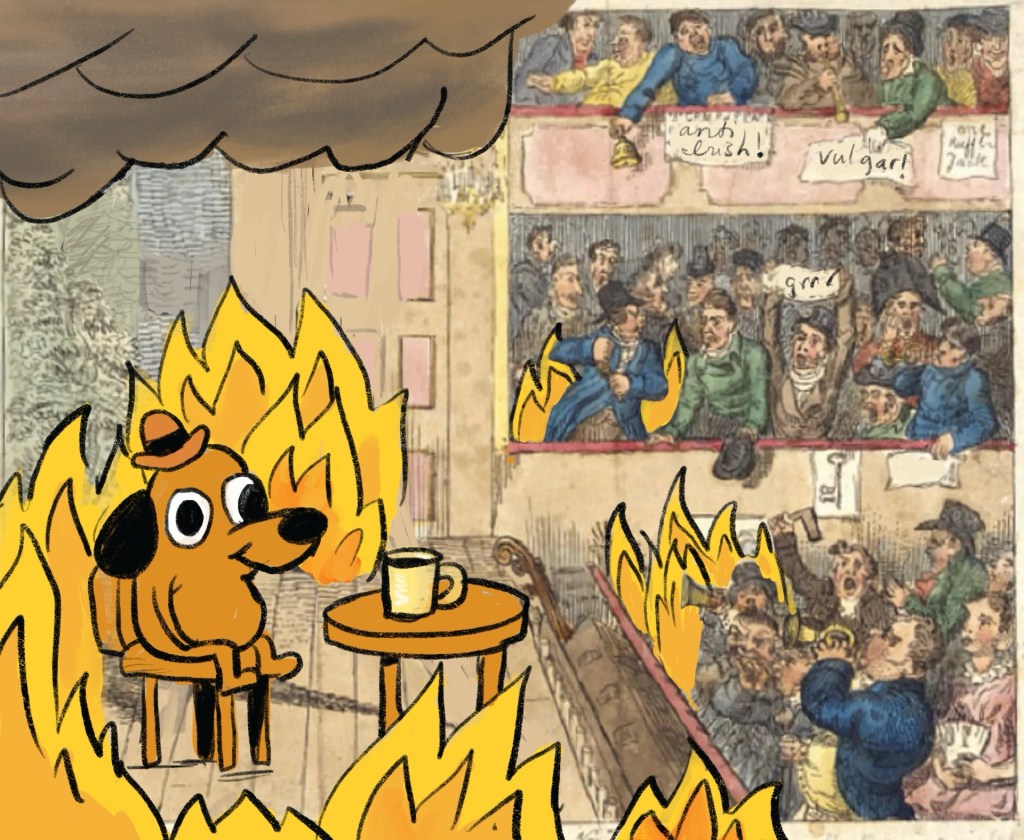
He was a co-founder and director of the Abbey, so he had some say in what shows were put on but he wasn’t the final word. The two other founding directors were split on the play’s merits. W.B. Yeats liked it. Isabella Augusta, Lady Gregory when she’s not at home, did not. Knowing Synge courted controversy, they risked outrage. A riot broke out in the theater on the second night.
From The Irish Monthly, July 1921, retrospective of the Abbey’s first sixteen or so years (as near contemporary as I can find):
“When the ‘Playboy of the Western World’ was produced, a perverse rumor ran round Dublin that the new play showed Irish peasants extolling a parricide: on the second night the pit was filled by a noisy audience, who had concealed beneath their coats tin-trumpets, drums and other ingredients of a jazz band; for a whole week their opposition reduced Synge’s comedy to a dumb show.”
Was my headmaster’s snore an homage?
Yeats wrote to Irish audiences that they had “disgraced yourselves again.” Lady Gregory, maybe not a fan but a defender nonetheless, wrote “It is the old battle, between those who use a toothbrush and those who don’t.”
Synge died two years later of Hodgkin lymphoma. He was only thirty-seven.
Queens
Seven dog-days we let pass
Naming Queens in Glenmacnass,
All the rare and royal names
Wormy sheepskin yet retains:
Etain, Helen, Maeve, and Fand,
Golden Deirdre’s tender hand;
Bert, the big-foot, sung by Villon,
Cassandra, Ronsard found in Lyon.
Queens of Sheba, Meath, and Connaught,
Coifed with crown, or gaudy bonnet;
Queens whose finger once did stir men,
Queens were eaten of fleas and vermin,
Queens men drew like Monna Lisa,
Or slew with drugs in Rome and Pisa.
We named Lucrezia Crivelli,
And Titian’s lady with amber belly,
Queens acquainted in learned sin,
Jane of Jewry’s slender shin:
Queens who cut the bogs of Glanna,
Judith of Scripture, and Gloriana,
Queens who wasted the East by proxy,
Or drove the ass-cart, a tinker’s doxy.
Yet these are rotten—I ask their pardon—
And we’ve the sun on rock and garden;
These are rotten, so you’re the Queen
Of all are living, or have been.
 The Columbo Game